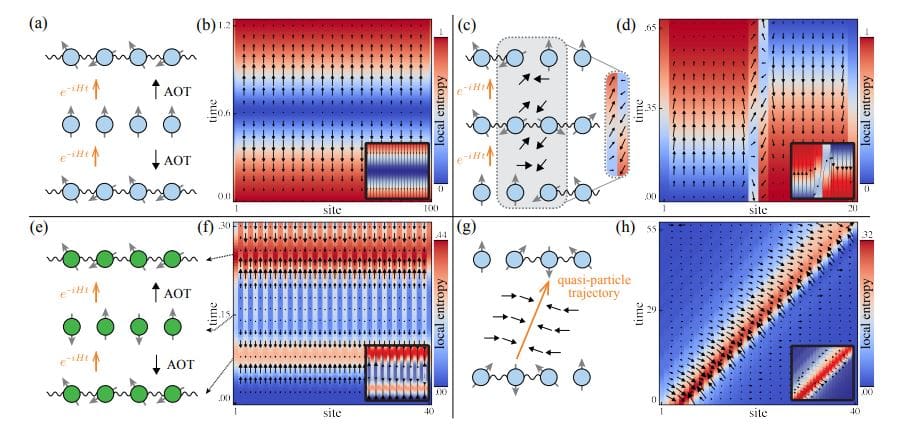
The fundamental direction of time, seemingly uniform throughout the universe, may not hold true at the quantum level, according to new research. Andrew G. Yates, Jordan Cotler, and Nishad Maskara, all from Harvard University, alongside Mikhail D. Lukin and colleagues, demonstrate that within complex quantum systems, localised regions can experience differing ‘arrows of time’ relative to the overall system evolution. This groundbreaking work defines and explores the concept of local arrows of time in these systems, revealing that the flow of time can be relative to each observer or, effectively, each subsystem. By combining analytical calculations with numerical simulations, the team uncovers surprising examples of these localised time flows, arising from phenomena such as thermalisation and error correction, which challenges our intuitive understanding of time’s universal direction.
Quantum Influence and Spacetime Mechanics
Scientists are investigating how quantum mechanics challenges our understanding of cause and effect, exploring whether we can define causal relationships in a quantum world and measure this influence. This research delves into the possibility of describing spacetime itself using quantum principles, focusing on the concept of temporal entanglement, correlations between quantum states at different times, which may reveal information about the direction of time and the underlying dynamics of a system. Quantum simulation plays a crucial role, employing controllable systems like trapped ions and Rydberg atoms to model complex quantum phenomena. Reconfigurable atom arrays are emerging as a promising platform, offering high control and connectivity, with the goal of building robust logical quantum processors utilizing quantum error correction and new architectures resilient to noise. This work extends to many-body quantum systems, consisting of a large number of interacting quantum particles, and explores quantum scars, special states that resist thermalization, as a potential pathway to building more robust quantum computers. These investigations have implications for fundamental physics, quantum technology, and our understanding of the arrow of time, potentially leading to new quantum algorithms and a deeper understanding of spacetime.
Local Time’s Arrow Emerges in Quantum Systems
Scientists have demonstrated that the perception of time can be relative within quantum systems, differing from the global flow dictated by the system’s evolution. This research introduces a definition of the local arrow of time and explains its connection to spacetime entropies, providing a new way to characterize quantum causal structure. Through a combination of numerical and analytical examples, the team explored how local arrows of time manifest in quantum dynamics, including instances arising from thermalization and quantum error correction. The study involved analyzing systems ranging from 20 to 100 qubits, evolving them under local Hamiltonian dynamics.
Researchers observed that when starting with a product state, the resulting local entanglement entropy increased over time, coinciding with a local arrow of time pointing towards the future. Further experiments revealed the possibility of coexisting arrows of time within the same system, demonstrating a scenario where one region experiences time flowing forward while an adjacent region experiences it flowing backward, with the spatial component consistently pointing across the boundary. In an investigation of the PXP model with quantum scarring, the temporal component of the local arrow of time exhibited periodic inversions coinciding with oscillations in local entropy, a hallmark of quantum many-body scars. These results demonstrate a novel approach to understanding the local causal structure within quantum systems and open new avenues for exploring the fundamental nature of time itself.
Local Time Flow in Quantum Systems
This research demonstrates that the direction of time’s flow can vary locally within quantum systems, differing from the global flow dictated by standard physical evolution. The team defined a method for quantifying these local arrows of time and explored how they manifest in quantum dynamics. This work establishes that time’s arrow is not necessarily uniform throughout a system, but can be relative to individual subsystems or observers. The researchers investigated this phenomenon using quantum error-correcting codes, specifically the [[5, 1, 3]] code, to show how causal influence can be protected at a logical level even when physical qubits experience errors. They identified conditions under which a physical error on one part of a system does not causally affect another part, demonstrating a form of localized temporal protection. Future research will extend these findings to more complex quantum systems and explore the implications of localized time flow for quantum information processing and the foundations of quantum mechanics.
👉 More information
🗞 Local arrows of time in quantum many-body systems
🧠 ArXiv: https://arxiv.org/abs/2511.09758