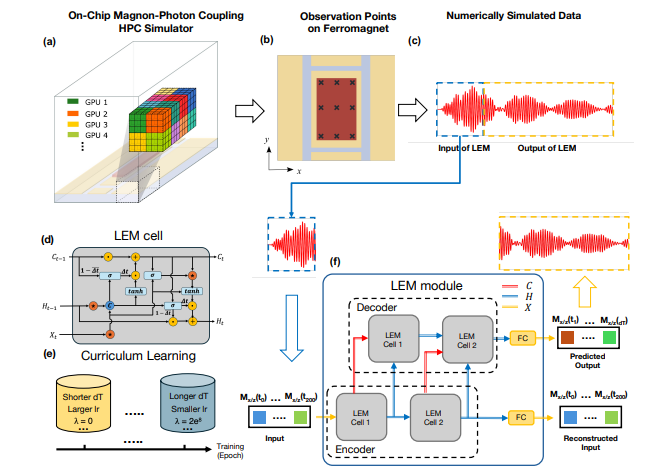
Simulating the complex interplay between magnetism and light in hybrid systems presents a significant challenge for modern physics, due to the vast differences in the timescales governing each phenomenon. Jialin Song from Simon Fraser University, Yingheng Tang from Lawrence Berkeley National Laboratory, and Pu Ren, along with their colleagues, now demonstrate a powerful new framework for modelling these systems. Their massively parallel simulation, accelerated by machine learning surrogates, overcomes the limitations of traditional methods by accurately capturing the dynamic interaction between magnetic and electromagnetic fields. This achievement unlocks the ability to simulate large-scale on-chip magnon-photon circuits, revealing crucial details of energy exchange and paving the way for the rapid design and prototyping of advanced spintronic devices.
Ferrite Resonator Nonlinearity and Electromagnetic Interactions
Scientists investigated nonlinear magnetic effects within a coplanar waveguide resonator containing a ferrite thin film, focusing on how strong electromagnetic fields influence the material’s magnetic properties. The experimental setup utilizes a microstrip transmission line designed to generate resonant electromagnetic fields that interact with the ferrite film, inducing nonlinear behavior. The study employs a detailed mathematical model based on the Landua-Lifshitz-Gilbert (LLG) equation, which describes the dynamics of magnetization in magnetic materials. Researchers simplified the equation using spherical coordinates and applied Floquet analysis to understand the nonlinear behavior, incorporating simplifying assumptions to make the problem tractable. To validate the analytical model, scientists performed numerical simulations, exploring the behavior of electromagnetic fields within the resonator and demonstrating how the superposition of resonant peaks influences magnetic field components, providing insights into the ferrite material’s nonlinear response. This work provides a comprehensive theoretical and numerical framework for understanding magnetic effects in these systems.
Magnon-Photon Dynamics via GPU-Accelerated Simulation
Researchers developed a highly efficient simulation framework to model hybrid magnonic systems, overcoming the challenge of vastly different timescales governing magnetic and electromagnetic phenomena. The framework directly integrates Maxwell’s equations with the Landua-Lifshitz-Gilbert (LLG) equation, enabling dynamic modeling of the interaction between microwave photons and magnons within fully coupled, large-scale on-chip circuits. This approach accurately captures the detailed exchange of energy between these excitations with high spatiotemporal fidelity. To achieve computational efficiency, the team employed a finite-difference time-domain (FDTD) framework, implemented on high-performance computing architectures.
Recognizing the limitations of traditional FDTD methods, they opted for an explicit scheme, carefully balancing computational cost with accuracy, and incorporated domain decomposition techniques and GPU acceleration to significantly enhance simulation speed and scalability. Researchers performed short-duration, high-fidelity numerical simulations, generating data used to train a physics-informed machine learning surrogate. This hybrid approach combines the precision of numerical modeling with the speed of data-driven techniques. The team incorporated physics constraints into the machine learning model, enhancing training efficiency and ensuring the preservation of fundamental physical principles. By learning latent electric and magnetic field patterns from the initial simulations, the surrogate model accurately extrapolates the remaining dynamics, drastically reducing the need for computationally expensive numerical solvers. Extensive numerical experiments demonstrate the effectiveness of this hybrid method, achieving significant speedups without sacrificing simulation accuracy or scalability when exploring complex coupled phenomena.
Hybrid Magnon-Photon Circuit Simulation with Machine Learning
Scientists have developed a new computational framework for simulating hybrid magnonic systems, overcoming challenges posed by the vastly different timescales governing their components. This work presents a massively parallel, GPU-based simulation capable of modeling on-chip magnon-photon circuits with high spatiotemporal fidelity, allowing for detailed analysis of dynamic interactions between electromagnetic and ferromagnetic fields. The framework integrates advanced physics-based simulation with machine learning techniques to accelerate design workflows and enable rapid prototyping of next-generation spintronic devices. The simulation setup centers on a coplanar waveguide (CPW) microwave resonator, fabricated on a silicon substrate, with specific dimensions resulting in a characteristic impedance of 50 Ω and a fundamental mode at 15.
2GHz. A magnetic thin film, with specific saturation magnetization and damping factor, is placed at the center of the conductor. Experiments reveal that the framework accurately models the disturbance of the magnetic field caused by the ferromagnet, creating a vortex where the magnetic material is present, while the electric field remains largely unaffected. By combining first-principles physics-based simulation with data-driven enhancement using a physics-informed machine learning network, the team achieved up to a 5x acceleration in predicting time-domain resonance responses, using input sequences as short as 20% of their full length. This advancement represents a significant leap in computational efficiency and predictive precision, paving the way for broader exploration of complex quantum systems and hybrid quantum computing.
Scalable Simulation of Magnon-Photon Circuit Dynamics
Researchers present a new computational framework for simulating hybrid magnonic systems, overcoming a significant challenge in the field due to the vast differences in timescales between magnetic and electromagnetic phenomena. They developed a massively parallel simulation, leveraging the power of graphics processing units, to model the dynamic interaction of ferromagnetic and electromagnetic fields with high accuracy and spatial-temporal resolution. This approach enables the scalable simulation of complex on-chip magnon-photon circuits, paving the way for the design of next-generation spintronic devices. To further accelerate the design process, the team also created a physics-informed surrogate model, trained using data from the full simulations.
This surrogate model significantly reduces computational cost while maintaining accuracy, allowing for rapid prototyping and analysis. Results demonstrate the model’s ability to accurately reproduce key physical behaviors, including energy exchange dynamics and suppression of ferromagnetic resonance under strong electromagnetic fields. Future work will focus on developing spatiotemporal models that can learn the coupled evolution of fields in two and three dimensions, improving the prediction of device response. Despite this limitation, the framework represents a substantial advance in the modeling of hybrid magnonic systems and provides a powerful tool for exploring new designs in quantum communication, storage, and computation.
🗞 HPC-Driven Modeling with ML-Based Surrogates for Magnon-Photon Dynamics in Hybrid Quantum Systems
🧠 ArXiv: https://arxiv.org/abs/2510.22221