

Non-Hermitian systems exhibit unusual behaviours, and recent research focuses on how these systems can display unique topological properties through exceptional points. Hao-Long Zhang, Yan Wang, and Wen Ning, alongside Shou-Bang Yang, Jia-Hao Lü, and Fan Wu, investigate the topological features arising from exceptional points within the Liouvillian superoperator, which accounts for the effects of quantum jumps in a system. Their work extends the exploration of exceptional topology beyond traditional, Markovian systems, into the more complex realm of non-Markovian dynamics where the system retains memory of its past interactions. The team demonstrates that a single closed path around a specific type of exceptional point can simultaneously generate two distinct winding numbers, a phenomenon they experimentally confirm using a circuit coupled to a decaying resonator. This achievement significantly advances our understanding of topological effects in open quantum systems and opens new avenues for exploring non-Markovian physics.
Distinct Winding Numbers Around Exceptional Points
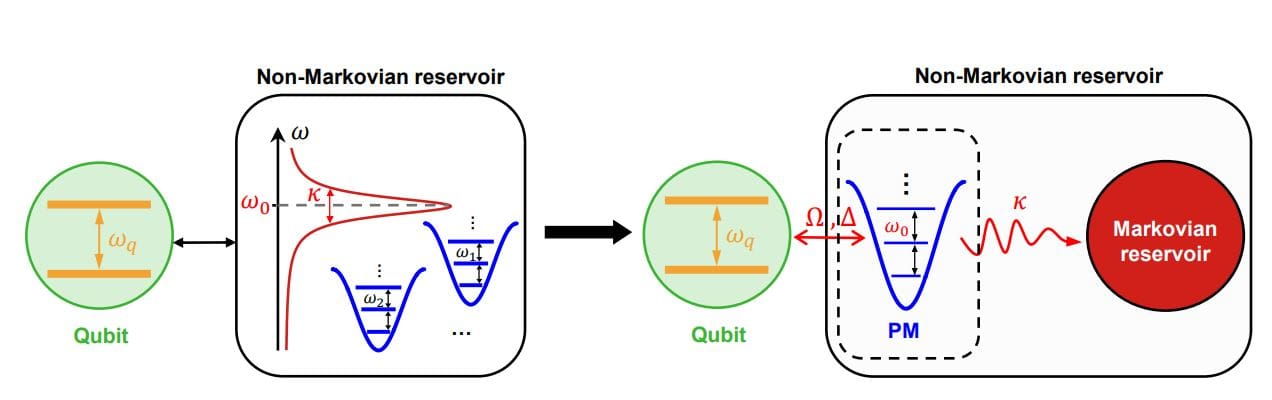
Scientists have achieved a breakthrough in understanding the topological properties of quantum systems interacting with complex environments, demonstrating a phenomenon previously confined to theoretical predictions. The research focuses on non-Hermitian systems, which exhibit behaviors not found in traditional quantum mechanics, and specifically investigates Liouvillian exceptional points (LEPs), points where the system’s quantum state undergoes dramatic changes. The team discovered that a single closed path encircling a twofold LEP2 can simultaneously produce two distinct winding numbers, a unique topological invariant characterizing the system’s behavior. Experiments involved a superconducting qubit coupled to a decaying resonator, functioning as a non-Markovian reservoir with memory effects, allowing for detailed observation of these LEPs.
This model accurately predicts the behavior of the qubit-reservoir system, governed by an extended Liouvillian operator that accounts for both the system’s Hamiltonian and quantum jumps induced by the reservoir. Measurements confirm the coexistence of LEPs with different orders, a direct consequence of the reservoir’s memory effect, and demonstrate a hybrid topological invariant consisting of different winding numbers associated with various Liouvillian eigenenergies. The team precisely controlled the coupling strength and detuning between the qubit and the reservoir, executing a cyclic path in parameter space to observe the simultaneous production of two winding numbers. This achievement pushes the exploration of exceptional topology beyond the Markovian regime, opening new avenues for understanding and controlling quantum systems in complex environments.
Non-Markovian Effects Reveal Dual Topology
This research demonstrates the existence of unique topological properties within non-Hermitian systems, extending current understanding beyond traditional Hermitian physics. Scientists investigated Liouvillian exceptional points, points where standard rules of symmetry break down, in a system where a quantum bit interacts with a complex environment possessing memory effects. They discovered that these systems can exhibit two distinct winding numbers simultaneously, a phenomenon arising from the interplay between the quantum bit and the environment’s ability to retain information. This contrasts with simpler systems where only a single winding number is observed, and highlights the importance of non-Markovian effects in shaping topological behaviour. The team experimentally verified these findings using a superconducting circuit, successfully demonstrating the predicted topological characteristics. Their work establishes a connection between non-Markovianity and the emergence of hybrid topological invariants, where seemingly contradictory properties coexist.
👉 More information
🗞 Exploring the topology induced by non-Markovian Liouvillian exceptional points
🧠 ArXiv: https://arxiv.org/abs/2512.06311


