Quantum computing promises revolutionary capabilities, but building systems with sufficient qubits and maintaining their reliability presents formidable challenges. Zefan Du, Pedro Chumpitaz Flores from the University of South Florida, Wenqi Wei, and colleagues address this issue by focusing on how to connect multiple quantum processors, a technique known as distributed quantum computing. Their work introduces InterPlace, a new framework that intelligently manages the connections between these processors, optimising how quantum information flows across the system. By carefully analysing noise and error rates, InterPlace guides the partitioning of complex calculations and the mapping of qubits, significantly reducing errors and improving overall performance, achieving up to a 53. 0% increase in fidelity and a 33. 3% reduction in required operations when tested on real quantum hardware. This advancement represents a crucial step towards building larger, more reliable, and ultimately more powerful quantum computers.
Connecting Quantum Modules for Scalability
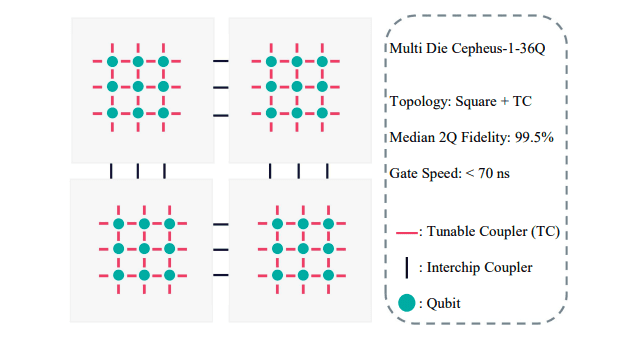
This research explores the development of modular quantum computing, a promising approach to building larger and more powerful quantum computers. As the number of qubits required for practical applications increases, constructing a single quantum processing unit becomes increasingly challenging due to physical limitations in wiring, control complexity, and maintaining qubit coherence. Modularity offers a solution by connecting multiple smaller QPUs, enabling parallel development and easier manufacturing. Key challenges in modular quantum computing include establishing high-fidelity communication between QPUs, managing complex control and calibration processes, and implementing effective error correction schemes across a distributed system.
Researchers are investigating various interconnect technologies, including superconducting cables, photonic links, and cavity-mediated coupling, focusing on minimizing communication latency and maintaining qubit coherence during transfer. Current research emphasizes the development of all-to-all reconfigurable routers, algorithms for efficient qubit allocation and scheduling, and hybrid quantum-classical systems for control and data processing. Scientists are also exploring robust error mitigation and correction techniques specifically designed for distributed quantum systems, alongside different network topologies and module designs. Software tools are being developed to simplify programming and control of these modular systems, with quantum state fidelity serving as a key metric for evaluating performance.
Hardware-Aware Optimization for Distributed Quantum Systems
Researchers have developed InterPlace, a novel framework designed to optimize distributed quantum computing systems. This work addresses the limitations of current systems by jointly optimizing inter-chip coupler placement and system-level communication, bridging the gap between physical feasibility and logical efficiency. InterPlace constructs a virtual system topology based on detailed analysis of qubit noise and error rates, guiding circuit partitioning and distributed qubit mapping to minimize communication overhead and enhance fidelity. The framework leverages detailed physical qubit information, including relaxation time, dephasing time, single-qubit gate error rate, two-qubit gate error rate, readout error probability, and cross-talk, to accurately model system performance.
Scientists implemented InterPlace in Python/Qiskit and rigorously evaluated it with state-of-the-art compilers, demonstrating consistent reductions in SWAP overhead and inter-chip operations. Extensive testing across diverse workloads and system configurations revealed up to a 53. 0% improvement in fidelity and a 33. 3% reduction in the combination of on-chip SWAPs and inter-chip operations, demonstrating the scalability and effectiveness of the approach.
InterPlace Boosts Fidelity in Distributed Quantum Systems
Scientists have developed InterPlace, a novel framework for distributed quantum computing systems utilizing multiple interconnected chips. This work addresses the critical need for efficient circuit partitioning and qubit mapping in these complex architectures, achieving significant improvements in fidelity and reducing operational overhead. Rigorous testing demonstrated a substantial 53. 0% improvement in overall system fidelity. Experiments revealed that InterPlace effectively minimizes the need for SWAP operations, reducing the combined count of on-chip SWAPs and inter-chip operations by as much as 33.
3%. This reduction in operational complexity directly translates to enhanced performance and scalability, crucial for tackling larger and more complex quantum algorithms. The framework operates by analyzing individual qubit noise and error rates, constructing a virtual system topology that guides the partitioning of quantum circuits and the mapping of qubits across multiple chips.
InterPlace Optimizes Modular Quantum System Performance
InterPlace, a novel framework for optimizing inter-chip connections in modular quantum systems, demonstrably improves both the scalability and fidelity of quantum processors. Researchers achieved this by developing a system that analyzes qubit characteristics to construct a virtual topology, guiding circuit partitioning and qubit mapping to minimize communication overhead and enhance performance. Evaluations on both homogeneous and heterogeneous multi-chip systems reveal that InterPlace effectively reduces the number of SWAP operations and inter-chip communications, leading to fidelity improvements of up to 53. 0% compared to conventional approaches. The team’s work represents a significant step toward building practical, large-scale quantum computers by bridging the gap between physical constraints and logical efficiency. While the framework requires pre-processing time to determine optimal inter-chip connections, this computation occurs during the design phase, delivering lasting performance benefits across all future workloads and compilers.
👉 More information
🗞 Optimizing Inter-chip Coupler Link Placement for Modular and Chiplet Quantum Systems
🧠 ArXiv: https://arxiv.org/abs/2509.10409