Building increasingly powerful quantum computers demands innovative approaches to interconnecting multiple processing units, and coordinating their actions relies heavily on efficient classical communication, a challenge researchers are now addressing with a new protocol. Maurizio Palesi, Enrico Russo, and Hamaad Rafique, all from the University of Catania, alongside Abhijit Das from the Indian Institute of Technology Hyderabad, and their colleagues, present a solution called instruction-directed medium access control, or ID-MAC. This protocol overcomes limitations of traditional communication methods by predefining transmission schedules based on the predictable nature of quantum circuit execution, effectively streamlining data flow. Simulations demonstrate that ID-MAC significantly reduces communication delays, cutting classical time by up to 70% and overall execution time by as much as 70%, while also enhancing the coherence of the entire system, representing a substantial step towards scalable and practical multi-chip quantum architectures.
Scalable Quantum Communication, Bottlenecks and Solutions
Scientists are tackling the communication challenges inherent in building larger, multi-core quantum computers. As these systems grow, efficiently connecting and communicating between individual quantum processing units becomes increasingly difficult. This research investigates optimizing this communication, proposing a new Medium Access Control (MAC) protocol called ID-MAC to overcome these limitations. ID-MAC aims to reduce communication overhead and improve efficiency by intelligently managing access to the communication channel, leveraging knowledge of how quantum systems communicate. The research focuses on communication within the extremely cold, cryogenic environment required for superconducting qubits, which presents unique challenges for communication hardware and protocols.
Scientists evaluated ID-MAC through detailed simulations of multi-core quantum computers, modeling realistic workloads to assess its performance. The protocol also reduces communication latency, critical for real-time quantum computations, and may even improve the coherence time of qubits. Experiments show a reduction in execution time for quantum algorithms when using ID-MAC.
Scalable Quantum Computing with Integrated Cores
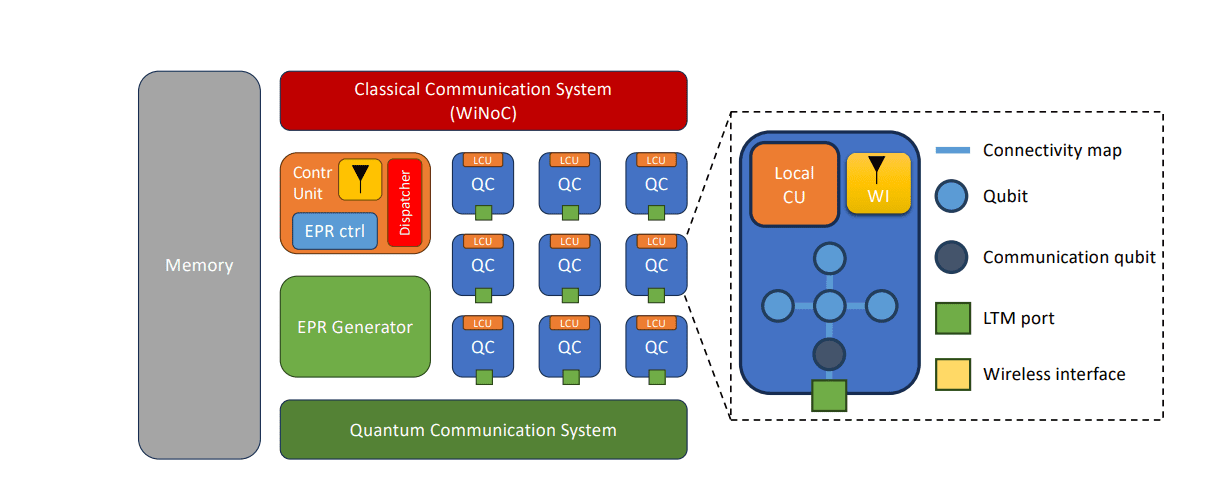
Scientists engineered a multi-core quantum system designed for scalable computing, integrating quantum cores with a sophisticated communication infrastructure operating within cryogenic environments. The architecture includes a Memory module for program instructions, a global Control Unit to manage instruction execution, an EPR Generator for creating entangled qubit pairs, and an array of Quantum Cores that perform quantum gate operations. These cores connect via both a quantum communication plane for qubit state transfer and a classical plane for coordinating control, synchronization, and teleportation post-processing. Each Quantum Core integrates physical qubits, light-to-matter ports for photonic communication, and a local controller interpreting instructions.
The team developed a compilation flow that maps logical quantum circuits to physical qubits, transforming operations involving different cores into teleportation-based instructions. This process generates assembly code consisting of instruction bundles, each grouping operations for parallel execution. Two specialized instructions, TPS for the source core and TPD for the destination core, manage the phases of quantum teleportation. The system employs a wireless network-on-chip for classical communication, ensuring scalable and low-latency control at cryogenic temperatures. This approach reduces classical time by up to 70% and total execution time by 30-70%, while extending effective system coherence.
Instruction Scheduling Optimizes Quantum Chip Communication
Scientists achieved a significant breakthrough in classical communication for scalable multi-chip quantum architectures, developing a novel medium access control (MAC) protocol named instruction-directed token MAC, or ID-MAC. This work addresses the critical need for efficient coordination and control within systems comprising multiple quantum cores interconnected through wireless networks operating in cryogenic environments. Traditional token-based MAC protocols suffer from latency penalties, but ID-MAC overcomes this limitation by leveraging the deterministic nature of quantum circuit execution. The team designed ID-MAC to predefine transmission schedules at compile time, embedding instruction-level information directly into the MAC layer. This innovative approach restricts token circulation solely to active transmitters, dramatically improving channel utilization and reducing communication latency. Experiments demonstrate that ID-MAC reduces classical communication time by up to 70%, leading to overall execution time reductions ranging from 30 to 70%, and extending effective system coherence.
ID-MAC Boosts Quantum Communication Performance
Scientists present a novel medium access control protocol, instruction-directed token MAC (ID-MAC), designed to enhance classical communication within scalable multi-chip quantum architectures. Researchers successfully demonstrated that by integrating knowledge of circuit execution into the protocol, ID-MAC significantly improves channel utilization and reduces communication latency. Simulations reveal that ID-MAC reduces classical communication time by up to 70%, leading to overall execution time reductions ranging from 30 to 70% depending on system characteristics. These improvements are particularly important as quantum systems scale, with benefits increasing proportionally as the number of quantum cores increases or quantum operations become faster.
Furthermore, the reduction in total execution time indirectly enhances the effective coherence time of the system, contributing to improved robustness and operational reliability. The team plans to extend the protocol to support multi-token operation, potentially further enhancing performance in complex quantum systems. These findings underscore the critical role of the classical communication subsystem in future large-scale quantum computing and highlight the benefits of co-designing classical and quantum subsystems.
👉 More information
🗞 Instruction-Directed MAC for Efficient Classical Communication in Scalable Multi-Chip Quantum Systems
🧠 ArXiv: https://arxiv.org/abs/2510.27273