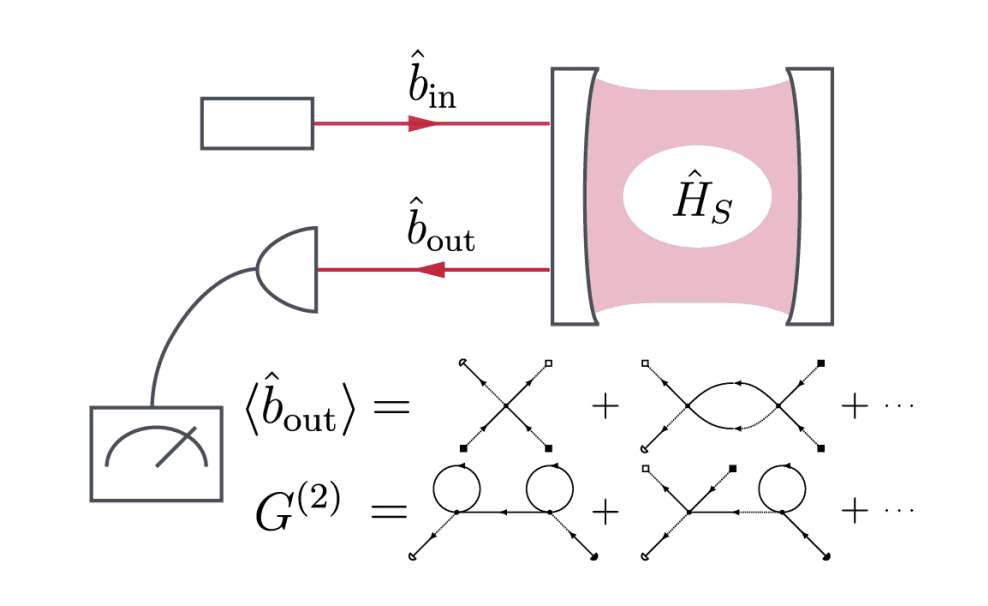
Input-output theory forms a cornerstone of quantum optics, providing a vital framework for understanding how light interacts with quantum systems, and is widely used in experiments involving superconducting circuits and cavity QED. Aaron Daniel, Matteo Brunelli, and Aashish A. Clerk, alongside Patrick P. Potts, now present a novel approach to this established theory, employing the Schwinger-Keldysh path integral formalism. This new method provides direct access to detailed statistics of the output light field, including crucial measures of coherence, and unlocks the powerful tools of non-equilibrium quantum field theory for analysing these systems. The team demonstrates the strength of their formalism by successfully modelling a nonlinear oscillator at realistic temperatures, revealing a surprising reduction in reflected light not caused by energy loss, but by the squeezing of the emitted light itself, which promises new insights into quantum light sources and detectors.
The team focuses on developing a path integral representation for the input-output correlation function, which describes the relationship between signals entering a system and the resulting responses. This framework aims to be broadly applicable to various physical systems, even those with complex internal behaviour and strong interactions with their environment. By leveraging the path integral formalism, the researchers hope to provide a more accurate and versatile tool for predicting and controlling system behaviour in diverse applications, ranging from quantum technologies to biological systems.
A cornerstone of quantum optics, input-output theory is widely used to describe quantum systems probed by light and finds application in experiments involving circuit and cavity quantum electrodynamics. The researchers present an approach using the Schwinger-Keldysh path integral formalism, which provides direct access to the full statistical properties of the output light, including its coherence. This formalism simplifies the analysis of nonlinear systems and offers a systematic way to obtain perturbative results, making a rich toolbox of non-equilibrium quantum field theory more accessible.
Dissipative Quantum Systems and Output Field Statistics
This research addresses the complex behaviour of dissipative quantum systems, systems that lose energy and coherence through interaction with their environment. The goal is to develop a robust theoretical framework for accurately calculating the statistical properties of the light emitted from these systems, with a particular focus on non-classical correlations like squeezing and entanglement. The authors integrate several theoretical approaches, including quantum optics, the study of open quantum systems, the Keldysh formalism for systems far from equilibrium, and mathematical tools like Wiener chaos and cumulant expansions.
The research centres on understanding how to calculate observables, measurable quantities, of the output light, such as its Wigner function, correlation functions, and higher-order statistical moments. This is crucial for designing and controlling quantum devices like lasers, cavity QED systems, and quantum sensors. Key concepts explored include input-output theory, which relates incoming and outgoing fields, quantum noise, the inherent fluctuations in quantum fields, and squeezing, a non-classical state of light where fluctuations are reduced in one direction.
The team utilizes the Keldysh formalism to treat the system as responding to fluctuating forces from the environment, enabling calculation of the system’s response. They also employ the Master Equation, which describes how the system’s quantum state evolves over time, and the Fluctuation-Dissipation Theorem, which connects fluctuations in the environment to the system’s energy loss. The researchers heavily utilize cumulants and Wiener chaos to simplify calculations of statistical moments, with cumulants measuring deviations from Gaussian distributions and Wiener chaos representing random processes as a sum of orthogonal components.
The research provides a unified framework for calculating the statistical properties of open quantum systems, combining the Keldysh formalism, Wiener chaos expansion, and cumulant expansion. The authors demonstrate how to calculate higher-order statistical moments and correlations, which are important for characterizing non-classical states of light. Applying this framework to a cavity QED system, they validate their results against existing theoretical predictions, demonstrating the accuracy and validity of their approach. This work represents a significant contribution to the field, providing a powerful and versatile theoretical framework for understanding and controlling dissipative quantum systems, with implications for the development of new quantum technologies like quantum sensors, communication devices, and computers.
Squeezed Light and Nonlinear Oscillator Analysis
This research introduces a new approach to input-output theory, a vital tool for understanding how light interacts with quantum systems. By employing the Schwinger-Keldysh path integral formalism, the team gains access to detailed statistical properties of the outgoing light, such as its coherence, which is often difficult to calculate using traditional methods. This formalism simplifies the analysis of nonlinear systems and provides a systematic way to obtain perturbative results.
The researchers demonstrated the power of their method by examining a Kerr nonlinear oscillator, revealing a reduction in reflected light not caused by leakage, but by the squeezing of the output light itself. The approach is broadly applicable, as the diagrammatic rules developed for the Kerr oscillator are expected to generalize to other quantum models. Future work could extend the formalism to include squeezed light sources or to explore systems with multiple energy levels and different types of quantum particles, potentially impacting the field of cavity materials engineering.
👉 More information
🗞 Path Integral Approach to Input-Output Theory
🧠 ArXiv: https://arxiv.org/abs/2509.07563