Simulating the behaviour of open quantum systems, those interacting with their environment, poses a significant challenge for modern computers, which typically operate using predictable, closed systems. Sameer Dambal from Los Alamos National Laboratory, Akira Sone from the University of Massachusetts, Boston, and Yu Zhang demonstrate a novel approach that fundamentally shifts how we tackle this problem. Rather than attempting to eliminate unavoidable noise within quantum processors, the team harnesses it as a computational resource, selectively preserving physical noise to mimic the behaviour of open systems. This innovative method significantly reduces the number of qubits required for accurate simulation and relaxes the demands on qubit fidelity, offering a pathway towards practical quantum simulation of complex, real-world phenomena and reframing noise not as a limitation, but as an asset.
This work introduces a novel approach that leverages the intrinsic noise present in near-term quantum devices to efficiently simulate the dynamics of open quantum systems, specifically focusing on how systems evolve over time. The method maps the system’s characteristics and its interaction with the environment onto a quantum circuit enhanced by noise, effectively utilising unwanted noise as a resource for simulation. Researchers demonstrate that by carefully designing the quantum circuit and calibrating the noise parameters, they can accurately simulate open quantum system dynamics with reduced circuit complexity compared to traditional methods.
This approach allows for the simulation of larger systems and longer timescales, currently inaccessible with conventional quantum simulation techniques. The study validates the method through numerical simulations of benchmark open quantum systems, including the single-qubit dephasing channel and the dissipative two-level system. Results demonstrate that the noise-enhanced simulation accurately reproduces the expected dynamics, achieving high fidelity even in the presence of substantial noise. This work represents a significant step towards harnessing the full potential of noisy intermediate-scale quantum computers for simulating complex quantum phenomena.
Schatten Norm Bounds Quantum Channel Differences
This research focuses on quantifying the difference between two quantum channels, representing how quantum information changes during processing. The goal is to provide a measure of how much these channels diverge, using a mathematical tool called the Schatten p-norm, which is crucial for understanding and mitigating errors in quantum computations and communications. The work develops tools to characterise the impact of noise or imperfections in a quantum system, utilising concepts such as quantum channels and density operators. The document details a mathematical derivation of bounds on the Schatten p-norm between two operators constructed from the system and effective channels, the density operator, and a specific operator. The derivation uses properties of operator norms, partial traces, and quantum Rényi entropy, providing a way to quantify how much the channels differ and assess the impact of noise. These bounds can be used to develop strategies for mitigating errors in quantum systems.
Harnessing Noise for Quantum Simulation
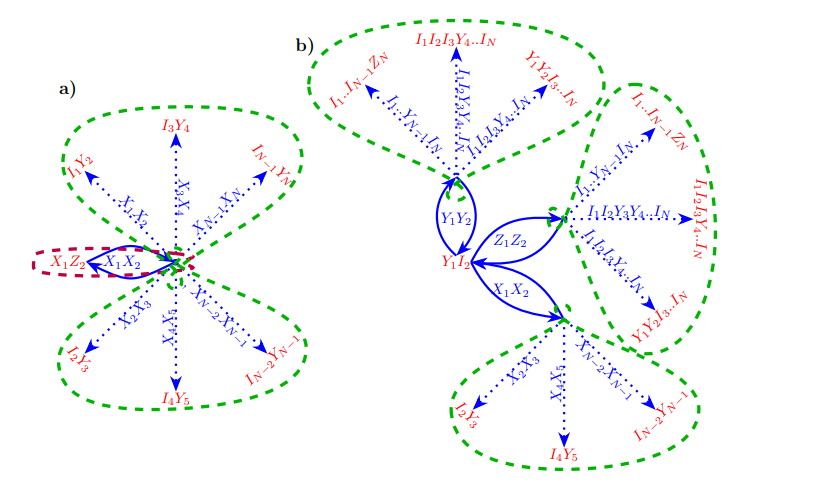
This research demonstrates a new approach to simulating open quantum systems, addressing a fundamental challenge in quantum computing where realistic systems inevitably interact with their environment. Rather than attempting to eliminate environmental noise, the team successfully harnessed it as a computational resource. They developed a method that encodes system decoherence as Pauli strings on a quantum circuit and then leverages the inherent noise within the quantum processor to produce an effective channel mirroring the desired system dynamics. Furthermore, the research reveals that intrinsic noise induces clustering among partially encoded channels, forming decoherence-free subspaces that can be exploited to further confine and manage dynamics. By reframing noise as an asset and reducing demands on qubit fidelity, this work represents a significant step towards achieving quantum advantage in simulating open quantum systems and informs the co-design of hardware optimized for such simulations.
🗞 Harnessing Intrinsic Noise for Quantum Simulation of Open Quantum Systems
🧠 ArXiv: https://arxiv.org/abs/2510.21075