Controlling the interactions between quantum systems is fundamental to building powerful quantum simulators, and researchers are increasingly turning to strongly nonlinear oscillators to achieve this goal. J. D. Koenig, G. Barbieri, and F. Fani Sani, from the Kavli Institute of Nanoscience at Delft University of Technology, alongside colleagues C. A. Potts, M. Kounalakis, and G. A. Steele, now demonstrate a new method for precisely tuning these interactions between two oscillators. The team achieves this control by parametrically modulating the system, effectively switching between regimes dominated by photon hopping, two-mode squeezing, or cross-Kerr interactions, and even observing level repulsion and attraction between the oscillators. This advance opens up exciting possibilities for building purely analog quantum simulators capable of studying complex spin systems and exploring previously inaccessible dynamics in strongly nonlinear oscillators, representing a significant step towards more versatile and powerful quantum simulation platforms.
This work investigates the dynamics of two strongly coupled nonlinear oscillators, demonstrating how external magnetic flux can modulate their interaction strength. Researchers show that by applying a time-varying magnetic flux, they can effectively tune the coupling between the oscillators, driving transitions between distinct interaction regimes. This precise control of magnetic flux allows manipulation of the oscillators’ energy exchange and coherence properties, establishing a pathway towards dynamically reconfigurable quantum circuits where interactions between quantum bits can be programmed on demand. The team achieves precise control over the oscillators’ coupling strength, enabling the exploration of novel quantum phenomena and the implementation of complex quantum algorithms. Furthermore, this tunability offers opportunities for optimising the performance of quantum devices by suppressing unwanted interactions and enhancing coherence times, contributing to the development of scalable and versatile quantum computing architectures.
Tunable Qubit Coupling and Parameter Extraction
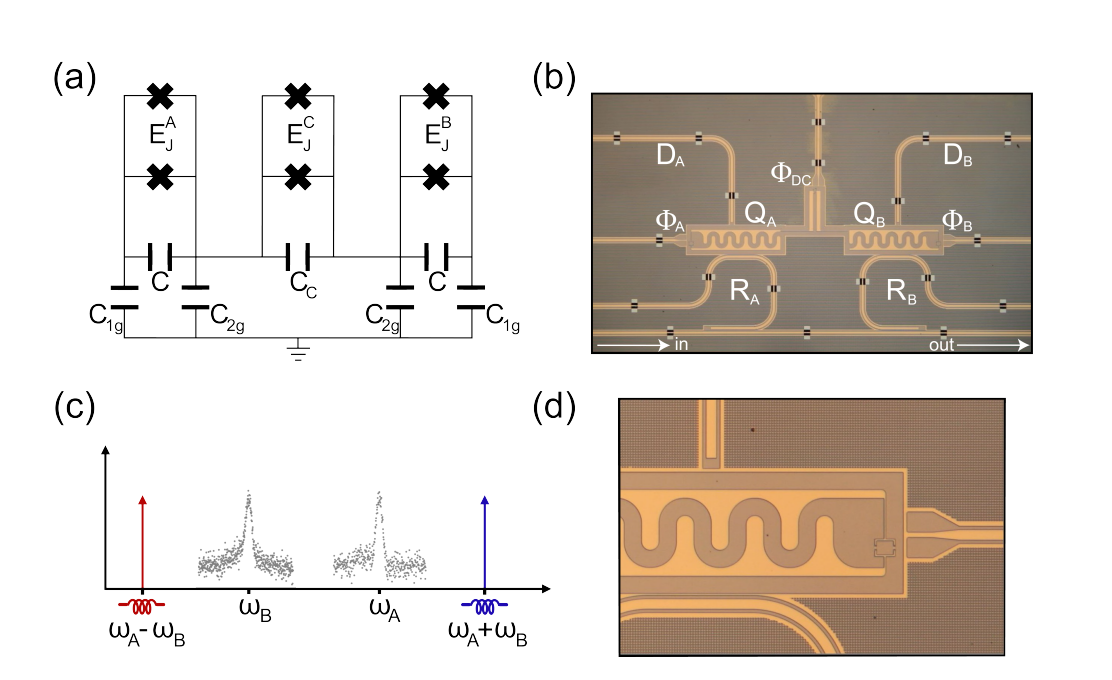
This research details a comprehensive characterisation of a system of two transmon qubits coupled by a tunable coupler. The primary goal is to determine the strength of the interactions between the qubits, including both hopping and squeezing effects, and the cross-Kerr effect. Researchers achieve this through spectroscopic measurements and detailed analysis of the system’s response to applied signals, controlling the coupling by adjusting the magnetic flux applied to the coupler. The team developed a theoretical framework, including a detailed Hamiltonian, to describe the system’s behaviour, accounting for individual qubit frequencies, nonlinearities, and the various coupling terms.
Comparing experimental data to simulations based on this model allows extraction of key parameters, considering potential sources of error such as crosstalk between control signals, providing a complete description of the qubit interactions essential for controlling and manipulating the system. Researchers performed spectroscopic measurements to determine the qubit frequencies and nonlinearities, applying an alternating current signal to the coupler flux to drive transitions and probe the coupling. The system’s response to this signal was measured and compared to simulations based on the theoretical model, allowing extraction of the coupling strengths and other relevant parameters, carefully considering potential sources of error to ensure accuracy. The analysis reveals a complex interplay of interactions within the system, acknowledging the importance of considering higher-order interactions and parasitic modes, which could affect the system’s behaviour, and suggesting further investigations are needed to fully understand these effects and optimise the system’s performance.
Tunable Oscillator Interactions and Nonlinear Dynamics
This research demonstrates a significant advance in controlling interactions between superconducting oscillators, paving the way for more versatile quantum simulation platforms. Scientists successfully designed and implemented a system where the coupling between two nonlinear oscillators can be selectively tuned using parametric modulation, activating distinct interaction regimes, including photon hopping and two-mode squeezing, offering unprecedented control over the system’s dynamics. The achievement lies in the ability to access a range of coupling strengths, where interactions can be stronger than, equal to, or weaker than the system’s inherent nonlinearities, crucial for emulating diverse physical systems, including models relevant to magnetism and condensed matter physics. Researchers acknowledge that further investigations with modified coupler designs, such as incorporating asymmetric nonlinear elements, could unlock even more interaction regimes, like correlated photon hopping and photon-pressure interactions, establishing a highly controllable platform for analog quantum simulation and providing a foundation for exploring complex quantum phenomena in previously inaccessible parameter spaces.
🗞 Flux-modulated tunable interaction regimes in two strongly nonlinear oscillators
🧠 ArXiv: https://arxiv.org/abs/2511.06533