The fundamental question of why systems heat up more readily than they cool down has long puzzled physicists, and now Álvaro Tejero from Universidad de Granada and Instituto Carlos I de F´ısica Te´orica y Computacional, along with his colleagues, sheds new light on this asymmetry. This research investigates the process of thermalization in systems interacting with their environment, focusing on how entropy production, a measure of disorder, drives the speed at which a system reaches equilibrium. The team demonstrates that heating initially generates a greater increase in entropy, leading to faster thermalization compared to cooling, and importantly, links this behaviour to fluctuations in heat transfer. These findings reveal the underlying principles governing asymmetric thermalization and establish the significance of thermodynamic uncertainty relations in understanding systems far from equilibrium.
The asymmetry between heating and cooling in open quantum systems is a hallmark of non-equilibrium dynamics, yet its fundamental origins remained incompletely understood. This work investigates the connection between entropy production, thermodynamic uncertainty relations, and the thermalization process in these systems. Researchers explore how the interplay between these concepts dictates the rate and efficiency with which open quantum systems approach thermal equilibrium. The approach involves analysing the fluctuations in heat currents and relating them to the overall entropy generated during the thermalization process, thereby establishing a quantitative link between microscopic fluctuations and macroscopic thermodynamic behaviour. This analysis reveals that thermodynamic uncertainty relations, which quantify the inherent limitations in predicting heat currents, place fundamental constraints on the thermalization rate and efficiency of open quantum systems, offering new insights into the dynamics of non-equilibrium processes.
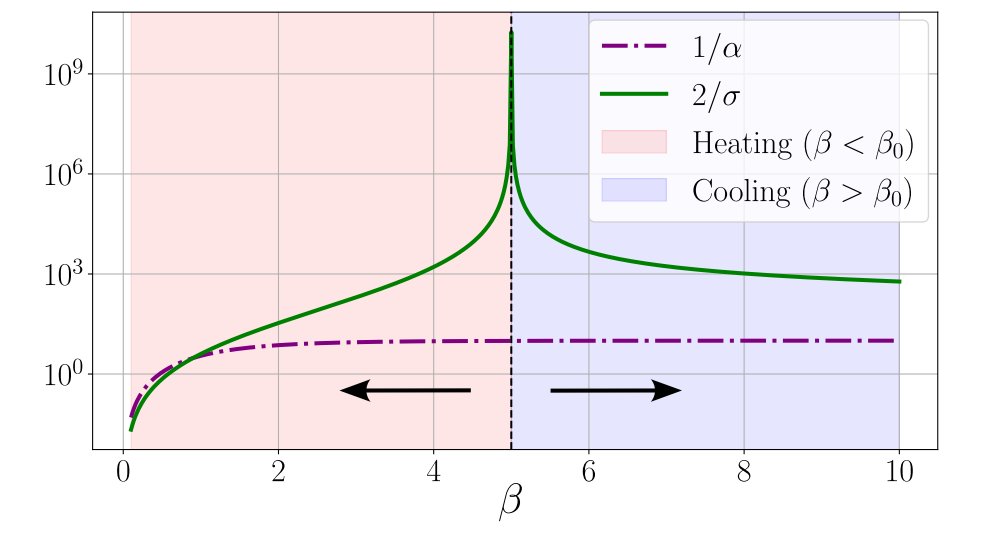
Scientists discovered that the rate of entropy production is consistently higher during heating than cooling, directly contributing to faster thermalization in the heating scenario. This finding clarifies why systems evolve more rapidly towards equilibrium when gaining energy compared to when losing it, resolving a long-standing question in nonequilibrium dynamics. The team linked this asymmetry to fluctuations in heat current through the thermokinetic uncertainty relation, revealing that increased entropy production suppresses these fluctuations, thereby stabilizing the heating process. By analysing the spectral decomposition of the system’s dynamics, researchers provided a purely physical explanation rooted in thermodynamics, emphasizing the interplay between entropy production and quantum limits.
The research focuses onopenquantum systems, systems that interact
The research focuses on open quantum systems, systems that interact with their environment. This interaction leads to dissipation and decoherence, crucial for understanding the asymmetry. When detailed balance is broken, the heating and cooling rates become different. The authors connect the observed asymmetry to thermodynamic uncertainty relations, which establish a fundamental relationship between the precision with which a current, like heat flow, can be measured and the entropy production in the system. The research also highlights the connection between the precision with which a system can respond to a perturbation and its ability to relax quickly; a system that responds quickly to temperature changes will also tend to heat up faster.
The investigation employed a quantum harmonic oscillator as a model system, validating the theoretical predictions and solidifying the understanding of this fundamental phenomenon. The principles underlying the observed asymmetry could potentially be exploited in the design of more efficient quantum devices and energy transfer systems. The asymmetry of thermal processes may also play a role in biological systems, where efficient energy transfer is crucial. This research opens up new avenues for investigation in non-equilibrium physics, quantum thermodynamics, and information theory.
Despite focusing on weakly coupled systems and a single bosonic bath, this research provides a crucial step towards a comprehensive understanding of nonequilibrium dynamics and establishes a foundation for investigating thermal processes in diverse physical systems. Future work could extend these findings to explore more complex environments and stronger coupling regimes. In essence, this paper presents a compelling argument that heating and cooling are not mirror images of each other in open quantum systems, and that this asymmetry is rooted in fundamental thermodynamic principles and the breaking of time-reversal symmetry.
👉 More information🗞The role of entropy production and
🗞 The role of entropy production and thermodynamic uncertainty relations in the thermalization of open quantum systems
🧠 ArXiv: https://arxiv.org/abs/2510.05072