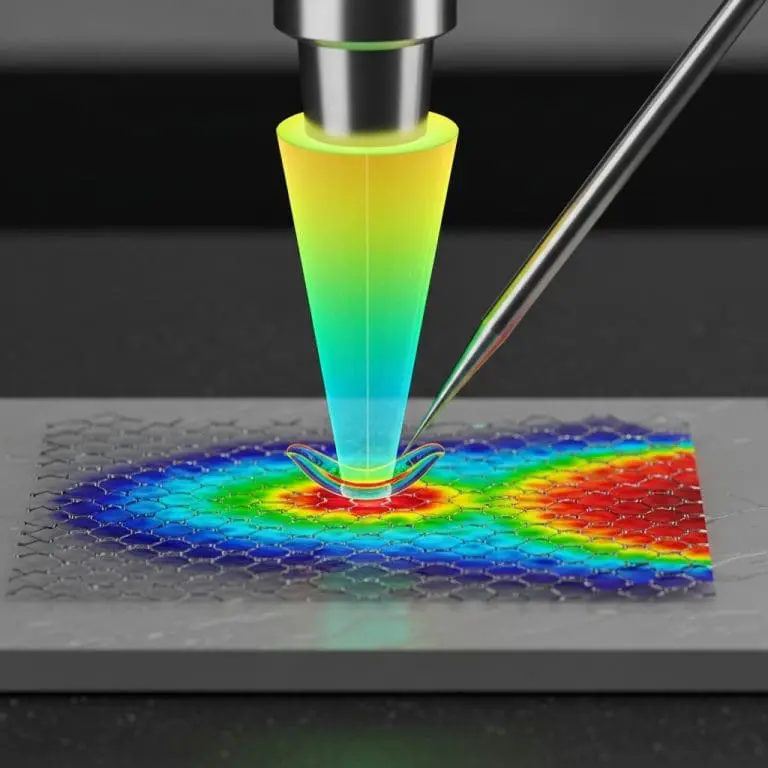
Understanding how particles interact fundamentally relies on calculating scattering phase shifts, a notoriously difficult problem in quantum mechanics. Peng Guo, Paul LeVan, and Frank X. Lee, from Dakota State University and The George Washington University, alongside Yong Zhao from Argonne National Laboratory, have now explored a novel approach to determine these shifts using quantum computers. Their research demonstrates a method for extracting infinite volume scattering phase shift within a one-dimensional mechanical model, linking integrated correlation functions to the crucial scattering data. This work is significant because it proposes and tests quantum circuits designed to implement this formalism on existing hardware, potentially paving the way for more efficient and accurate simulations of quantum interactions. While initial tests with two qubits showed promising results, the team also identified limitations with scaling to larger systems due to current hardware constraints.
A simple one-dimensional quantum mechanical model is employed, utilising the formalism established in Ref. [citation needed] which relates the integrated correlation functions (ICF) for a trapped system to the infinite volume scattering phase shifts through a weighted integral. The system is first discretised in a finite box with periodic boundary conditions, and the formalism in real time is verified by employing a contact interaction potential with exact solutions. Quantum circuits are then designed and constructed to implement the formalism on current quantum computing architectures. To overcome the fast oscillatory behaviour of the integrated correlation functions in real-time simulation, different methods of post-data analysis are investigated.
Linking Scattering Theory to Quantum Circuits
Scattering Theory, Finite Volumes and Quantum Computing This
Advanced Theoretical Frameworks for Scattering Studies
This body of work, primarily authored by Peng Guo, focuses on theoretical physics, particularly scattering theory, finite volume effects, resonances, and the application of quantum computing to these problems. The research develops and applies theoretical tools to understand interactions between particles, especially in confined spaces, and how resonances manifest. Papers explore the S-matrix, Friedel formula, Krein’s theorem, and related mathematical tools, establishing a theoretical framework for understanding these interactions. A significant portion of the work focuses on how confining particles to a finite volume alters their behavior, particularly the properties of resonances, which is crucial for connecting theoretical calculations to lattice QCD and potentially to quantum simulations.
Modeling Decay and Complex Quantum Potentials
Investigations extend to complex potential scattering, using complex potentials to model decay and absorption processes, and applying the finite volume/resonance framework to “artificial traps” to model interactions in a controlled environment. This research also explores the potential of quantum computers to solve problems in nuclear and particle physics intractable for classical computers. The work applies algorithms like Harrow-Hassidim-Lloyd (HHL) and its variants to solve linear equations, and focuses on improving the efficiency and accuracy of Quantum Imaginary Time Evolution (QITE) on near-term quantum devices. Developing quantum algorithms to simulate scattering processes directly represents a challenging but potentially revolutionary application.
The research incorporates techniques such as Trotterization and Taylor expansion for approximating time evolution operators, and complex absorbing potentials to model decay. The work bridges theoretical physics, nuclear physics, and quantum information science, with a strong emphasis on developing algorithms for noisy intermediate-scale quantum (NISQ) devices and error mitigation. The increasing number of quantum computing-related publications indicates a significant shift in research focus, underpinned by mathematical rigor and collaborative research. In summary, Peng Guo’s research is at the forefront of applying quantum computing to solve challenging problems in nuclear and particle physics, combining rigorous theoretical development with a practical focus on current quantum hardware. The combination of expertise in scattering theory and quantum algorithms is particularly valuable.
Infinite Volume Scattering from Quantum Circuits
Translating Physics Models for Quantum Algorithms
Translating Infinite Scattering to Quantum Circuits
Scientists have demonstrated the feasibility of extracting infinite volume scattering phase shifts using a one-dimensional quantum mechanical model implemented on a computer. The research applied the integrated correlation function (ICF) formalism to relate correlation functions of a trapped system to scattering phase shifts through a weighted integral. The system was initially discretized within a finite box employing periodic boundary conditions, and the real-time formalism was validated using a contact interaction potential possessing known exact solutions. Experiments involved designing and constructing quantum circuits to implement this formalism on existing quantum computing architectures.
Computational Techniques for Simulation Accuracy
To address the rapid oscillatory behaviour inherent in integrated correlation functions during real-time simulations, the team proposed and evaluated several post-data analysis methods. Tests conducted on IBM quantum hardware revealed successful agreement with the theoretical model when utilising two qubits, but the study recorded complete failure when scaling to three qubits, attributed to errors in two-qubit gate operations and the effects of thermal relaxation. Measurements were performed on a 1D quantum mechanical model featuring a trapped particle interacting with a contact potential, discretising position into a lattice. The periodic boundary condition, ψ(x + L) = ψ(x), was enforced, effectively simulating particle motion on a circle.
Demonstrated Convergence and Computational Advantages
Results demonstrate that the ICF method bypasses traditional energy spectrum determination, offering rapid convergence at short Euclidean times and potentially mitigating the signal-to-noise ratio problem. The work establishes a baseline for more complex scenarios, such as scalar field theory models, and paves the way for exploring the potential of quantum computing to overcome limitations in classical lattice QCD simulations. This delivers a crucial step towards real-time quantum simulation of scattering processes, opening possibilities for advancements in understanding interactions in nature.
Extracting Scattering Phase Shifts via Quantum Computation
This work demonstrates the feasibility of extracting infinite volume scattering phase shifts using quantum computation, achieved through a one-dimensional mechanical model. Researchers successfully related integrated correlation functions within a trapped system to these phase shifts via a weighted integral, building upon previously established formalism. The study first verified this approach using a contact interaction potential with known analytical solutions, then designed and implemented corresponding quantum circuits. Numerical tests conducted on quantum hardware with two qubits yielded promising results, aligning with theoretical predictions.
However, the implementation faced limitations with three qubits, where errors in two-qubit gate operations and thermal relaxation hindered accurate calculations. The authors propose methods for post-data analysis to mitigate the impact of fast oscillatory behaviour in real-time simulations. Future research may extend this baseline formalism to more complex scenarios, such as those found in scalar field theory, potentially offering new avenues for investigating quantum phenomena.
🗞 Extracting scattering phase shift in quantum mechanics on quantum computers
🧠 ArXiv: https://arxiv.org/abs/2601.04092