Parametric modulation forms a cornerstone of modern quantum circuit design, enabling high-fidelity operations and versatile quantum simulations, but traditionally relies on adjusting the amplitude of control signals which can significantly alter circuit parameters. Zhuang Ma, Xianke Li, and Hongyi Shi, alongside colleagues at their institutions, now demonstrate a novel approach that instead utilises the relative phase of parametric flux pulses to precisely tune the interaction strength between coupled superconducting circuits. The team successfully characterised this phase modulation technique across a broad range of coupling strengths, both at optimal and non-optimal operating points, confirming its effectiveness through detailed population dynamics and spectroscopic analysis. This achievement represents a significant step towards more precise and controllable parametrically driven quantum simulations and gate operations, offering a promising pathway for advancing quantum technologies.
Parametric modulation is a widely used technique in superconducting circuits for quantum simulations and creating high-fidelity two-qubit gates, valued for its flexibility. Traditionally, the strength of the interaction between qubits is determined by the amplitude of control pulses, which can significantly affect qubit parameters. This work introduces a new approach, a phase modulation scheme, to tune the interaction strength by adjusting the relative phase between the control pulses.
Superconducting Qubit Fabrication and Coherence Studies
Extensive research focuses on the development and understanding of superconducting qubits, a cornerstone of modern quantum computing. This body of work encompasses a diverse range of topics, from fundamental qubit technologies to advanced architectural concepts. Transmon qubits, a dominant type due to their ease of fabrication and relatively long coherence times, receive considerable attention, with research focused on improving fabrication techniques and enhancing coherence. Other qubit designs, including charge qubits and flux qubits, continue to be explored for their unique properties and potential advantages.
A significant area of investigation centers on how to connect qubits, enabling them to interact and perform computations, including both fixed-frequency and tunable couplers, with the goal of achieving high-fidelity coupling with minimal unwanted interactions. Researchers also address the challenges of material quality and fabrication defects, striving to improve qubit performance and scalability. Understanding and mitigating decoherence, the loss of quantum information, is crucial, and studies investigate various noise sources and techniques to prolong coherence times. Furthermore, research explores methods for correcting or mitigating errors in quantum computations, a vital step towards building fault-tolerant quantum computers. The implementation of fundamental quantum gates and the exploration of specific quantum algorithms and simulations on superconducting qubits are also key areas of investigation. Advanced architectures, including 3D integration and the exploration of topological qubits, aim to increase qubit density and connectivity, while synthetic dimensions and chiral interactions offer novel approaches to qubit interactions.
Phase Modulation Controls Qubit Coupling Strength
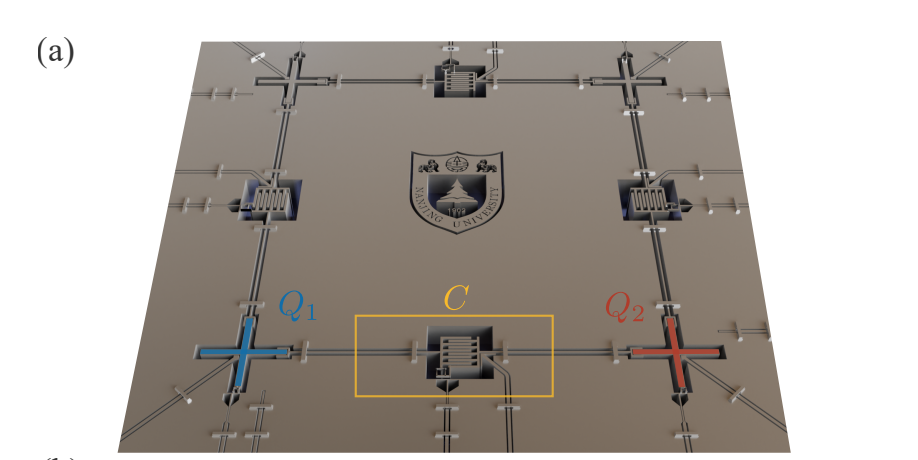
Scientists have demonstrated precise control over qubit interactions using a novel phase modulation technique, offering a new method for tuning coupling strength in superconducting quantum systems. This work introduces a scheme where the interaction between two qubits is adjusted not by changing the amplitude of control pulses, but by carefully manipulating their relative phase. The team successfully implemented this phase modulation for both optimal and non-optimal coupling conditions, achieving a broad range of interaction strengths suitable for implementing high-fidelity two-qubit gates or performing quantum simulations. The experiment utilized a two-qubit system fabricated on a superconducting chip, featuring grounded transmon qubits and tunable couplers.
Detailed characterization of the qubits and coupler revealed specific frequencies and anharmonicities. Two parametric flux pulses were applied to the qubits, and the relative phase between these pulses was used to modulate the coupling strength. Measurements reveal that the team achieved substantial control over the coupling strength through phase modulation. The data demonstrates that this phase modulation technique effectively suppresses unwanted frequency shifts while tuning the coupling strength, a significant advantage for precise quantum control. Theoretical models accurately matched the experimental results, validating the approach. Furthermore, the team successfully applied and characterized this technique for qubits interacting via parametric resonance, demonstrating its versatility and potential for broader applications in quantum information processing.
Phase Modulation Controls Qubit Interaction Strength
This research demonstrates a new method for controlling the interaction strength between qubits using parametric phase modulation, a technique commonly employed in quantum computing and simulation. Scientists successfully modulated the coupling strength by adjusting the relative phase between parametric pulses applied to coupled qubits, achieving a broad range of interaction strengths confirmed through both population dynamics and spectroscopic analysis. This phase-controlled modulation offers a versatile alternative to traditional methods that rely on adjusting the amplitude of parametric pulses. The team established a systematic methodology, incorporating spectroscopy, population oscillations, and mathematical analysis, to characterize parametric modulation even in strongly nonlinear systems. Experiments confirmed the effectiveness of this approach for both optimal and non-optimal operating points, expanding the capabilities of parametric modulation and providing a stable and scalable technique for adjusting qubit interactions, potentially enabling more complex quantum simulations.
🗞 Parametric Phase Modulation in Superconducting Circuits
🧠 ArXiv: https://arxiv.org/abs/2510.20192