

Understanding how energy disperses through complex quantum materials presents a significant hurdle for physicists, particularly when moving beyond simple, one-dimensional systems. Valeriia Bilokon, Elvira Bilokon, and Illya Lukin, from Tulane University and Haiqu, Inc., along with Andrii Sotnikov and Denys I. Bondar, address this challenge by developing a new method for calculating dispersion relations in both two- and three-dimensional quantum systems. Their approach, based on a powerful technique called tensor networks, accurately maps energy flow within these materials, successfully matching existing theoretical results where available. Importantly, this work achieves a breakthrough by providing the first calculations of dispersion relations for three-dimensional quantum lattice models, opening up exciting new avenues for research in areas like quantum simulation and the design of advanced materials with tailored properties.
Tensor Networks For Quantum Simulation Foundations
Scientists have extensively explored tensor network methods, building a comprehensive toolkit for simulating quantum systems and understanding complex condensed matter physics. Core to this approach are matrix product states and projected entangled pair states, which efficiently represent the quantum states of many-body systems, enabling calculations that would be impossible with traditional methods. This research benefits from connections to established theoretical frameworks like renormalization group theory and cluster Monte Carlo simulations, providing valuable insights and validation for tensor network calculations. Researchers continually refine algorithms to improve the efficiency and accuracy of tensor network simulations, employing techniques such as optimization, decimation, and recycling of the environment. Emerging trends, such as the integration of machine learning techniques and the development of generating functions, promise to accelerate simulations and discover new phases of matter. This demonstrates a vibrant and rapidly evolving field, pushing the boundaries of quantum simulation and condensed matter physics.
Momentum Spectra from Infinite Entangled Pair States
Scientists have developed a novel tensor network approach to calculate momentum-resolved excitation spectra in strongly correlated quantum systems, overcoming a major challenge, particularly beyond one spatial dimension. The study pioneers the use of infinite projected entangled-pair states combined with imaginary-time evolution to determine dispersion relations, effectively mapping the energy of quantum excitations as a function of momentum. This method efficiently represents quantum states in two- and three-dimensional lattices, sidestepping the computational limitations of traditional techniques. The team engineered a method to extract dispersion relations by evolving the quantum system in imaginary time, isolating the ground state and probing its excitations.
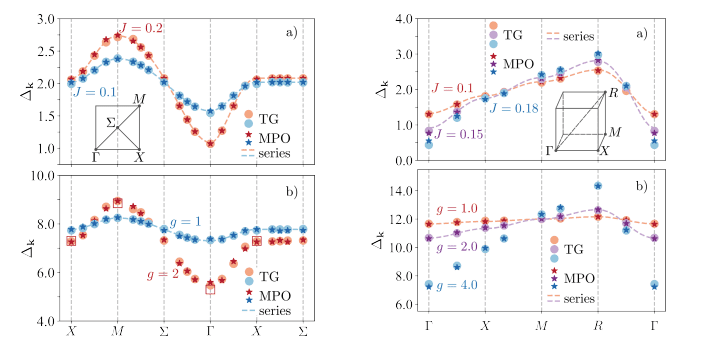
This process involves calculating momentum-space observables, revealing how the energy of excitations changes with momentum across the Brillouin zone. Researchers successfully benchmarked the approach on the transverse-field Ising model, achieving strong agreement with series expansion methods in both two and three dimensions. Crucially, this work demonstrates the first systematic calculation of dispersion relations for three-dimensional quantum lattice models, a long-standing computational barrier. The technique requires modest computational resources while maintaining high accuracy, enabling the study of larger and more complex systems. This positions it as a powerful tool for quantum materials design, characterization of quantum simulators, and fundamental investigations of strongly correlated matter.
Momentum Spectra for Correlated Quantum Systems
Scientists have achieved a breakthrough in calculating momentum-resolved excitation spectra for strongly correlated quantum systems, successfully extending this capability to three-dimensional lattices. This work introduces an efficient tensor-network approach utilizing imaginary-time evolution within the infinite projected entangled-pair states framework, enabling the precise determination of dispersion relations. The method demonstrates strong agreement with established series expansion methods where applicable, while providing reliable spectra in parameter regimes where traditional approaches struggle. Researchers successfully captured dispersion relations in both the paramagnetic and ferromagnetic phases of the transverse-field Ising model for two- and three-dimensional lattices, validating the accuracy of the new approach.
They employed a technique involving the calculation of the spectral gap, extracting this value from the exponential decay of commutator expectation values during imaginary-time evolution, and generalizing this to momentum-space observables. This allowed them to map the energy difference between the ground state and lowest-energy excitations at a given momentum, effectively defining the dispersion relation. The method’s efficiency is remarkable, requiring modest computational resources while maintaining high accuracy across a wide range of parameters. Researchers utilized both matrix-product-operator evolution and gate-based Trotterization to perform the imaginary-time evolution, optimizing the system within a periodic unit cell.
For calculations, a 2×2 unit cell was used in 2D and a 2x2x2 unit cell in 3D, enabling access to high-symmetry points in momentum space. Specifically, calculations on the transverse-field Ising model confirmed the method’s capabilities, accurately determining the critical field strength separating the ferromagnetic and paramagnetic phases. This breakthrough delivers a powerful computational framework applicable to quantum materials design, quantum simulator characterization, and fundamental studies of strongly correlated matter.
Momentum Dispersion in Strongly Correlated Systems
This work presents a new tensor-network approach for calculating momentum-resolved dispersion relations in strongly correlated quantum systems, successfully addressing a long-standing challenge, particularly in three dimensions. Researchers developed a method based on imaginary-time evolution within the infinite projected entangled-pair states framework, demonstrating its effectiveness using the transverse-field Ising model as a benchmark. The calculations accurately reproduce known dispersion relations in both paramagnetic and ferromagnetic phases, across two and three-dimensional lattices, with strong agreement confirmed by comparison with series expansion methods. Notably, this research achieves, to the knowledge of the authors, the first demonstration of dispersion relation calculations for three-dimensional quantum lattice models, opening new possibilities for investigating higher-dimensional quantum systems.
The method proves remarkably efficient, maintaining high accuracy with modest computational resources and consistently performing well with different computational schemes. The generality of this approach suggests broad applicability to a wide range of lattice Hamiltonians, potentially advancing understanding of dynamical properties, transport phenomena, and critical behaviour in strongly correlated quantum matter. These results have immediate implications for quantum simulation platforms and offer new theoretical tools for photonic material engineering and quantum information applications where precise knowledge of dispersion properties is crucial.
👉 More information
🗞 Dispersion Relations in Two- and Three-Dimensional Quantum Systems
🧠 ArXiv: https://arxiv.org/abs/2509.15483

