

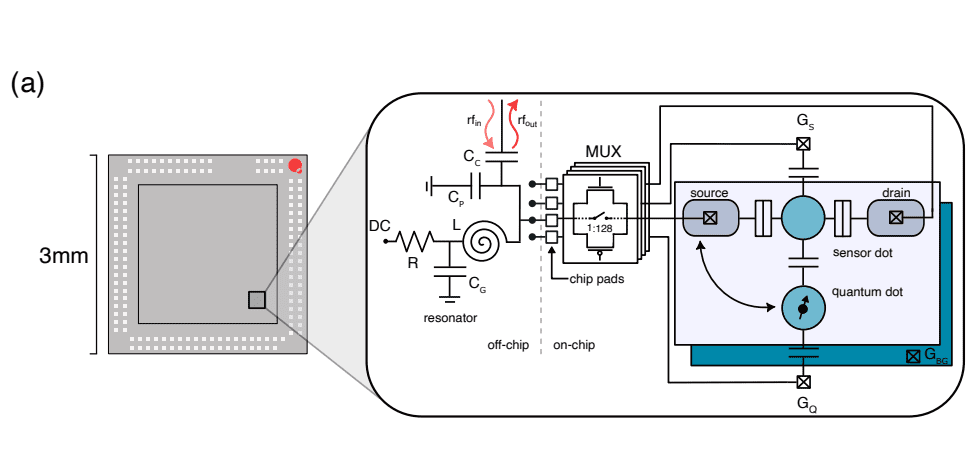
The pursuit of scalable quantum computing demands the integration of millions of qubits with controlling classical electronics, and a significant challenge lies in achieving this large-scale integration. Isobel C. Clarke, Virginia Ciriano-Tejel, David J. Ibberson, and colleagues at Quantum Motion demonstrate a crucial advance by achieving single-shot spin readout directly within a standard 22 nanometer integrated circuit. This breakthrough utilises fully depleted silicon-on-insulator technology to fabricate both the spin qubits and the control electronics on a single chip, a feat previously unattainable. The team’s method converts spin information into a measurable electrical signal with exceptional visibility exceeding 90%, and observes millisecond spin relaxation times, demonstrating the reproducibility and potential for highly scalable, integrated quantum devices. This achievement represents a key step towards building practical and complex quantum processors.
Silicon Quantum Dots for Scalable Qubits
Scientists are developing quantum computers using silicon quantum dots as qubits, leveraging existing silicon manufacturing techniques for a potentially scalable approach. This research focuses on creating, controlling, and reading out the quantum states of electrons confined within these nanoscale structures, with the electron’s spin serving as the qubit’s quantum state. Key to this progress is the development of advanced fabrication techniques to create precise and uniform quantum dots. Controlling qubit states involves applying voltages to nearby gates, manipulating the electron’s wave function, and using electromagnetic radiation to drive transitions between quantum states.
Reading out the qubit’s state presents a significant challenge, with researchers exploring techniques such as single-electron transistors and gate reflectometry to detect the quantum information. Crucially, control and readout circuits are integrated directly onto the same chip as the quantum dots, operating at extremely low temperatures to minimize interference. Fully Depleted Silicon-On-Insulator CMOS technology is central to this integration, offering low power consumption and good performance at cryogenic temperatures. Superconducting circuits are also employed to enhance the sensitivity of both readout and control.
Maintaining the quantum state of the qubit, known as coherence, is a major hurdle, as interactions with the environment can cause decoherence. Achieving high accuracy in qubit control and readout, known as fidelity, is also critical. Scalability, building a large number of interconnected qubits, requires dense integration of qubits and control electronics. Recent advancements include integrating CMOS electronics directly onto the chip with the quantum dots, simplifying wiring and improving signal integrity. Scientists are achieving high-fidelity single-shot readout of qubits and demonstrating control over multiple qubits. Progress is being made towards operating qubits at temperatures above 1 Kelvin, potentially simplifying cryogenic requirements. Rapid characterization techniques are being developed to test large numbers of quantum dot devices, and small quantum circuits with multiple qubits are now being demonstrated.
Integrated Circuit Achieves Millisecond Spin Readout
Scientists have achieved a significant breakthrough in quantum computing by demonstrating single-shot spin readout within a fully integrated circuit fabricated using standard 22nm fully depleted silicon-on-insulator technology. This work represents the first demonstration of electron spin readout in an integrated circuit containing classical addressing electronics, paving the way for more scalable quantum systems. Experiments revealed consistent readout visibilities exceeding 90% and millisecond spin relaxation times in multiple nominally identical devices within an addressable array, confirming the reproducibility of the unit cell design. Detailed analysis of spin relaxation rates, measured at varying magnetic fields, distinguished the dominant relaxation mechanisms, revealing a dependence on both Johnson noise and phonon-induced relaxation.
The team established a relationship describing spin relaxation, demonstrating that Johnson noise dominates at lower fields while phonon noise becomes prevalent at higher fields. Measurements at 2 Tesla yielded a relaxation time of 13. 2 ±1. 7 milliseconds, comparable to other silicon MOS devices and significantly longer than typical dephasing times in silicon quantum dots. Further analysis using an analytical model and fitting to experimental data confirmed the validity of the readout process and allowed determination of readout fidelity.
The team achieved a visibility of 93. 1% for one device and 91. 7% for another at a magnetic field of 3. 25 Tesla, demonstrating high accuracy in distinguishing spin states. Predictions based on the model indicate that visibilities exceeding 98% are achievable at higher magnetic fields for one of the devices. These results open a path toward integrating more quantum components onto a single chip, potentially transitioning from distributed quantum computing systems to fully integrated semiconductor-based quantum computers.
Integrated Spin Qubit Readout in Silicon
This research demonstrates single-shot spin readout within a fully integrated circuit fabricated using standard 22nm fully depleted silicon-on-insulator technology, representing a significant step towards scalable quantum computing. Scientists successfully converted spin information into a measurable charge, detecting it with a radio-frequency single-electron transistor and controlling the devices with on-chip cryogenic electronics. Consistent readout visibilities exceeding 90% and millisecond spin relaxation times were observed in multiple nominally identical devices within an addressable array, confirming the reproducibility of the core unit cell design. These findings establish a pathway to integrate control electronics and spin qubits onto a single manufacturing platform, potentially reducing the complexity of quantum systems and facilitating a transition from distributed to integrated semiconductor-based quantum computers. Future research directions include incorporating isotopically enriched silicon-on-insulator to enhance qubit gate fidelity and exploring more complex unit cell designs to enable two-qubit interactions.
👉 More information
🗞 Spin Readout in a 22 nm Node Integrated Circuit
🧠 ArXiv: https://arxiv.org/abs/2510.13674

