The limited availability of reliable data frequently hinders progress in industrial biotechnology, creating difficulties for accurate process monitoring and optimisation. Shawn M. Gibford, Mohammad Reza Boskabadi, Christopher J. Savoie, and colleagues at the Technical University of Denmark and SiC Systems Inc. address this challenge by pioneering a new approach to data generation using the principles of quantum computing. Their work introduces a novel method employing a Wasserstein Generative Adversarial Network with Gradient Penalty, incorporating a Parameterized Circuit to create synthetic time series data that accurately replicates the complex behaviour of real-world bioprocesses. This breakthrough offers the potential to significantly improve bioprocess management, reducing the reliance on costly and time-consuming experiments, and paving the way for more efficient monitoring, modelling, and predictive control strategies within the field.
Machine Learning Advances in Bioprocess Engineering
Research in bioprocess engineering increasingly leverages machine learning to improve efficiency and productivity. Scientists are employing machine learning for real-time monitoring and control of bioprocesses, creating digital representations for simulation and predictive maintenance. Deep learning, encompassing a broad range of techniques, is also proving valuable for complex modeling and pattern recognition. This approach replicates the complex dynamics observed in industrial bioprocesses, offering a solution when experimental data is limited. The core of the data generation system is a Parameterized Quantum Circuit, which forms the generator within the GAN framework, enabling the creation of realistic process data. This innovative use of quantum computing aims to improve process monitoring, modeling, forecasting, and optimization, ultimately enhancing bioprocess management efficiency.
Researchers rigorously evaluated the generated data, demonstrating its high fidelity to actual historical experimental data. This method addresses a fundamental challenge in the field, where acquiring sufficient data for robust model development is often difficult due to the time-consuming and resource-intensive nature of bioprocess experiments. This work addresses the critical challenge of data scarcity that hinders the development of accurate models for complex biomanufacturing processes. The team successfully generated synthetic time series data mirroring the dynamics of real industrial bioprocesses, offering a powerful new approach to process monitoring, modeling, forecasting, and optimization. The QWGAN-GP methodology circumvents limitations by creating realistic data without the need for extensive physical experimentation.
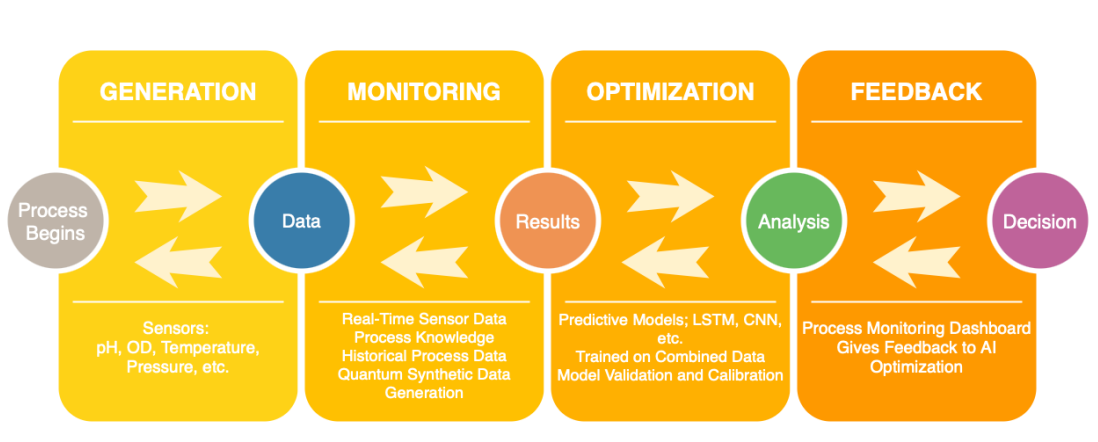
By generating synthetic data that accurately reflects these complexities, the QWGAN-GP enables more robust model development and improved process control. This breakthrough delivers a valuable tool for increasing prediction accuracy and for use in predictive control strategies, ultimately enhancing efficiency and productivity in biomanufacturing. The team developed an eight-stage pipeline integrating sensor assessment, mechanistic modelling, data-driven learning, and quantum synthetic data generation within a unified feedback loop. A key achievement lies in the successful development and validation of a specifically optimised QWGAN architecture, utilising a Parameterized Quantum Circuit as its generator. Empirical validation using real-world photobioreactor data confirms the effectiveness of this approach, with the QWGAN achieving improved temporal alignment compared to existing methods. The generated synthetic data accurately preserved global statistical properties, including normality, auto-correlation structures, and probability distributions. By making code and datasets openly available, this work contributes to open science and facilitates future advancements in quantum-enhanced bioprocess engineering.
🗞 Quantum Synthetic Data Generation for Industrial Bioprocess Monitoring
🧠 ArXiv: https://arxiv.org/abs/2510.17688