
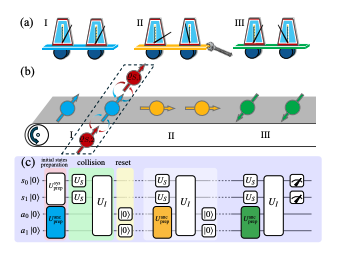
Researchers observed a transition between synchronised and anti-synchronised states in two quantum bits (qubits) interacting via a shared environment. Controlled transitions were achieved by manipulating dissipation, exhibiting robustness to noise and verified using correlation measurements on superconducting circuits. Qutrit systems promise enhanced observation of this effect.
The coordinated behaviour of oscillating systems, familiar in everyday phenomena such as pendulum clocks maintaining time, extends to the quantum realm. Researchers are now demonstrating analogous synchronisation effects in qubits – the fundamental units of quantum information – mediated by their interaction with a shared environment. A team led by Xingli Li, Yan Li, and Yangqian Yan, all affiliated with the Department of Physics and the State Key Laboratory of Quantum Information Technologies and Materials at The Chinese University of Hong Kong, alongside colleagues at the Shenzhen Research Institute, detail this work in their paper, “Two-body Dissipator Engineering: Environment-Induced Quantum Synchronization Transitions”. They demonstrate controlled transitions between synchronised states in two qubits, achieved by carefully manipulating the dissipation – the loss of energy – within the shared environment, and confirm these transitions through measurements on superconducting circuits.
Controlled Quantum Synchronisation via Dissipative Coupling
Researchers have demonstrated a quantum analogue of metronome synchronisation – the coordinated oscillation of two systems – within a two-qubit system interacting via a shared environment. The study derives an effective master equation – a mathematical description of a system’s time evolution – by mathematically eliminating the environmental degrees of freedom. This reveals a two-body dissipator responsible for mediating the interaction between the qubits. This dissipation facilitates controlled transitions between in-phase and anti-phase synchronisation states, establishing a novel approach to manipulating quantum correlations.
The investigation centres on a collision model where two qubits couple to a common environment, mirroring the behaviour of classical oscillating systems. The derived equation incorporates a two-body dissipator, a term representing the energy lost from the system due to interaction with the environment, which plays a crucial role in the synchronisation process. Crucially, manipulating the strength of this dissipator allows for controlled transitions between in-phase and anti-phase synchronisation of the qubits, offering a pathway to engineer quantum correlations.
Experimental validation occurs on superconducting circuits – a leading platform for building and controlling quantum systems. Researchers measure the Pearson correlation coefficient between the qubits, revealing clear signatures of the synchronisation transition as the dissipator is quenched – its effect diminished. The observed transition exhibits robustness against noise, a crucial characteristic for practical quantum technologies, suggesting the potential for building more resilient quantum devices. This robustness stems from the inherent properties of the dissipative coupling, which effectively shields the qubits from environmental disturbances.
The study highlights the potential of utilising environmental interactions not merely as sources of decoherence – the loss of quantum information – but as resources for controlling and manipulating quantum states. Traditionally, environmental interactions are viewed as detrimental to quantum coherence. However, this research demonstrates that carefully engineered environmental interactions can be harnessed to create and control quantum correlations, opening up new possibilities for quantum information processing.
While the current experiment utilises qubits – quantum systems with two possible states – researchers anticipate a more pronounced effect by extending the experiment to qutrit systems – quantum systems with three levels. Simulations predict that qutrit systems will exhibit a more pronounced synchronisation effect, potentially enhancing the clarity and precision of future experiments.
Investigating the scalability of this approach is also a key priority, as extending the synchronisation control to larger numbers of qubits represents a significant challenge. Building larger quantum systems requires overcoming significant technical hurdles, including maintaining coherence and controlling interactions between a large number of qubits.
This research provides a means to engineer quantum correlations between qubits via dissipative coupling, establishing a novel approach to quantum control. The methodology employed effectively simulates an open quantum system, where the system of interest interacts with its surroundings, allowing for a more realistic and controllable experimental setup. By carefully controlling the strength of the dissipative coupling, researchers can precisely tune the interactions between the qubits, enabling the creation of complex quantum states and correlations. This level of control is essential for building more powerful and versatile quantum technologies.
👉 More information
🗞 Two-body Dissipator Engineering: Environment-Induced Quantum Synchronization Transitions
🧠 DOI: https://doi.org/10.48550/arXiv.2506.07580