

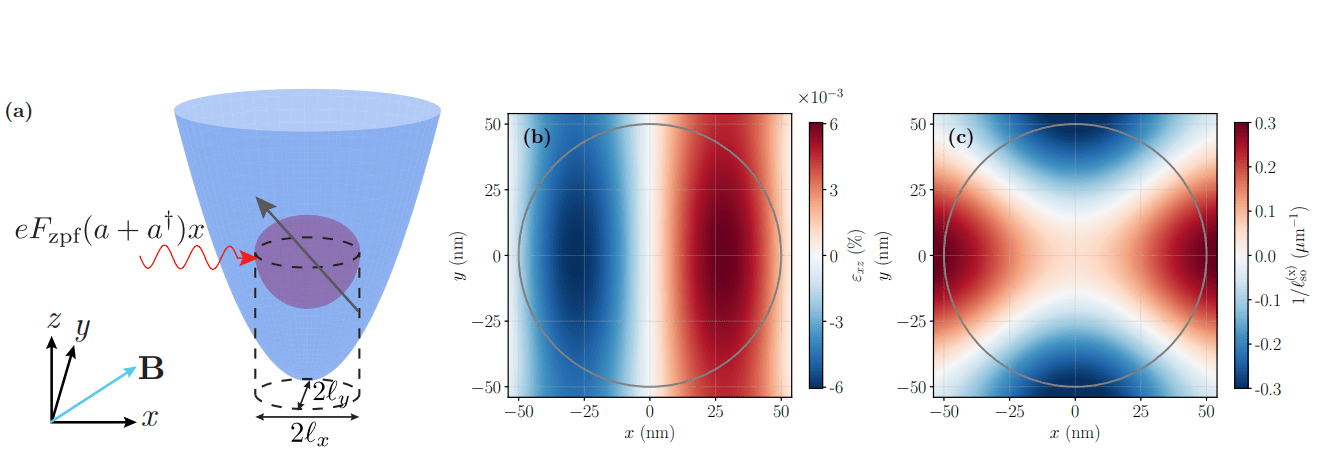
Harnessing the interaction between electron spin and light is crucial for building powerful quantum technologies, and researchers are actively exploring semiconductor quantum dots as promising platforms for this interaction. Carlos Sagaseta, María José Calderón, and José Carlos Abadillo-Uriel, alongside their colleagues, now demonstrate a method for precisely controlling the coupling between spin and photons within single quantum dots. Their work reveals that subtle variations in material strain significantly influence this coupling, identifying three distinct mechanisms that govern the interaction, and crucially, shows that silicon and unstrained germanium offer the strongest connections. This achievement enables efficient switching of spin-photon coupling while maintaining optimal performance, and the team’s modelling of quantum state transfer and two-qubit gates suggests that these single-dot hole spins represent a viable pathway towards compact and scalable spin-based quantum technologies.
Hole-Spin Qubits in Germanium Heterostructures
This research details a comprehensive theoretical investigation into hole-spin qubits in germanium heterostructures, aiming to create scalable quantum computers. The study focuses on utilizing the spin of holes, positive charge carriers, within germanium quantum dots as qubits, a promising approach due to germanium’s compatibility with silicon manufacturing and its potential for minimizing noise. Scientists addressed challenges including the typically small g-factor and limited anisotropy of hole spins in germanium by exploring innovative methods to enhance these properties through precise strain engineering and advanced heterostructure designs. The team investigated the crucial role of spin-orbit interaction, essential for controlling and reading out qubit states.
They delved into the interplay of linear and cubic spin-orbit interaction terms within germanium, aiming to maximize interaction for control while minimizing unwanted effects. To achieve this, the research proposes utilizing superconducting resonators, a technique known as circuit quantum electrodynamics, to both read out and control the hole-spin qubits, with a particular focus on longitudinal coupling for efficient readout. Furthermore, the study explores utilizing sideband transitions, a method for driving transitions between qubit states via the resonator, as a means for achieving fast and coherent qubit control. The design incorporates unstrained germanium layers combined with germanium-silicon layers to create quantum dots with tailored properties.
Applying strain to the germanium heterostructure is central to the approach, as strain modifies the material’s band structure, enhances the g-factor, and increases the spin-orbit interaction. Lateral gates are also incorporated to control the qubit’s potential and fine-tune its properties. The team employed density functional theory calculations to model the electronic structure and spin-orbit interaction, and utilized circuit quantum electrodynamics modeling to simulate the interaction between the qubits and the superconducting resonators. The research demonstrates that strain engineering can significantly enhance both linear and cubic spin-orbit interaction in germanium quantum dots.
The proposed design maximizes longitudinal coupling between the qubit and the resonator for dispersive readout, and sideband transitions are identified as a promising mechanism for achieving fast and coherent qubit control. The design also allows for tuning the qubit’s anisotropy using lateral gates. This work presents a comprehensive theoretical investigation into the potential of germanium hole-spin qubits for scalable quantum computing, focusing on innovative heterostructure designs, strain engineering, and circuit quantum electrodynamics control schemes.
Electric Field Control of Spin-Photon Coupling
Scientists engineered a sophisticated method for controlling the interaction between hole spins in semiconductor dots and single photons, paving the way for compact spin-based quantum technologies. The research focused on utilizing unstrained germanium as an optimal material for achieving strong spin-photon coupling and maximizing tunability. The team systematically investigated strategies for manipulating this coupling within compact, planar quantum dot devices, employing electric fields and modifications to harmonic confinement. By carefully adjusting harmonic confinement parameters, researchers demonstrated the ability to tune the Larmor frequency, a key characteristic of the hole spin, and modulate the strength of the spin-photon coupling.
The study revealed that applying an electric field along one axis effectively detuned the qubit, while modifying the harmonic length offered a superior approach, preserving optimal coherence. Results showed that changing the electric field provided substantial tuning range, whereas altering the harmonic length yielded a significant frequency shift while preserving the sweet spot. Furthermore, the study demonstrated that modulating the coupling strength via harmonic length changes was more effective for fully switching the interaction off than attempting to minimize the coupling directly. To assess the viability of this platform for quantum information processing, scientists evaluated quantum state transfer and two-qubit gate protocols using unstrained germanium devices. These experiments established single-dot hole spins as a promising candidate for building compact spin-cQED architectures and highlighted unstrained germanium as a particularly advantageous material for realizing strong and tunable spin-photon interactions.
Strong Spin-Photon Coupling in Quantum Dots
Scientists have achieved substantial spin-photon coupling strengths in semiconductor quantum dots, demonstrating a viable platform for compact spin-cQED architectures. The research focused on hole spins in single quantum dots, investigating coupling channels influenced by strain and magnetic field orientation. Experiments reveal that unstrained germanium and silicon provide optimal coupling strengths, due to their reduced heavy-hole, light-hole splitting. The team measured spin-photon coupling as a function of magnetic field orientation and dot size, identifying dominant contributions from vector-potential-spin-orbit geometric mechanisms and strain-induced effects.
Results demonstrate that a vertical magnetic field yields a specific Larmor frequency in unstrained germanium, while a different field achieves the same frequency in strained germanium. Measurements confirm that the transverse spin-photon coupling reaches approximately 21MHz in unstrained germanium, significantly exceeding the value observed in strained germanium under the same conditions. Further analysis of size dependence reveals that increasing harmonic lengths enhances coupling strength. Specifically, the team found that for circular dots, the transverse coupling reaches approximately 10MHz in unstrained germanium. The longitudinal coupling, measured under resonant conditions, also exhibits comparable values, reaching approximately 20MHz in unstrained germanium. These measurements, approaching the strong-coupling regime, establish unstrained germanium as a promising material for spin-photon interactions and compact quantum devices.
Spin-Photon Coupling in Semiconductor Nanostructures
This research demonstrates efficient control of spin-photon coupling in semiconductor nanostructures, establishing a promising platform for compact spin-based quantum technologies. Scientists successfully identified and characterized.
👉 More information
🗞 Switchable spin-photon coupling with hole spins in single-quantum dots
🧠 ArXiv: https://arxiv.org/abs/2510.05301

