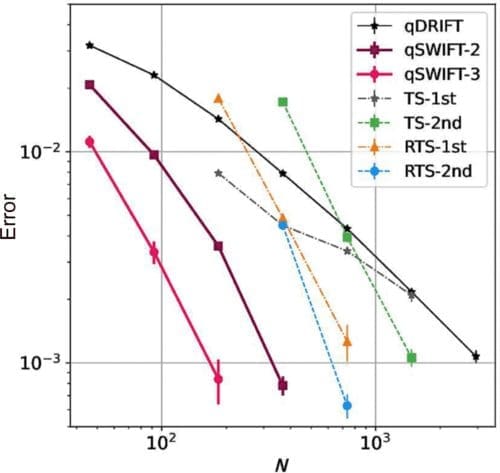
Hamiltonian simulation, a key subroutine for simulating quantum systems, has a new high-order randomized algorithm called the quantum swift protocol (qSWIFT). Developed by researchers from the University of Toronto and other institutions, qSWIFT improves upon the quantum stochastic drift protocol (qDRIFT) by having better scaling with respect to precision and the same scaling with respect to the sum of the strengths of all terms. Numerical experiments show that qSWIFT requires significantly fewer gates than qDRIFT, particularly in high precision problems, making it a promising approach for Hamiltonian simulation in quantum computing.
What is Hamiltonian Simulation and Why is it Important?
Hamiltonian simulation is a fundamental building block of a variety of quantum algorithms. Its most immediate application is simulating many-body systems to extract their physical properties. In the world of quantum computing, Hamiltonian simulation is a key subroutine for simulating quantum systems. Given a Hamiltonian, the task in Hamiltonian simulation is to construct a quantum circuit that approximately emulates the time evolution of the system. Several approaches have been established for this task, each with its own strengths and weaknesses.
The conventional approach to Hamiltonian simulation uses the Trotter-Suzuki decompositions, a deterministic method. However, the gate count of this approach scales at least linearly with the number of terms, making it impractical for many applications, particularly for the electronic structure problem in quantum chemistry where the number of terms in a Hamiltonian is prohibitively large. An alternative approach is to randomly permute the order of terms in the Trotter-Suzuki decompositions. This randomized compilation provides a slightly better scaling for the gate count, but the gate count still depends quadratically on the number of Hamiltonian terms.
What is the Quantum Stochastic Drift Protocol?
The quantum stochastic drift protocol (qDRIFT) is another randomized Hamiltonian simulation approach. Unlike the previous methods, the gate count in qDRIFT is independent of the number of terms. In qDRIFT, gates of the form exp iHlscriptτ with a small interval τ are applied randomly with a probability proportional to the strength of the corresponding term in the Hamiltonian. qDRIFT improves upon the Trotter-Suzuki approach in that its gate count is independent of the magnitude of the strongest term in the Hamiltonian and instead depends on the sum of the strengths of all terms. However, qDRIFT has poor scaling with respect to the precision, in contrast to that in the Trotter-Suzuki approach.
What is the Quantum Swift Protocol?
In a recent paper, Kouhei Nakaji, Mohsen Bagherimehrab, and Alán AspuruGuzik from the University of Toronto and other institutions propose the quantum swift protocol (qSWIFT), a high-order randomized algorithm for Hamiltonian simulation. qSWIFT has better scaling with respect to the precision and the same scaling with respect to the sum of the strengths of all terms compared to qDRIFT. Specifically, the gate count of qSWIFT scales as O(λt^2/ε^1/K), where K is the order parameter, while that of qDRIFT scales as O(λt^2/ε).
How Does qSWIFT Work?
In qSWIFT, the required number of gates for a given precision is independent of the number of terms in the Hamiltonian, while the systematic error is exponentially reduced with regard to the order parameter. In this respect, qSWIFT is a higher-order counterpart of qDRIFT. The researchers construct the qSWIFT channel and establish a rigorous bound for the systematic error quantified by the diamond norm. qSWIFT provides an algorithm to estimate given physical quantities by using a system with one ancilla qubit, which is as simple as other product-formula-based approaches such as regular Trotter-Suzuki decompositions and qDRIFT.
What are the Advantages of qSWIFT?
Numerical experiments reveal that the required number of gates in qSWIFT is significantly reduced compared to qDRIFT. In particular, the advantage is significant for problems where high precision is required. For example, to achieve a systematic relative propagation error of 10^-6, the required number of gates in third-order qSWIFT is 1000 times smaller than that of qDRIFT. This makes qSWIFT a promising approach for Hamiltonian simulation in quantum computing.
Publication details: “High-Order Randomized Compiler for Hamiltonian Simulation”
Publication Date: 2024-05-08
Authors: Kouhei Nakaji, Mohsen Bagherimehrab and Alán Aspuru-Guzik
Source: PRX Quantum 5, 020330
DOI: https://doi.org/10.1103/PRXQuantum.5.020330