Quantum computation relies on protecting fragile quantum information from disruptive noise, and low-density parity check codes currently represent a promising path toward achieving this goal with minimal overhead. Josias Old, Juval Bechar, and Markus Müller, all from the Institute for Quantum Information at RWTH Aachen University and Forschungszentrum Jülich, alongside Sascha Heußen from neQxt GmbH, now demonstrate a significant advance in this field by developing a method for performing all essential quantum gate operations within a specific type of code known as lift-connected surface codes. This research introduces a construction that enables deterministic, fault-tolerant circuits for manipulating quantum information, utilising a technique based on ‘flag qubits’ and a procedure for preparing ‘magic states’. Crucially, numerical simulations reveal that these gate constructions achieve performance levels suitable for near-term experiments, paving the way for practical, fault-tolerant quantum logic within high-rate error-correcting codes and accelerating progress towards robust quantum computation.
Scalable Quantum Computation with LDPC Codes
Scientists are investigating methods to build quantum computers that can reliably perform calculations even with imperfect components. This requires protecting quantum information from errors, a process called fault-tolerant quantum computation. Researchers are exploring the use of Low-Density Parity-Check (LDPC) codes, a type of error-correcting code, to encode and protect quantum information, potentially simplifying their implementation due to relatively few required checks. The team focuses on a method of applying error correction using round-robin flag-FT gates, analysing how the number of potential errors scales as the number of qubits increases.
A critical parameter is the pseudothreshold, representing the maximum physical error rate below which computation remains reliable, essential for building a practical quantum computer. The core of the analysis involves estimating a coefficient, determining the logical error rate, the probability of errors in the computation itself. Researchers made a pessimistic estimate that the number of dangerous faults scales quadratically with the code distance, suggesting the coefficient may grow rapidly, potentially limiting scalability, though they acknowledge factors could improve this scaling.
Lift-Connected Surface Code Clifford Gate Construction
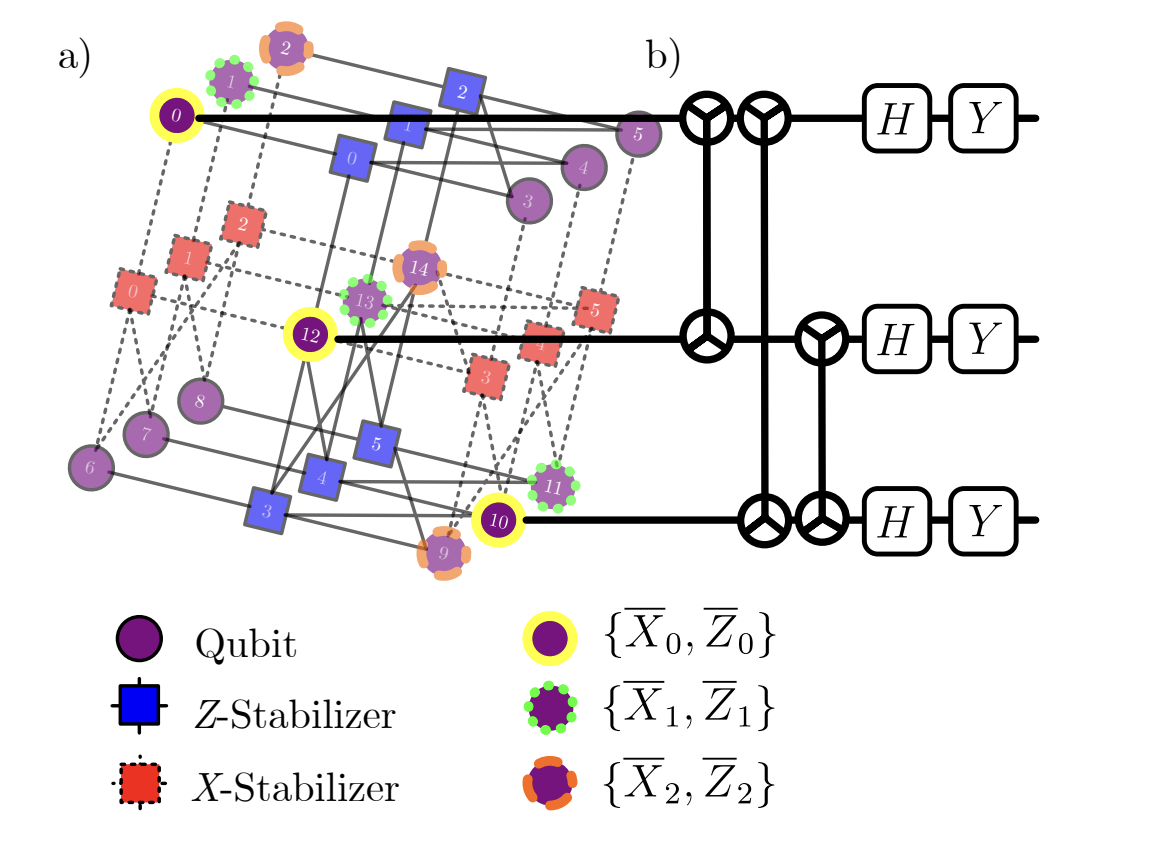
Researchers have engineered a new approach to implementing quantum error correction using lift-connected surface (LCS) codes, a promising architecture for low-overhead error-corrected memories. The team constructed circuits for addressable and fault-tolerant logical quantum gates within the J15, 3, 3K code, which encodes three logical qubits into fifteen physical qubits and can correct single errors. Scientists systematically constructed circuits to perform all operations within the logical Clifford group, implementing a flag-based approach with a small number of flag qubits to achieve fully deterministic Clifford gates, eliminating the need for post-selection. This rendered the J15, 3, 3K code’s logical gate set, including Hadamard, S, and CX gates, fault-tolerant. To complete the universal gate set, necessary for any quantum computation, the researchers provided a fault-tolerant magic state enabling logical π/4-rotations. Numerical simulations demonstrated that these gate constructions achieve pseudothresholds suitable for realistic circuit-level noise, offering a pathway toward realizing fault-tolerant error-corrected logic in high-rate qLDPC codes.
LCS Codes Enable Full Logical Gate Set
Scientists have achieved a breakthrough in fault-tolerant quantum computing by constructing deterministic circuits for logical gate operations within lift-connected surface (LCS) codes, implementable in a three-dimensional local architecture with favorable scaling properties. The team systematically constructed all quantum gate operations required to span the logical Clifford group, a crucial step towards practical quantum computation. Experiments reveal that the J15, 3, 3K code can realize a full logical gate set, including Hadamard, S, and CX gates, through the addition of a small number of flag qubits, yielding fully deterministic Clifford gates. Furthermore, by providing a fault-tolerant magic state enabling logical π/4-rotations, the researchers completed a universal gate set, essential for universal quantum computation.
The team’s approach incorporates flag qubits, auxiliary qubits used to detect correlated errors, enhancing the circuit’s ability to correct errors. Measurements confirm these qubits can detect faults propagating through the circuit, ensuring fault tolerance. Numerical simulations demonstrate that these gate constructions achieve pseudothresholds suitable for realistic circuit-level noise, indicating robust performance with a moderate number of physical qubits.
Fault-Tolerant Clifford Gates with Surface Codes
This work presents a construction for implementing Clifford gates within lift-connected surface (LCS) codes, a promising approach to low-overhead quantum error correction. Researchers successfully designed circuits enabling all Clifford gate operations on these codes, suitable for implementation using a three-dimensional local architecture, utilising flag qubits to achieve this. Numerical simulations indicate that these gate constructions can achieve pseudothresholds needed for practical circuit-level noise mitigation, requiring a moderate number of qubits and potentially facilitating progress towards fault-tolerant error-corrected logic in high-rate quantum low-density parity-check codes. The approach leverages a circuit-centric perspective on error correction, adapting techniques to detect and correct errors by carefully managing measurement outcomes and utilising flag qubits to catch correlated errors. The authors acknowledge that the performance of these gate constructions is subject to the limitations of the pseudothresholds achieved in simulations, and further work is needed to optimise performance and explore scalability.
🗞 Addressable fault-tolerant universal quantum gate operations for high-rate lift-connected surface codes
🧠 ArXiv: https://arxiv.org/abs/2511.10191