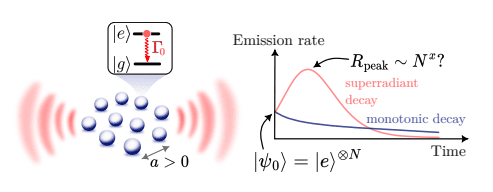
The collective emission of light from numerous excited quantum systems, known as superradiance, presents a fundamental challenge in scaling intensity with system size due to the exponential increase in computational complexity. Researchers now demonstrate a compact analytical formula predicting the peak photon emission rate for fully excited quantum emitter systems undergoing superradiant decay, irrespective of their spatial arrangement. This work reveals a universal linear relationship between peak emission rate and system extent, identifying an optimal emitter number for any given geometry. Raphael Holzinger and Susanne F. Yelin, both from Harvard University, detail these findings in their article, “Beyond Dicke superradiance: Universal scaling of the peak emission rate”, offering insights applicable to diverse quantum systems including cold atomic gases, neutral-atom arrays, molecular aggregates and solid-state materials.
Superradiance, a collective emission of photons from multiple quantum emitters, exhibits a surprising limitation in peak intensity despite increasing numbers of emitters, as researchers now demonstrate a linear scaling of peak photon emission rate with emitter count in spatially extended quantum systems. This finding resolves a long-standing challenge concerning the scaling of superradiance with system size, previously hampered by the exponential growth of the Hilbert space – the mathematical space encompassing all possible states of the system – and establishes a universal behaviour applicable across diverse quantum systems including cold atomic gases, neutral-atom arrays, molecular aggregates, and solid-state materials. Crucially, the analysis reveals each geometry possesses an optimal number of emitters for maximising photon emission, beyond which simply adding more emitters does not proportionally increase the intensity of emitted light, highlighting the importance of spatial arrangement in controlling superradiant emission.
Researchers establish a clear relationship between system size and peak photon emission rate in superradiant systems, demonstrating a universal linear scaling regardless of emitter geometry or material platform. They derive an analytical formula that accurately predicts the peak emission rate for fully excited quantum emitter systems undergoing collective decay, validating the formula with comparison to exact numerical simulations, and resolving a long-standing question regarding the limitations of achieving enhanced emission intensity with increasing numbers of spatially separated emitters. Collective decay refers to the process where excited quantum emitters lose energy through the emission of photons, and this process is accelerated when the emitters act collectively.
Researchers derive a compact analytical formula that accurately predicts the peak photon emission rate for any emitter configuration, building upon exact numerical simulations and providing a robust, easily applicable tool for understanding and optimising superradiance in various physical systems. This work provides a fundamental understanding of the limitations governing superradiant emission, offering valuable insights for designing and controlling quantum systems capable of generating intense bursts of light.
The analysis reveals spatially extended quantum systems exhibit an optimal emitter number for maximising photon emission, and increasing the number of emitters beyond this point does not yield a corresponding increase in peak emission rate. This confirms inherent limitations imposed by the system’s geometry and provides a unifying principle for understanding superradiance across different physical implementations. The finding suggests that simply scaling up the number of emitters is not a viable strategy for achieving arbitrarily high emission intensities, and that careful consideration of spatial arrangement is crucial for optimising superradiant performance.
👉 More information
🗞 Beyond Dicke superradiance: Universal scaling of the peak emission rate
🧠 DOI: https://doi.org/10.48550/arXiv.2506.12649