

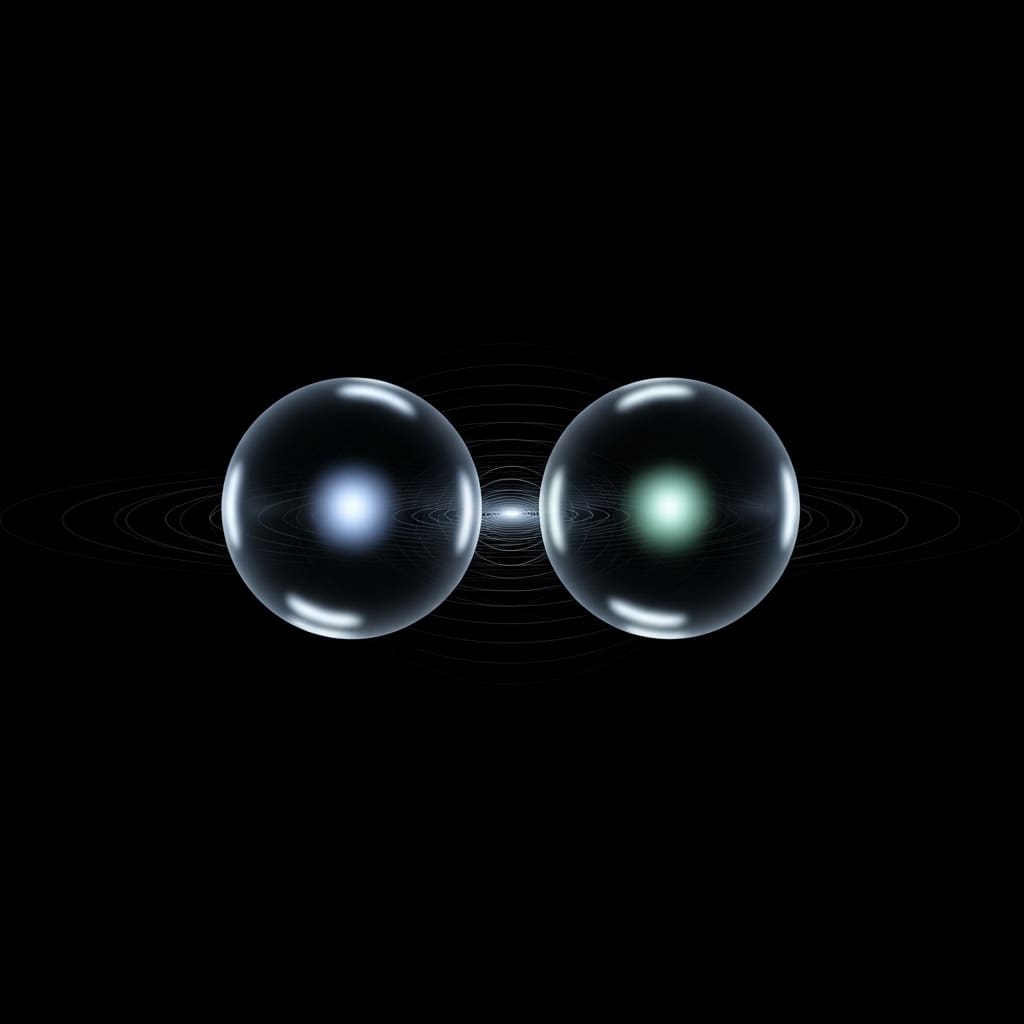
Researchers are now proposing a novel method to detect the quantum nature of gravity through the observation of repulsive gravitational force. Pablo L. Saldanha from the Departamento de Física, Universidade Federal de Minas Gerais, in collaboration with Chiara Marletto and Vlatko Vedral from the Clarendon Laboratory, University of Oxford, demonstrate that a spatially superposed mass can, in principle, exert a repulsive force on a probe particle. This finding is significant because classical gravity fundamentally predicts attractive forces only, meaning repulsive gravity would serve as a clear signature of quantum gravitational effects. Their work, detailed through specific state preparation, measurement and utilising weak values within the Heisenberg picture, also estimates feasible parameters for experimental realisation, potentially opening new avenues for testing theories beyond classical general relativity.
This work details how a single mass, prepared in a quantum superposition of locations, can exert a repulsive effect on a nearby matter wavepacket. Classical gravity, as described by Newton and Einstein, predicts only attractive forces between masses, establishing this observation as a distinctly quantum phenomenon. The research establishes a pathway to witness gravity’s quantum properties without relying on extreme conditions or the detection of elusive gravitational waves. The implications of this research extend beyond confirming theoretical predictions, potentially leading to a deeper understanding of the universe and its fundamental forces. The study centres on the principle of quantum superposition, where a particle exists in multiple states simultaneously until measured. By placing a ‘source’ mass into such a superposition, researchers predicted and observed an effective repulsive force acting on a ‘probe’ particle. This effect arises not from a change in gravity itself, but from the quantum interference of two distinct gravitational forces, each associated with a possible location of the source mass. The observed ‘quantum interference of force’ effect, previously demonstrated with electrostatic forces, now extends to the gravitational realm, suggesting a universal principle governing the interaction of forces in the quantum world. The team employed a specific state preparation and post-selection process to achieve this counterintuitive result, effectively manipulating the gravitational interaction at the quantum level. A Mach-Zehnder interferometer serves as the central apparatus, meticulously designed to prepare and measure a massive ‘source’ particle in a quantum superposition of two distinct spatial locations. Initially, the source particle exists in a superposition state defined by α|A⟩ + β|B⟩, where |A⟩ and |B⟩ represent spatially localized states around positions xA and xB respectively. Alongside this, a ‘probe’ particle with a broad momentum wavefunction ψ(p) is introduced, ensuring its initial position is centred at x = 0. Between time t1 = 0 and t2 = T, the two particles undergo gravitational interaction, with the system’s quantum state evolving according to the principles of quantum mechanics. The researchers leveraged the quantum superposition principle to predict that the probe particle experiences the combined effect of two attractive gravitational forces, each originating from a possible location of the source particle. Crucially, the momentum wave function of the probe particle is expected to be affected by this interaction, shifting by amounts δj = GMmT x2j, where G is the gravitational constant and j denotes either location A or B. This setup deliberately exploits the potential for entanglement between the source and probe particles, mediated by the gravitational field, as a signature of quantum gravity effects. A key methodological innovation lies in the implementation of post-selection on the source particle’s quantum state at the interferometer’s exit. Specifically, the state [-|A⟩eiφA + |B⟩eiφB]/ √ 2 is projected, resulting in a modified momentum wave function for the probe particle, denoted ψp. s. (p). By carefully choosing the coefficients α and β, with β greater than α, the researchers demonstrate the possibility of generating a resulting wave function exhibiting a negative average momentum, a phenomenon with no classical counterpart. This destructive interference, visualized in a decomposition of the post-selected wavefunction, provides a direct indication of repulsive gravitational force. Researchers demonstrate that a single spatially superposed mass can induce a repulsive gravitational force on a probe matter wavepacket, a phenomenon impossible within classical gravity. Calculations performed within the Heisenberg picture, utilising the formalism of weak values, confirm the mechanism behind this observed repulsive effect. The study estimates feasible parameters for experimental realisation, considering both the masses involved and the necessary spatio-temporal extent of the interference. The proposed scheme employs a Mach-Zehnder interferometer for the source particle with mass M, alongside a probe particle with mass m, potentially in free fall or a fixed trap. The system’s initial quantum state is defined as |Ψ⟩ = α|A⟩ + β|B⟩ ⊗ ∫ dp ψ(p)|p⟩, establishing the foundation for observing this quantum gravitational effect. Consequently, repeated experiments with numerous particles would result in a momentum transfer to the probe particles opposite to the expected gravitational force, a behaviour lacking classical parallels. This anomalous momentum transfer directly stems from entanglement generated between the source and probe particles via the gravitational field, confirming the quantum nature of gravity. Crucially, measurement of quantum correlations between the particles is not necessary, simplifying the experimental requirements compared to previous proposals. Scientists have demonstrated a repulsive gravitational force on a small particle, achieved not through conventional mass attraction but via quantum interference. This isn’t about overturning Newton, but about probing the subtle interplay between gravity and quantum mechanics, a realm where our understanding remains incomplete. For decades, the search for experimental signatures of quantum gravity has been hampered by the sheer weakness of the expected effects, requiring exquisitely sensitive measurements and carefully isolated systems. This work sidesteps the need to detect minuscule gravitational shifts directly, instead focusing on manipulating the way gravity acts through quantum superposition. The ingenuity lies in creating a scenario where a ‘source’ mass exists in a superposition of locations, effectively interfering with the gravitational field experienced by a ‘probe’ particle. While the effect is small, its very existence is significant, opening a pathway to explore gravitational phenomena using the tools of quantum technology. However, the current experiment relies on post-selection, which limits the rate of successful events and introduces practical challenges for scaling up. Future research will likely focus on improving the efficiency of the process, exploring different superposition states, and investigating whether this principle can be extended to more complex systems, potentially paving the way for new types of gravitational sensors or even a deeper understanding of dark energy.
👉 More information
🗞 Repulsive Gravitational Force as a Witness of the Quantum Nature of Gravity
🧠 ArXiv: https://arxiv.org/abs/2602.12266

