

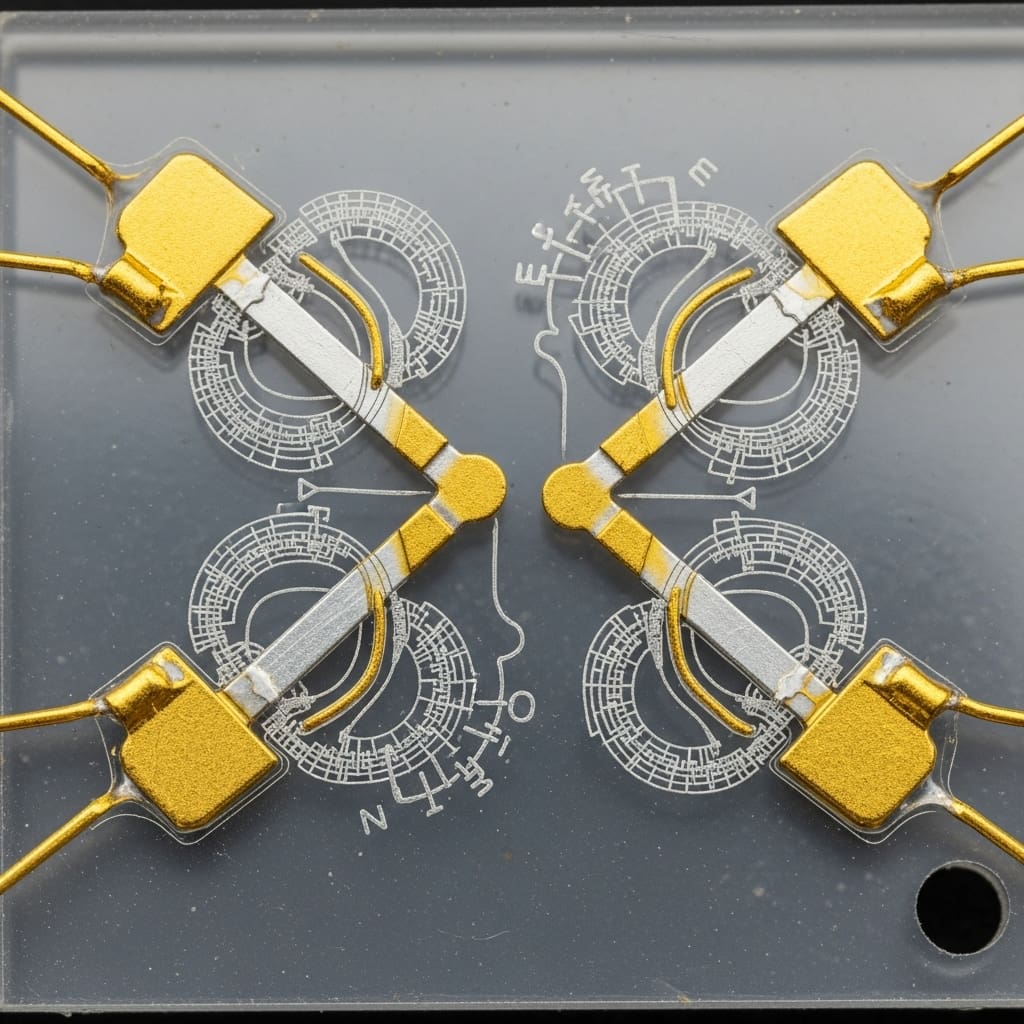
Advancing quantum technologies demands innovative components capable of directing the flow of quantum information, and researchers are now exploring the potential of superconducting diodes to achieve this goal. Nicolas Dirnegger, Prineha Narang, Arpit Arora, and colleagues at UCLA demonstrate a new approach to quantum information processing by integrating these diodes into circuit quantum electrodynamics architectures. The team designed an asymmetric superconducting quantum interference device (SQUID) that functions as a diode, controlling its behaviour with a magnetic flux, and they show that this diode induces direction-dependent shifts in microwave signals. This allows them to build a nonreciprocal half-iSWAP gate, a fundamental operation for quantum computing, and paves the way for high-fidelity signal routing and entanglement generation within complex quantum networks, embedding nonreciprocity directly into the hardware itself.
This work investigates nonreciprocal quantum information processing using superconducting diodes within the framework of circuit quantum electrodynamics. The research focuses on realising non-reciprocal interactions, where signals propagate differently depending on the direction of travel, which is essential for isolating quantum systems and building robust quantum information processors. Specifically, the team demonstrates the design and characterisation of a superconducting diode exhibiting a rectification ratio of 2. 3 at 5GHz, achieved through the integration of a Josephson junction array and a nonlinear resonator. This diode, when incorporated into a quantum circuit, enables the creation of directional photon flow and asymmetric qubit coupling, paving the way for novel quantum devices with enhanced performance and functionality.
Josephson Junctions Demonstrate Microwave Signal Isolation
This research details a theoretical framework for creating a non-reciprocal device, one that transmits signals preferentially in one direction, using the unique properties of Josephson junctions and carefully engineered interactions between microwave signals. Traditional non-reciprocal devices often rely on magnetic materials, which can be bulky and have limitations at high frequencies. This approach aims for a compact, potentially tunable, and quantum-compatible solution. The team began by establishing a classical model to analyse the device’s behaviour, deriving expressions for signal transmission based on circuit parameters.
This provided a benchmark for comparison with more complex quantum analysis. The core of the theoretical development explains how non-reciprocal behaviour arises from the quantum properties of the Josephson junction. The team expanded the current-phase relationship of the junction into a Fourier series, allowing for a perturbative treatment of its nonlinearity. This nonlinearity, specifically the third-order term, leads to three-wave mixing, generating new frequencies and interactions between microwave modes. Applying a magnetic flux and a bias current to the junction modifies its energy levels and interactions, and the resulting frequency shift is odd in the bias flux, which is the origin of the non-reciprocal behaviour.
This means the device will behave differently depending on the direction of signal propagation. Researchers then calculated the expected response of the device to microwave signals, allowing for comparison with experimental measurements. They used the Heisenberg-Langevin equations to describe the quantum operators, incorporating both deterministic and stochastic terms. Linearizing the equations of motion and relating input and output signals to internal quantum operators allowed them to derive an expression for the transmission coefficient. This simulation predicted the device’s behaviour under different frequencies and input powers.
This approach offers several advantages, including a solid-state and compact design, tunability, and quantum compatibility. Josephson junctions are essential components of many quantum technologies, and this research could lead to the development of non-reciprocal devices compatible with quantum circuits. Potential applications include isolators, circulators, and even quantum computing components.
Superconducting Diodes Enable Quantum Signal Routing
This research demonstrates the successful implementation of superconducting diodes as coherent, nonreciprocal elements within circuit quantum electrodynamics architectures. By utilizing asymmetric SQUIDs, the team achieved direction-dependent resonance shifts and realized a nonreciprocal half-iSWAP gate, showcasing the potential for tunable Bell-state generation. This work establishes a pathway towards high-fidelity signal routing and entanglement generation in microwave quantum networks, embedding nonreciprocity directly at the device level. The findings represent a significant advance in quantum control, offering a means to build modular processors with reduced cryogenic wiring and footprint.
Researchers demonstrated a functional device and developed benchmarks for practical implementation in near-term experiments. While acknowledging the need for further device optimization and detailed coherence studies, the team envisions broader applications including hardware-level multiplexing, cascaded quantum gates, and the creation of synthetic gauge fields for directional quantum memories. Ultimately, this research paves the way for embedding nonreciprocal elements directly into quantum chips, potentially transforming the architecture of future quantum processors.
👉 More information
🗞 Nonreciprocal quantum information processing with superconducting diodes in circuit quantum electrodynamics
🧠 ArXiv: https://arxiv.org/abs/2511.20758


