Spatial correlations, possessing an infinite dimensionality that makes them ideal for advanced technologies, currently drive innovation in fields like imaging, cryptography and information processing. Jerin A Thachil, Chirang R Patel, U. Ashwin and Ashok Kumar, all from the Indian Institute of Space Science and Technology, now present a detailed investigation into how these correlations evolve within bright, structured beams of light. Their work combines theoretical modelling with experimental measurements, revealing how spatial correlations transition from being tightly focused in the near field to becoming more widely spread as the beams propagate. This research demonstrates a crucial link between the initial structure of the light beam and the resulting behaviour of its spatial correlations, offering valuable insights for developing new applications in information technology and advanced imaging techniques.
Spatial Correlation Evolution in Twin Beams
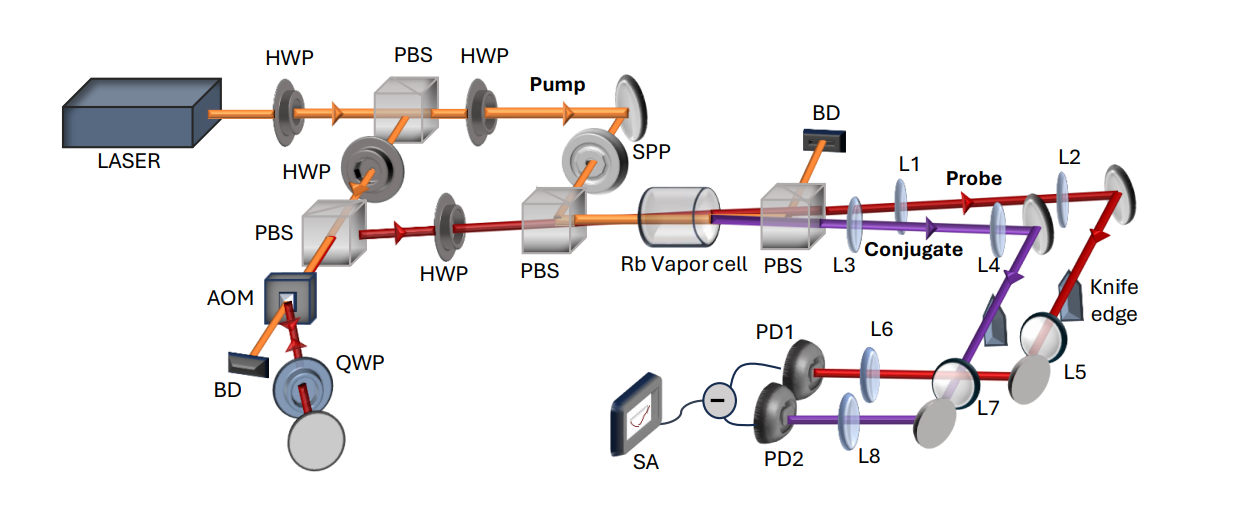
Scientists investigate how spatial quantum correlations evolve from localized to delocalized states within structured bright twin beams, offering potential for advancements in quantum technologies. The team experimentally generates and characterizes these beams using spontaneous parametric down-conversion, carefully controlling the spatial correlation properties through a specifically designed phase matching scheme. By manipulating the pump beam, they demonstrate a controlled transition from highly localized quantum correlations, suitable for high-resolution imaging, to extended, delocalized correlations ideal for secure communication protocols. This work provides a new understanding of spatial quantum correlation dynamics and paves the way for developing advanced quantum technologies leveraging the unique properties of structured light.
The research also derives an analytical expression describing the evolution of the spatial quantum correlation distribution from the near field to the far field, providing a theoretical framework for understanding these complex interactions. Experiments measure intensity-difference noise between different spatial subregions of the twin beams as they propagate, confirming the presence of quantum correlations and demonstrating successful generation and observation of spatially correlated twin beams.
Spatial Correlations of Entangled Photon Pairs
Research focuses on generating and characterizing entangled photon pairs, often referred to as twin beams, with a major emphasis on their spatial correlations, describing how the photons are distributed in space and how their spatial properties are linked. The generation of these entangled states relies heavily on nonlinear optical processes, including spontaneous parametric down-conversion and four-wave mixing. Scientists explore the use of orbital angular momentum in these entangled states, encoding information in the photons’ spatial mode for applications in quantum imaging, communication, and information processing. They also explore phenomena like self-healing, where beams carrying orbital angular momentum reconstruct themselves after partial obstruction, and utilize Gaussian approximations to model the spatial distribution of photons. The use of structured pump beams allows for control over the properties of the generated entangled states, while topological charge quantifies the twist of beams carrying orbital angular momentum.
This research highlights the possibility of generating brighter entangled beams using four-wave mixing compared to spontaneous parametric down-conversion, crucial for many applications. Scientists explore the potential for observing entanglement in macroscopic beams and investigate the use of structured pump beams to create entangled states with specific spatial patterns for pattern recognition tasks. Understanding how the spatial correlations and entanglement properties of twin beams change as they propagate through space is also a key focus. The self-healing property of orbital angular momentum beams could be exploited to create more robust quantum communication systems.
Pump Beam Shapes Dictate Spatial Correlations
This work demonstrates both theoretical and experimental control over spatial quantum correlations in bright twin beams, revealing how the initial pump beam structure influences correlation development during propagation. Theoretical analysis showed that Gaussian pumps generate localized correlations that persist as a Gaussian shape, while Laguerre-Gaussian pumps create correlations evolving from localized features into delocalized, doughnut-shaped profiles. Experimental measurements of intensity-difference noise confirmed qualitative agreement with these predictions, validating the theoretical framework and deepening understanding of spatial correlation behavior. These findings establish a clear link between pump beam characteristics and the resulting spatial correlation structure, offering new avenues for engineering nonclassical light fields. By manipulating the pump beam, researchers can tailor the spatial distribution of quantum correlations for potential applications in quantum information processing and quantum imaging.
🗞 Localized to delocalized spatial quantum correlation evolution in structured bright twin beams
🧠 ArXiv: https://arxiv.org/abs/2511.02268