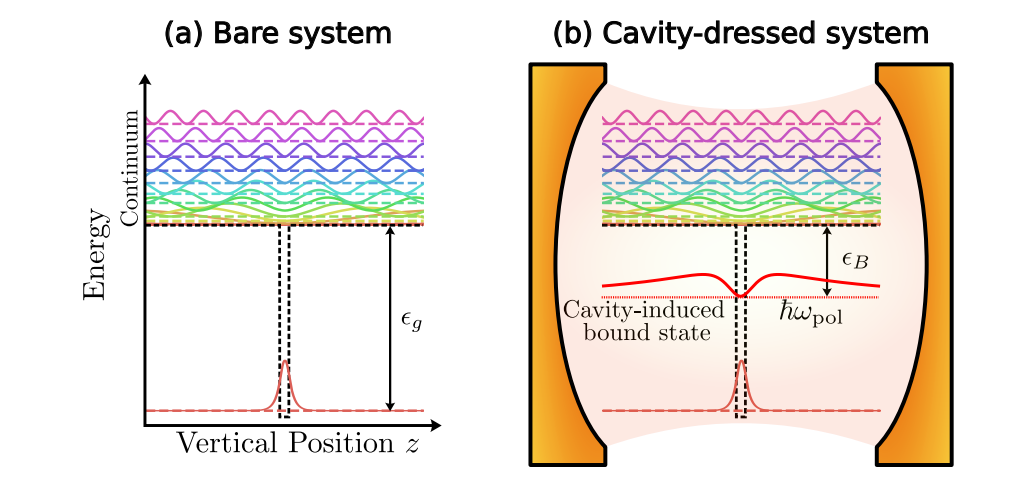
The interplay between light and matter at the quantum level promises revolutionary advances in photonics, and recent work by Miguel S. Oliveira, Cristiano Ciuti, and colleagues at Université Paris Cité and CNRS, Matériaux et Phénomènes Quantiques, explores a novel pathway to strong interactions between quantum particles. The team theoretically predicts a significant enhancement of interactions between excitons, bound pairs of electrons and holes, when they exchange photons within a cavity, effectively creating excitons bound by light. This research demonstrates that reducing the binding energy of these light-bound excitons dramatically increases their interaction strength, mirroring the behaviour of Rydberg atoms and opening the door to giant nonlinearities in the mid and far infrared spectrum, a region with substantial potential for both fundamental scientific investigation and technological applications.
Researchers theoretically predict that when cavity photons couple with electrons transitioning between energy levels in a semiconductor quantum well, a unique exciton forms, bound together by the continuous exchange of photons. The binding energy of this exciton, and therefore its properties, depends strongly on the characteristics of the cavity and the concentration of electrons within the quantum well. Their calculations demonstrate that strong coupling between light and matter significantly enhances the exciton binding energy and modifies its spatial extent, potentially leading to the emergence of novel quantum phenomena. This theoretical framework provides valuable insights into the fundamental properties of these hybrid light-matter excitations and paves the way for developing innovative quantum devices based on strong light-matter interactions.
Strongly Interacting Polaritons via Intersubband Transitions
This work details the creation and investigation of polaritons, quasi-particles formed from the strong coupling of light and matter, specifically using transitions between energy levels within a semiconductor. Researchers aim to understand excitons bound by photon exchange, a novel type of polariton exhibiting potentially strong interactions. Microcavities are used to enhance the light-matter interaction and achieve the strong coupling regime. Polaritons are formed when electromagnetic fields strongly interact with electronic excitations, specifically intersubband transitions within the semiconductor. Strong coupling leads to the formation of these hybrid states, and the team focuses on excitons where the interaction between electron-hole pairs is mediated by photon exchange, leading to strong correlations and potentially novel quantum phenomena. The results demonstrate the successful creation of a system where polaritons exhibit strong interactions, opening up the possibility of observing and controlling novel quantum phenomena and suggesting potential applications in quantum devices such as polariton lasers and quantum simulators.
Strong Polariton Interactions Mimic Rydberg Matter
This research demonstrates the theoretical prediction of strongly interacting polaritonic excitations arising from the coupling of light and matter within a semiconductor quantum well. Scientists have shown that when cavity photons interact with electrons transitioning between bound and continuum states, a unique exciton forms, bound together by the exchange of photons. Crucially, the binding energy of this exciton can be tuned by altering the frequency of the cavity, allowing for control over its properties. The team discovered that interactions between these polaritons are significantly enhanced when the exciton binding energy is reduced, effectively increasing the spatial extent of the exciton. This behaviour mirrors that of Rydberg atoms, where weak binding leads to strong interactions, and suggests the possibility of achieving giant nonlinearities in the mid and far infrared regions of the electromagnetic spectrum, a relatively unexplored area for strong light-matter interactions.
🗞 Strong quantum interaction between excitons bound by cavity photon exchange
🧠 ArXiv: https://arxiv.org/abs/2510.24421