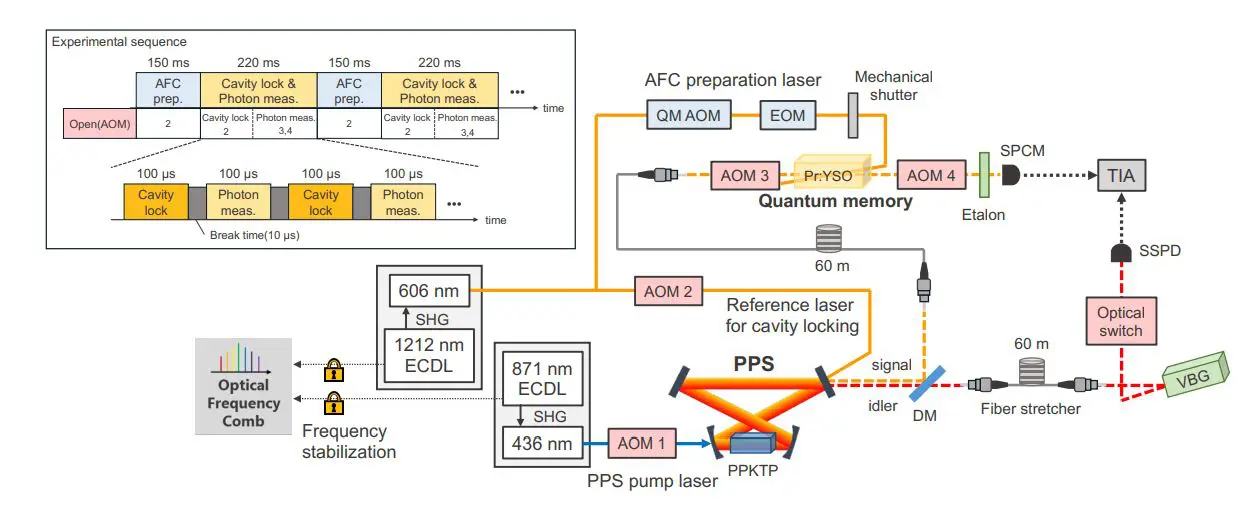
Efficiently distributing quantum information demands increasingly sophisticated methods for storing and transmitting photons, and recent work addresses this challenge by integrating advanced photon sources with quantum memories. Hiroki Tateishi, Daisuke Yoshida, and Tomoki Tsuno, along with their colleagues, have demonstrated a significant step forward by successfully combining a novel photon-pair source with a frequency-multiplexed atomic memory. The team’s approach achieves broadband storage of photons using a rare-earth crystal capable of handling 83 distinct frequency channels, a crucial advancement for increasing the capacity of future quantum networks. Importantly, the researchers observed strong nonclassical correlations even after storage, confirming the viability of this integrated system for preserving the delicate quantum states necessary for secure communication and distributed quantum computing.
Multiplexing is essential for improving entanglement distribution rates in quantum communication. Frequency multiplexing offers a promising and scalable path toward large-capacity quantum networks, but further progress demands increasing the number of frequency modes and developing broadband photon-pair sources and quantum memories that are spectrally compatible.
Telecom Photon Storage via Frequency Multiplexing
The researchers have demonstrated frequency-multiplexed storage and distribution of narrowband telecom photon pairs using a quantum memory based on a Pr3+:Y2SiO5 crystal. They achieved a gain of up to 33 in the coincidence rate compared to single-mode operation, demonstrating the effectiveness of frequency multiplexing. They maintained a high correlation of g(2) = 8. 1 ±0. 7 even after storing the photons in the quantum memory for a 400-ns time window.
The quantum memory utilizes a Pr3+:Y2SiO5 crystal, chosen for its excellent storage capabilities. A photon source generates narrowband telecom photon pairs using a Sagnac interferometer-type nondegenerate polarization entangled two-photon source. Frequency multiplexing increases the storage capacity of the quantum memory by encoding information across multiple frequency modes of the photons. The system operates at telecom wavelengths, ensuring compatibility with existing fiber optic networks. An optical frequency comb stabilizes and controls the frequency of the photons, while narrowband filtering achieves high-quality storage and retrieval.
This work represents a step towards building practical quantum repeaters and quantum networks. The use of telecom wavelengths and frequency multiplexing makes the system more compatible with existing infrastructure and scalable for long-distance quantum communication. The high coincidence rate and strong correlation demonstrate the quality of the stored and retrieved quantum states.
Broadband Quantum Storage with Atomic Combs
Scientists achieved a breakthrough in integrating cavity-enhanced photon-pair sources with atomic frequency comb memories, demonstrating a significant step towards scalable quantum networks. The research team successfully coupled a source generating non-degenerate photon pairs at 606nm and 1550nm with a Praseodymium-doped Yttrium Orthosilicate crystal-based atomic frequency comb memory. This integration enabled broadband storage of signal photons, supporting up to 83 frequency modes with 123MHz spacing, and effectively storing information across a wider spectral range than previously possible. Experiments revealed 32.
7 ±4. 8 effective modes were achieved, demonstrating the ability to reliably store and retrieve quantum information across multiple frequency channels. The cavity-enhanced photon-pair source, utilizing a bow-tie cavity, simultaneously resonated at both 606nm and 1550nm, generating a clustered frequency-comb spectrum crucial for multiplexing. This spectral structure, with a cluster width of approximately 10GHz and spacing of 200GHz, allowed for efficient coupling with the atomic frequency comb memory. Measurements confirmed strong nonclassical correlations after storage, with cross-correlation values of g(2) reaching 8.
1 ±0. 7, indicating the preservation of quantum entanglement during the storage and retrieval process. This work extends the approach to the telecom C-band, a critical advancement because photons at 1550nm experience minimal transmission loss in optical fibers, making the system well-suited for long-distance quantum communication. The team’s results demonstrate a high degree of frequency multiplicity, essential for increasing the capacity and efficiency of future quantum networks, and pave the way for more complex quantum information processing and distribution systems.
Efficient Quantum Storage Across Many Channels
Researchers have successfully integrated a highly efficient photon source with a quantum memory capable of storing a significant number of frequency channels, demonstrating a key step towards scalable quantum networks. The team created a system where a cavity-enhanced source generates pairs of light particles, and these are then stored within a solid-state memory based on a special crystal. Importantly, the memory can handle up to 83 different frequency modes simultaneously, substantially increasing the amount of quantum information that can be stored and transmitted. Measurements confirm strong quantum correlations are maintained even after the light is stored, indicating the viability of this approach for practical applications.
This achievement represents a significant advance in the field of quantum communication, as increasing the number of frequency channels is crucial for boosting data transmission rates. The integrated system demonstrates a substantial improvement in capacity compared to single-mode operation, with a gain of up to 33times more information stored. Ongoing research will likely focus on extending the storage time and enhancing the overall efficiency of the system, paving the way for more complex and powerful quantum networks.
🗞 Quantum Storage of Frequency-Multiplexed Photons Exhibiting Nonclassical Correlations with Telecom C-Band Photons
🧠 ArXiv: https://arxiv.org/abs/2511.16977