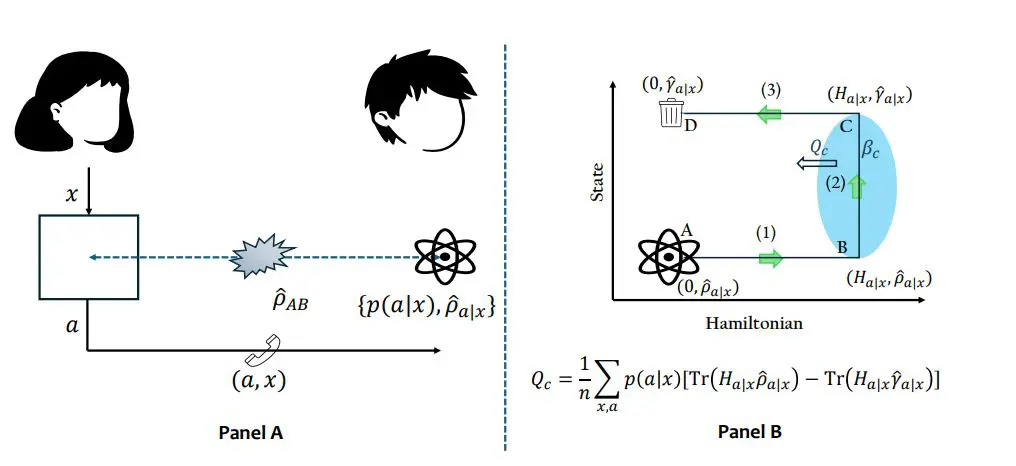
Removing heat generated during computation presents a significant challenge for both conventional and emerging technologies, and efficient cooling is vital for advancing our understanding of fundamental limits and enabling new developments. Tanmoy Biswas from Los Alamos National Laboratory, Chandan Datta from the Indian Institute of Technology Jodhpur, and Luis Pedro Garcia-Pintos from Los Alamos National Laboratory demonstrate that quantum correlations, specifically those exhibiting ‘steerability’, consistently outperform classical approaches in a cooling task. The team proves that steerable correlations always provide an advantage in removing heat, and importantly, establishes a direct link between the magnitude of this advantage and a quantifiable measure of steerability known as robustness. These findings suggest that this cooling advantage can serve as a reliable indicator of steerability itself, and the researchers show that this benefit increases as the complexity of the system grows, opening new avenues for harnessing quantum resources in thermal management.
Efficient cooling is paramount, not only for deepening our understanding of thermodynamics in the quantum regime but also for advancing modern quantum technologies. The team devised a cooling task that exploits steerability, a fundamental feature of quantum correlations, to demonstrate a provable quantum advantage over classically correlated scenarios. They quantified this advantage by comparing the amount of heat removed using quantum and classical methods.
Quantum Steering and Resource Theory Connections
This body of work represents a comprehensive exploration of quantum information theory, quantum resources, and related concepts. It examines quantum steering as a resource, its quantification, its relationship to other quantum correlations like entanglement and discord, and its applications. The research covers criteria for steering, its connection to measurement incompatibility, and its role in various quantum tasks. The framework relies heavily on quantum resource theories, which study quantum phenomena as resources for achieving tasks impossible or less efficient classically.
The collection explores the relationship between entanglement and other types of correlations, including steering and discord, and covers measures of entanglement robustness. It also examines the nature of quantum measurement, focusing on measurement incompatibility and its implications for quantum information processing. A significant portion of the research focuses on demonstrating and quantifying quantum advantage in tasks like communication complexity, showing how quantum protocols can outperform classical ones. The research also highlights applications in quantum communication, including quantum key distribution and secure communication, and explores the role of quantum resources in enhancing quantum computation, including fault-tolerant computing and algorithm development.
A strong emphasis is placed on finding operational interpretations of quantum resources, defining how these resources can be used in concrete quantum tasks and protocols. There is growing interest in the intersection of quantum information and thermodynamics, with research exploring how quantum resources can improve the efficiency of thermodynamic processes and extract work from quantum systems. The collection also touches on quantum metrology and the use of quantum resources to enhance measurement precision, as well as quantum state discrimination.
A notable trend is the discovery of scenarios where quantum advantage can be unbounded, growing arbitrarily large as the system size increases. The focus on robustness and resilience of quantum states is crucial for building practical quantum technologies that can withstand noise and decoherence. The intersection of quantum information and thermodynamics is a rapidly growing area of research.
This research suggests that quantum information theory is a vibrant and rapidly evolving field with the potential to revolutionize secure communication, quantum computing, quantum sensing, and fundamental physics.
Steerability Enhances Cooling, Reveals Quantum Advantage
This research demonstrates a clear advantage for utilising quantum steerability in cooling processes, surpassing the limits achievable with classically correlated states. The team established that steerable correlations always enhance cooling efficiency and quantified this improvement by comparing heat removal in quantum and classical scenarios. Importantly, they proved this advantage is fundamentally linked to steerability robustness, a geometric measure of the quantum state, suggesting a method for verifying steerability through observed cooling performance.
The findings reveal that, particularly in systems with prime dimensions, the cooling advantage increases with system size, demonstrating a potentially unbounded quantum advantage. While the research focuses on specific cooling protocols involving quenching and thermalization, these are standard operations within microscopic thermal machines, suggesting experimental feasibility with current technology. The authors acknowledge that the analysis considers specific cooling scenarios and that extending the framework to encompass multipartite systems represents a promising avenue for future investigation, potentially revealing even richer thermodynamic behaviour and new quantum advantages. This work contributes to the broader field of quantum thermodynamics and may inform the development of more efficient cooling mechanisms crucial for advancing quantum technologies.
🗞 All steerable quantum correlations can provide thermodynamic advantages in cooling
🧠 ArXiv: https://arxiv.org/abs/2511.16999