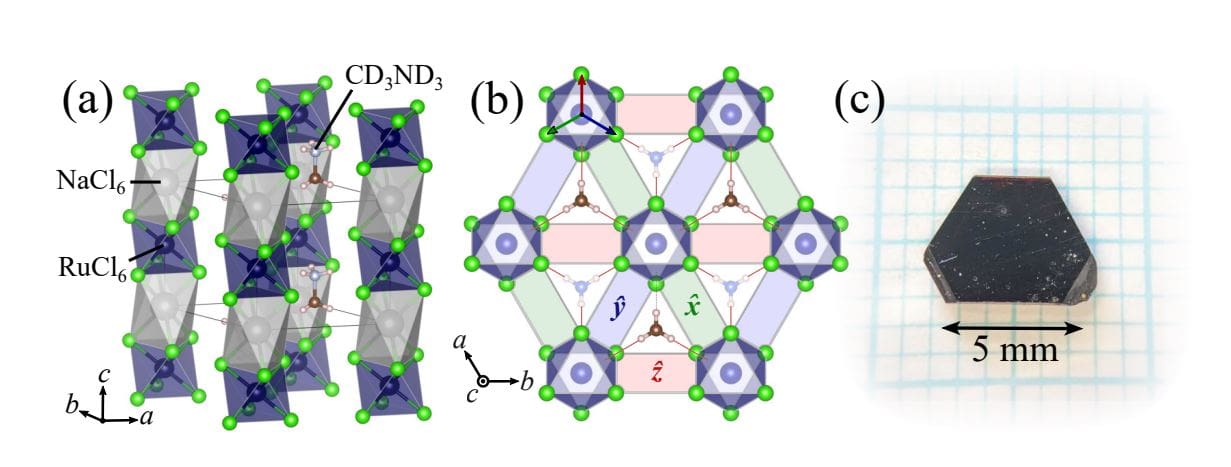
The search for novel magnetic states in geometrically frustrated systems receives a significant boost from recent work on a promising new material, (CDND)NaRuCl. J. Nagl, K. Yu. Povarov, B. Duncan, and colleagues investigate this organic antiferromagnet, revealing a complex phase diagram and unusual magnetic behaviour. Their experiments demonstrate that (CDND)NaRuCl possesses an ideal triangular arrangement of ruthenium ions, exhibiting residual magnetic order at low temperatures and transitioning through multiple incommensurate states under magnetic fields. This research identifies the material as a strong candidate for hosting a vortex crystal, a highly sought-after magnetic state predicted by theoretical models, and establishes (CDND)NaRuCl as a key member of a new family of triangular lattice magnets for exploring the interplay between geometric frustration and spin-orbit effects.
Triangular Lattices and Magnetic Frustration
This collection of research focuses on materials exhibiting frustrated magnetism, particularly those with triangular lattice structures. These materials present a unique challenge to conventional magnetic ordering, as competing interactions prevent spins from aligning in a simple, stable pattern. Researchers investigate these systems to uncover novel ground states, including spin liquids and vortex crystals, and to understand the quantum phase transitions between them. The studies explore the influence of material composition, crystal structure, and external fields on magnetic behaviour, employing both theoretical modelling and experimental techniques.
A central theme is the search for spin liquids, exotic states where spins are highly entangled but do not exhibit long-range order. Researchers also investigate the formation of vortex crystals, ordered arrangements of magnetic vortices, and the emergence of magnetization plateaus, intermediate states where the magnetization remains constant over a range of applied fields. Theoretical approaches include real-space perturbation theory, quantum Monte Carlo simulations, and spin wave analysis, providing insights into the complex interactions governing these materials. Advanced experimental techniques, including neutron scattering, resonant x-ray scattering, and muon spin rotation, are crucial for probing the magnetic structure and dynamics of these materials. Researchers utilize these techniques to characterize the magnetic excitations, determine the magnetic order, and investigate the low-temperature behaviour. Ultimately, this research aims to unlock the secrets of frustrated magnetism and discover new quantum materials with potentially revolutionary properties.
Deuterated Ruthenium Chloride Crystal Growth and Characterisation
Scientists successfully grew high-quality single crystals of a deuterated ruthenium chloride compound, (CD₃ND₃)₂NaRuCl₆, using a hydrothermal method. These crystals, ranging in size from 10 to 200 milligrams, were crucial for detailed investigations of the material’s magnetic properties. The use of fully deuterated precursors minimized unwanted scattering during neutron experiments, ensuring clearer data collection. Structural integrity and quality were confirmed using x-ray diffraction, revealing a well-defined crystal structure. Comprehensive characterization involved a range of techniques, including magnetic susceptibility, magnetization, electron spin resonance, and heat capacity measurements.
Magnetostriction and sound velocity measurements further determined the crystal’s deformation under magnetic fields and its elastic properties. These experiments revealed the material’s magnetic response, low-temperature behaviour, and electronic structure. Neutron scattering experiments, conducted at multiple facilities, provided detailed information about the magnetic structure and dynamics. The resulting data were analyzed using sophisticated software tools to extract key parameters and understand the material’s magnetic behaviour, establishing a solid foundation for further investigations into its quantum properties.
Ruthenium Trichloride Exhibits Strong Magnetic Anisotropy
This research introduces (CD3ND3)₂NaRuCl₆, a novel quantum magnet exhibiting a unique combination of properties. Scientists have comprehensively characterized this material’s fundamental characteristics through a combination of thermodynamic measurements, magneto-elastic studies, and neutron scattering experiments on single crystals. The material features an ideal triangular arrangement of ruthenium ions and hosts residual magnetic order below 3 Kelvin. Measurements of magnetic susceptibility reveal a pronounced easy-axis anisotropy, with a significantly stronger magnetic response along one axis at low temperatures.
Further investigation using electron spin resonance confirms the presence of anisotropic degrees of freedom, revealing distinct g-factors for different field orientations. Specific heat capacity measurements reveal a distinct feature at low temperatures, indicating the onset of magnetic ordering. The team determined the material’s Hamiltonian parameters through a global fit to susceptibility, magnetization, and ESR data, obtaining values for spin-orbit coupling and a trigonal distortion. These findings establish (CD3ND3)₂NaRuCl₆ as the first member of a new family of quantum triangular lattice magnets, providing fertile ground to explore the interplay between geometric frustration and spin-orbit coupling. The material’s unique properties position it as a promising candidate for investigating exotic magnetic phenomena and exploring new quantum states of matter.
Novel Quantum Magnetism in Ruthenium Chloride
This research establishes (CD3ND3)₂NaRuCl₆ as a novel quantum antiferromagnet, uniquely combining strong spin-orbit coupling with geometric frustration on a triangular lattice. Through thermodynamic, magneto-elastic, and neutron scattering experiments on single crystals, scientists have mapped a complex phase diagram featuring several incommensurate magnetic states and a multi-q ground state. This multi-q state is of particular interest as a potential host for the exotic Z2 vortex crystal phase predicted by theoretical models. The team’s findings demonstrate that the magnetism of this material is well-described by a Heisenberg Hamiltonian with additional, smaller interactions including inter-plane coupling, bond anisotropies, and magneto-elastic effects.
The discovery of this material, and its unusual magnetic behaviour, opens new avenues for investigating the interplay between geometric frustration and spin-orbit effects in quantum materials. Further polarized diffraction studies are needed to definitively confirm the spin configuration and spectroscopy experiments to investigate the dynamics of the vortex crystal phase. Importantly, this material represents the first member of a larger family of triangular lattice magnets, suggesting the potential for tuning magnetic properties through chemical substitution and exploring a wider range of quantum phenomena. This research paves the way for future investigations into the fundamental properties of quantum magnetism and the development of new quantum materials.
👉 More information
🗞 Vortex Crystal Candidate in the Triangular Quantum Antiferromagnet
🧠 ArXiv: https://arxiv.org/abs/2512.01793