

Quantum computing promises revolutionary advances, but building stable and reliable quantum bits remains a significant challenge, requiring robust methods for error correction. Sijo K. Joseph and Sudhir Singh, from GITAM Deemed to be University, alongside their colleagues, now present a solution to long-standing problems with Generalized Gottesman-Kitaev-Preskill (GKP) states, a promising approach to encoding quantum information. Their work overcomes issues like infinite energy and mathematical inconsistencies that previously plagued GKP states, demonstrating these arise from defining the code on an unbounded space. By reformulating the code on a compact, torus-shaped phase-space, the team achieves a physically realistic and mathematically well-behaved GKP state, revealing a surprising connection between quantum error correction, the geometry of space, and advanced mathematical functions, ultimately paving the way for more stable and scalable photonic quantum computers.
The core of this achievement lies in shifting the definition of the code from an unbounded phase-space to a compact phase-space, intrinsic to systems like coupled harmonic oscillators. This innovative approach yielded a Generalized GKP (GGKP) state that is both mathematically exact and physically realizable, resolving long-standing theoretical problems. To achieve this, scientists applied a Quantum Zak Transform (QZT) to Squeezed Coherent States, a technique that revealed Riemann-Theta functions as the natural representation of these states on the torus phase-space.
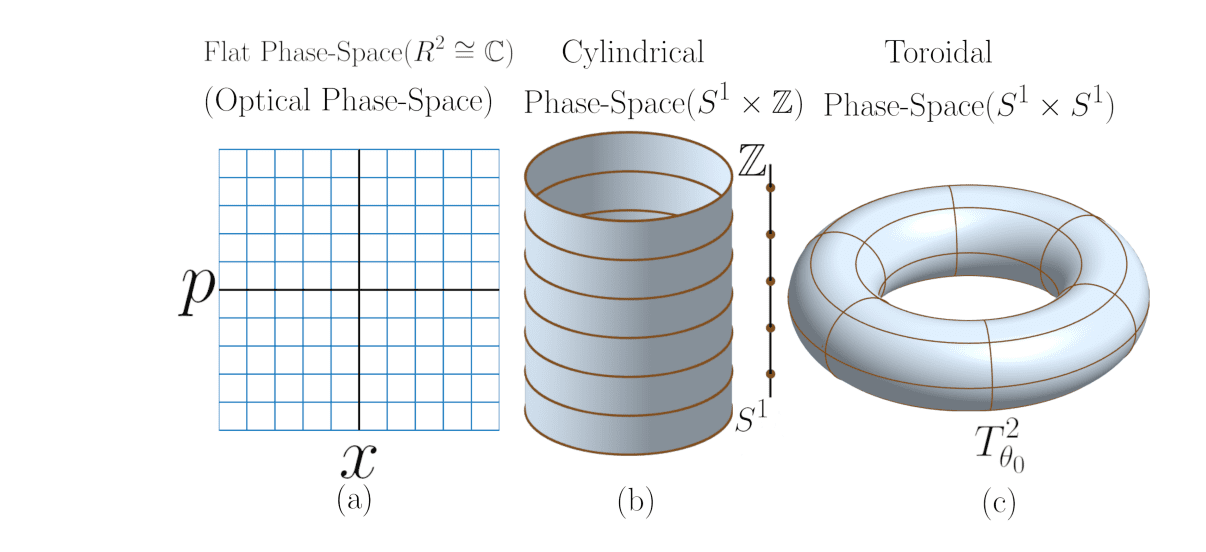
This transformation effectively maps the quantum state into a more manageable and physically relevant framework. The study pioneered the use of Riemann-Theta functions in this context, demonstrating their utility in representing and manipulating GKP states. This method allows for precise control and characterization of the quantum state, essential for implementing error correction protocols. Further investigation revealed a deep connection between error correction, non-commutative geometry, and the theory of generalized Theta functions, highlighting the mathematical elegance and broad implications of this work. Researchers demonstrate these problems arise from defining the code on an unbounded phase-space, and instead achieve a physically realizable GKP state by considering compact phase-space geometries intrinsic to coupled harmonic oscillators. This is accomplished through the application of a Quantum Zak Transform (QZT) to Squeezed Coherent States, revealing that Riemann-Theta functions naturally represent these states on a torus phase-space. The team explored how compact quantum phase-spaces emerge in systems like quantum rotors and coupled harmonic oscillators, establishing a hierarchy of geometries ranging from unbounded planes to discrete cylinders and ultimately, the compact quantum torus.
They mathematically demonstrate that trajectories in integrable classical systems with multiple degrees of freedom lie on tori, and upon quantization, these classical phase-spaces become quantum tori governed by non-commutative algebra. This algebra is defined by the relationship between modular translation operators, which do not commute, and is fundamental to the structure of the quantum torus. To construct the GKP state, researchers compare the modular translation operators with the standard Weyl displacement operator, determining the fundamental spacing of the lattice in both position and momentum directions. They then define a Rieffel-Heisenberg module, utilizing the Schwartz space as a Hilbert module and completing it in the L2-norm to obtain the physical Hilbert space of states. This achievement stems from defining the code on a compact phase-space, mirroring the geometry of coupled harmonic oscillators, and applying a Zak Transform to squeezed coherent states. The resulting GGKP state is mathematically well-behaved, physically realizable, and represented naturally by Riemann-Theta functions on a torus phase-space, establishing a deep connection between quantum error correction, non-commutative geometry, and the theory of generalized Theta functions. The researchers demonstrate that the inner product of these states can be understood as a quantum optical quasi-probability distribution, and that the obtained GGKP state closely matches the original GKP state in simpler, flat phase-space scenarios. While acknowledging that the toroidal phase-space geometry requires specific physical conditions to emerge, the team suggests that coherent state interactions may provide a natural pathway for experimental realization, providing a robust foundation for building more resilient and powerful photonic quantum computers.
👉 More information
🗞 Generalized Gottesman-Kitaev-Preskill States on a Quantum Torus
🧠 ArXiv: https://arxiv.org/abs/2509.18204