

Recent advances explore the potential of light-based systems for complex computational tasks, and a team led by Rosario Di Bartolo, Simone Piacentini, and Francesco Ceccarelli at the Polytechnic University of Milan now demonstrates a significant step forward in time-series forecasting. They achieve this by harnessing the unique properties of multiphoton quantum states within integrated photonic circuits, creating a system capable of learning and predicting patterns in data. The researchers show that using indistinguishable photons, where multiple photons act as a single entity, dramatically improves the system’s predictive power, allowing it to approximate more complex relationships with the same resources. This breakthrough highlights the power of quantum interference and indistinguishability as valuable tools for building advanced photonic computing systems, potentially paving the way for faster and more efficient data analysis.
Indistinguishable Photons Enhance Quantum Reservoir Performance
Scientists investigated the performance of quantum reservoirs, a type of recurrent neural network implemented with photonic circuits, for various machine learning tasks. The core focus is how the indistinguishability of input photons affects the reservoir’s ability to learn and generalize. The research combines experimental results with theoretical simulations to demonstrate that using indistinguishable photons enhances performance, particularly in tasks requiring complex temporal processing. The experiment centers on a photonic quantum reservoir, a network of interconnected optical elements that creates a complex, high-dimensional state space.
Input data is encoded onto photons, which then propagate through this network, creating a dynamic response. The reservoir is implemented using an integrated photonic circuit, allowing precise control over the optical elements and the creation of complex network topologies. Indistinguishable photons are created by manipulating their path using beam splitters and other optical elements to create superpositions. Detector signals measure the output of the reservoir, and these signals are processed using machine learning algorithms to train the reservoir for specific tasks. The reservoir was trained using standard machine learning techniques and evaluated on tasks including a benchmark task for recurrent neural networks called NARMA, a task requiring the reservoir to learn the XOR function over time, and a chaotic time-series forecasting task using the Mackey-Glass series.
Theoretical simulations complemented the experimental results, providing insights into the underlying mechanisms. The research consistently demonstrates that using indistinguishable photons improves the performance of the quantum reservoir across all evaluated tasks. Specifically, indistinguishable photons increase the reservoir’s expressivity, allowing it to represent more complex functions and relationships. The reservoir trained with indistinguishable photons generalizes better to unseen data, meaning it performs more accurately on data it hasn’t been trained on. This benefit is particularly pronounced on tasks requiring modeling nonlinear relationships, such as the NARMA task.
Indistinguishable photons also improve the reservoir’s ability to retain information over short periods of time, crucial for processing temporal data. Furthermore, the use of indistinguishable photons promotes internal information recycling within the reservoir, allowing it to process information more efficiently. The performance gains from using indistinguishable photons tend to saturate beyond a certain level, suggesting other factors limit the reservoir’s performance, such as the size of the accessible state space and the depth of internal transformations. Theoretical simulations corroborate the experimental results, providing further evidence that indistinguishability is a key factor in the reservoir’s performance.
Detailed analysis of the NARMA task showed lower error rates, while the temporal XOR task demonstrated higher accuracy, especially for longer delays. The Mackey-Glass time-series forecasting task also showed lower error rates, particularly for short- to medium-term predictions. Simulations confirmed that indistinguishable photons improved the reservoir’s ability to retain information over short periods of time. The research suggests the benefits of indistinguishability arise from several key mechanisms. Indistinguishable photons effectively increase the dimensionality of the state space, allowing the reservoir to represent more complex states.
They also create quantum correlations between the photons, enhancing the reservoir’s ability to process information. Indistinguishable photons promote a more thorough exploration of the state space, and the system’s capacity to model nonlinear relationships is improved. This research demonstrates a significant advancement in reservoir computing, with important implications for the development of future quantum machine learning algorithms and architectures. Future research will explore different photonic architectures, develop more sophisticated input encoding schemes, investigate the role of quantum entanglement, scale up the reservoir to tackle more challenging machine learning tasks, and combine quantum reservoirs with classical machine learning algorithms.
Photonic Reservoir Computing with Integrated Interferometers
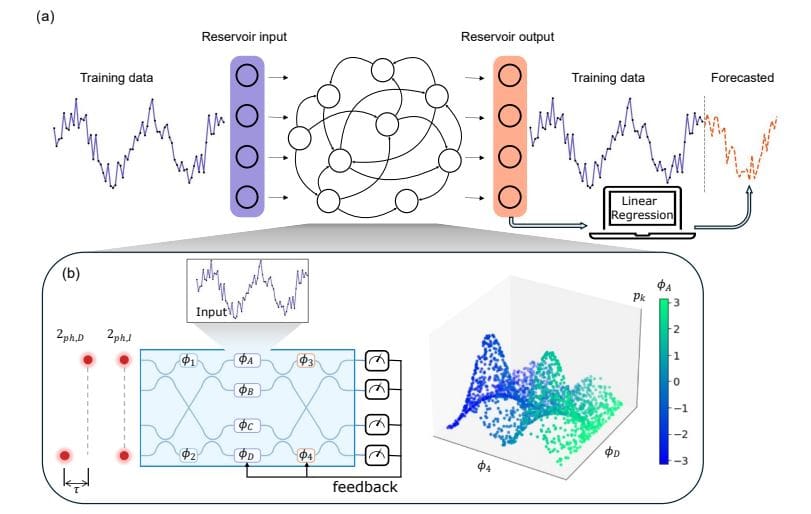
Scientists engineered a photonic quantum reservoir computing system to explore the potential of light-based computation, focusing on time-series forecasting. The core of the study involves a reconfigurable four-arm integrated interferometer fabricated using femtosecond laser waveguide writing in glass, coupled with a source of indistinguishable photons generated via spontaneous parametric down-conversion. This integrated circuit allows precise control over the optical paths and manipulation of photon states, forming the computational substrate. Single-photon detectors measure the output of the interferometer, providing the data used for prediction.
The team implemented a reservoir computing protocol, where information is encoded in the phase of photons entering the circuit, modulating the reservoir’s internal state. A multiphoton-based approach was employed, and the resulting output probabilities were used to set feedback phases, ultimately feeding into a classical digital layer trained using Ridge regression for prediction. To assess performance, data was divided into training and testing sets, with the model’s accuracy evaluated using the determination coefficient R2 and mean-squared error. The determination coefficient quantifies the similarity between predicted and actual values, while the mean-squared error measures the average squared difference between them.
Researchers characterized the system’s computational capabilities by evaluating its short-term memory and expressive power, standard metrics from classical machine learning. Memory capacity was assessed by processing random input sequences and measuring the system’s ability to recall values from previous cycles. Expressivity, the ability to approximate complex functions, was evaluated by training the readout layer to approximate nonlinear target functions, such as monomials and polynomials. The team also characterized the dimensionality of the computational space explored by the system using the Gram matrix of the reservoir state, providing a quantitative measure of the effective dimensionality. This approach allows for a detailed understanding of the system’s limitations and potential for scaling.
Indistinguishable Photons Boost Photonic Reservoir Computing
Scientists have demonstrated a significant advancement in reservoir computing by implementing a protocol within a reconfigurable integrated photonic circuit, achieving enhanced performance through the use of multiphoton inputs. The research focuses on exploiting quantum correlations to improve the system’s ability to forecast time-series data, revealing that indistinguishable two-photon states deliver substantially better results compared to distinguishable photon inputs. Experiments show this enhancement arises from the correlations inherent in indistinguishable states, enabling the photonic reservoir to approximate higher-order nonlinear functions with comparable physical resources. The team meticulously assessed the impact of quantum correlations by comparing performance with both indistinguishable and distinguishable photon inputs, maintaining consistent physical resources and optimization protocols.
Results demonstrate that the use of indistinguishable photons, combined with active feedback dynamics, significantly enhances the reservoir’s expressivity, allowing it to accurately reconstruct complex nonlinear functions without compromising its fading memory property, essential for effective temporal information processing. This improvement translates into superior performance on challenging time-dependent benchmark tasks, including temporal XOR, NARMA sequences, and the prediction of chaotic Mackey-Glass series. The photonic quantum reservoir computing architecture.
👉 More information
🗞 Time-series forecasting with multiphoton quantum states and integrated photonics
🧠 ArXiv: https://arxiv.org/abs/2512.02928


