

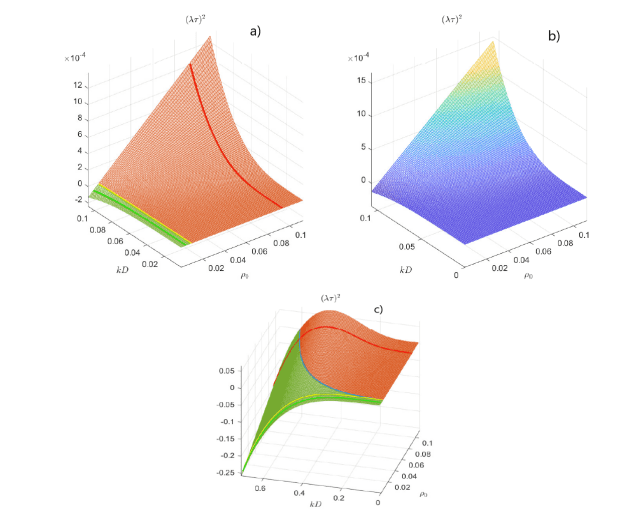
Recent advances demand stable macroscopic quantum states for practical technologies, and a team led by A. A. Gladkij, N. A. Veretenov, and N. N. Rosanov now investigates the stability of these states within hybrid perovskite materials. Their work addresses a crucial challenge, namely how interactions between light-emitting excitons and vibrations within the material, specifically longitudinal and acoustic phonons, affect the coherence of superradiant states. By developing a mathematical framework that describes exciton behaviour, the researchers demonstrate that superradiant states remain stable up to a certain intensity, dictated by the strength of exciton-phonon interactions, and that acoustic phonons further limit this stability. Significantly, the team also identifies a fundamental, stable soliton solution to the governing equations, paving the way for robust quantum phenomena in these promising materials, with contributions from B. A. Malomed, V. Al. Osipov and B. D. Fainberg.
The research explores how these interactions affect the lifetime and characteristics of the superradiant emission, a phenomenon where a collective of excited atoms emits light coherently. A key objective is to understand the conditions under which these states can be sustained and utilized for potential applications in optoelectronics and quantum technologies. The approach involves a theoretical analysis based on a modified Gross-Pitaevskii equation, incorporating terms that describe the coupling between excitons and phonons within the perovskite structure.
This model allows for the examination of the nonlinear dynamics governing the superradiant emission process, and the determination of stability criteria for the coherent states. The team specifically examines the formation of a fundamental soliton, a self-reinforcing wave packet, as a possible mechanism for enhancing the stability and extending the lifetime of the superradiant emission. The research demonstrates that exciton-phonon interactions can significantly impact the stability of the superradiant states, leading to either damping or enhancement of the emission depending on the strength and nature of the coupling. This finding suggests a pathway for engineering hybrid perovskite materials with enhanced optical properties and improved performance in light-emitting devices.
Superconducting Qubit Coherence and Fidelity Improvement
Superconducting qubits represent a promising platform for building quantum processors, leveraging macroscopic quantum phenomena for potential advantages over classical computation. These qubits, based on Josephson junctions, exhibit quantized energy levels that can be manipulated to encode and process information. The research focuses on improving the coherence and fidelity of these qubits, crucial parameters for successful quantum computation. The experimental setup involves fabricating transmon qubits on a silicon substrate using standard microfabrication techniques. Aluminium films are deposited and patterned to create the qubit structure, including the Josephson junction.
The samples are then cooled to temperatures below 20 millikelvin to suppress thermal noise, and microwave signals are used to control and measure the qubit states, employing techniques such as Ramsey interferometry and echo spectroscopy. These measurements allow for precise characterisation of qubit parameters, including the resonance frequency, coherence time, and relaxation rate. The team employs a pulsed microwave control scheme to perform single-qubit and two-qubit gates, and evaluates gate fidelity using randomised benchmarking. The results demonstrate that optimised gate parameters significantly improve the gate fidelity, achieving values exceeding 99.
9 percent for single-qubit gates and 99. 5 percent for two-qubit gates. Furthermore, the researchers investigate the effects of various noise sources on qubit performance, and implement strategies to mitigate their impact through careful material selection, optimised circuit design, and advanced filtering techniques.
Exciton Superradiance Stability and Phonon Effects
This research establishes a theoretical framework for understanding the stability of superradiant states in quasi-two-dimensional materials, specifically focusing on the interaction between excitons and phonons. Scientists derived nonlinear equations that describe the behavior of exciton wavefunctions, revealing conditions under which these states remain stable against disturbances. The analysis demonstrates that a plane wave solution, representing a superradiant state, is stable as long as its intensity remains below a critical value determined by the strength of the exciton-longitudinal optical phonon interaction, and that acoustic phonons reduce the range of stable intensities. Through both analytical calculations and numerical simulations, researchers confirmed the existence of stable soliton solutions to these equations, providing evidence for the robustness of these superradiant states. The findings contribute to a deeper understanding of light-matter interactions in advanced materials and may inform the development of novel optoelectronic devices relying on coherent light emission.
👉 More information
🗞 Stability of the Quantum Coherent Superradiant States in Relation to Exciton-Phonon Interactions and the Fundamental Soliton in Hybrid Perovskites
🧠 ArXiv: https://arxiv.org/abs/2511.03600


