

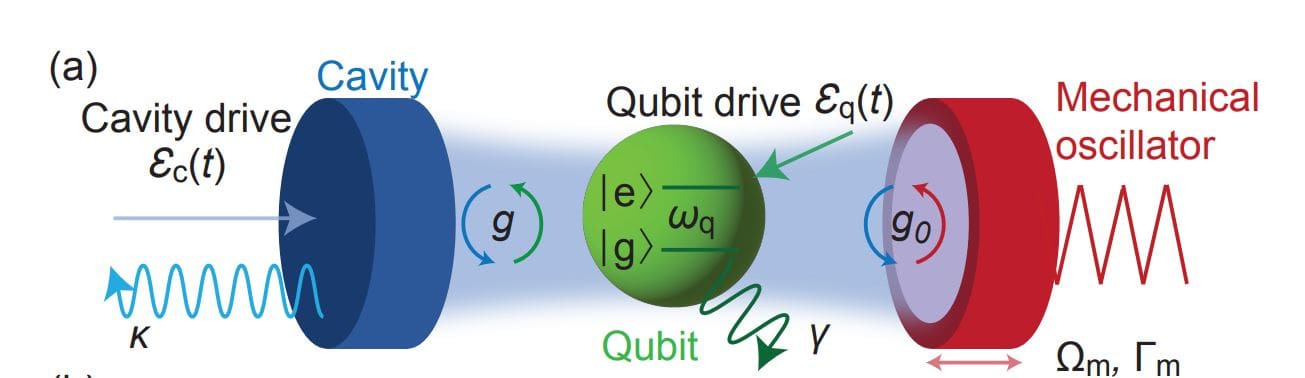
The pursuit of advanced quantum technologies demands innovative approaches to state preparation and transfer, and researchers are now exploring hybrid systems that combine the strengths of different physical platforms. Xuxin Wang, Jiahe Pan, and Tobias J. Kippenberg, alongside Shingo Kono and colleagues at the Swiss Federal Institute of Technology Lausanne and the Niels Bohr Institute, have demonstrated a method for generating and transferring non-Gaussian quantum states using a strongly driven system that merges cavity quantum electrodynamics and cavity optomechanics. This achievement addresses a significant challenge in the field, as controlling non-Gaussian states under strong driving conditions, crucial for optomechanical interactions, has remained largely unexplored. By developing a framework to model cavity dynamics with high photon numbers, the team reveals new behaviours in driven cavity systems and establishes a pathway towards creating advanced mechanical memories and highly sensitive sensors.
Strongly driven cavity quantum electrodynamical-optomechanical hybrid system Hybrid quantum systems combine the strengths of different physical platforms, but integrating them can be challenging due to mismatched properties and inefficient coupling. This work presents a strongly driven cavity quantum electrodynamical-optomechanical hybrid system, where a mechanical resonator interacts with both a superconducting qubit and the electromagnetic field within a microwave cavity. The system achieves strong coupling between the qubit and cavity, and between the cavity and the mechanical resonator, enabling coherent energy exchange between all three components. Researchers investigate the complex behaviour arising from strong driving and hybridization, observing the emergence of novel quantum states and enhanced optomechanical effects. The results demonstrate a versatile platform for exploring fundamental quantum phenomena and developing advanced quantum technologies, including quantum transduction and multi-partite entanglement.
Non-Gaussian States via Cavity Optomechanics
Researchers have developed a technique for generating non-Gaussian mechanical states by combining cavity quantum electrodynamics and cavity optomechanics within a hybrid system. The protocol prepares a non-Gaussian state within a cavity field, then transfers it to a mechanical oscillator using the optomechanical interaction, significantly enhanced by a strong, coherent drive applied to the cavity. This achievement extends established techniques for controlling non-Gaussian cavity states to regimes of strong cavity driving previously unexplored in optomechanical systems. The study reveals that a strong cavity drive effectively decouples the cavity state, minimizing unwanted deformations during the transfer process and ensuring high-fidelity quantum state transfer to the mechanical oscillator. Through both numerical and analytical modelling, the researchers demonstrated the generation of a non-Gaussian mechanical state, paving the way for potential advancements in mechanical memories and sensors.
Transmon Qubits, Materials and Coherence Optimisation
This body of work represents a comprehensive investigation into superconducting qubits and quantum information processing, encompassing qubit design, control, measurement, and error mitigation. Research focuses on transmon qubits, minimizing sensitivity to charge fluctuations and optimizing coherence, while addressing unwanted effects like Bloch-Siegert shifts. Precise qubit control relies on microwave pulses, with investigations into Rabi oscillations and gate operations. Parametric interactions, utilizing tunable couplings between qubits or resonators, are also explored, alongside the use of squeezed states and non-classical light to enhance signal-to-noise ratios.
Dispersive readout, coupling qubits to resonators to detect frequency changes, is the dominant measurement technique, with efforts to improve accuracy and speed. Photon-resolved readout, detecting individual photons, provides more information about the qubit state. Researchers investigate measurement-induced effects and techniques to mitigate them, such as non-demolition measurement and Purcell filters. Dynamical decoupling, applying pulse sequences to suppress decoherence, is a key area of research, alongside error correction techniques. Research into Wigner-negative states and optimized pulse sequences aims to prepare complex quantum states for specific algorithms.
The Jaynes-Cummings model, a fundamental description of qubit-resonator interaction, is widely used, alongside investigations into non-linear effects like the Cross-Kerr effect and Single-Photon Kerr effect. Unwanted qubit excitation due to strong microwave fields, known as ionization, is also addressed, alongside the complex dynamics of driven transmons. A significant portion of the research focuses on improving qubit readout, highlighting its importance as a bottleneck in scaling up quantum computers. Addressing decoherence and errors through error mitigation techniques is paramount, and computational tools like QuTiP demonstrate the importance of theoretical modelling and simulation. In summary, this work represents a comprehensive overview of cutting-edge research in superconducting qubit technology, covering the entire spectrum from fundamental design to advanced measurement and error mitigation, all aimed at building practical and scalable quantum computers.
High-Fidelity State Transfer to Mechanical Oscillators
This research demonstrates a new method for generating non-Gaussian states in mechanical oscillators by integrating cavity electrodynamics and cavity optomechanics within a hybrid system. The team successfully prepared a non-Gaussian state within a cavity, then coherently transferred it to a mechanical oscillator, leveraging an enhanced optomechanical interaction driven by a strong cavity field. This achievement builds upon established techniques for controlling non-Gaussian cavity states, extending them to regimes of strong cavity driving previously unexplored in optomechanical systems. The study reveals that a strong cavity drive effectively decouples the cavity state, minimizing unwanted deformations during the transfer process and ensuring high-fidelity quantum state transfer to the mechanical oscillator.
Through both numerical and analytical modelling, the researchers demonstrated the generation of a non-Gaussian mechanical state, paving the way for potential advancements in mechanical memories and sensors. Detailed simulations confirm that additional interactions, such as counter-rotating terms and the multi-level nature of commonly used superconducting qubits, cause only minimal degradation in the fidelity of the transferred mechanical state, indicating the robustness of the proposed protocol. Future work may focus on further refining the system and exploring the practical implementation of this approach with existing technologies.
👉 More information
🗞 Strongly driven cavity quantum electrodynamical-optomechanical hybrid system
🧠 ArXiv: https://arxiv.org/abs/2512.07788

