

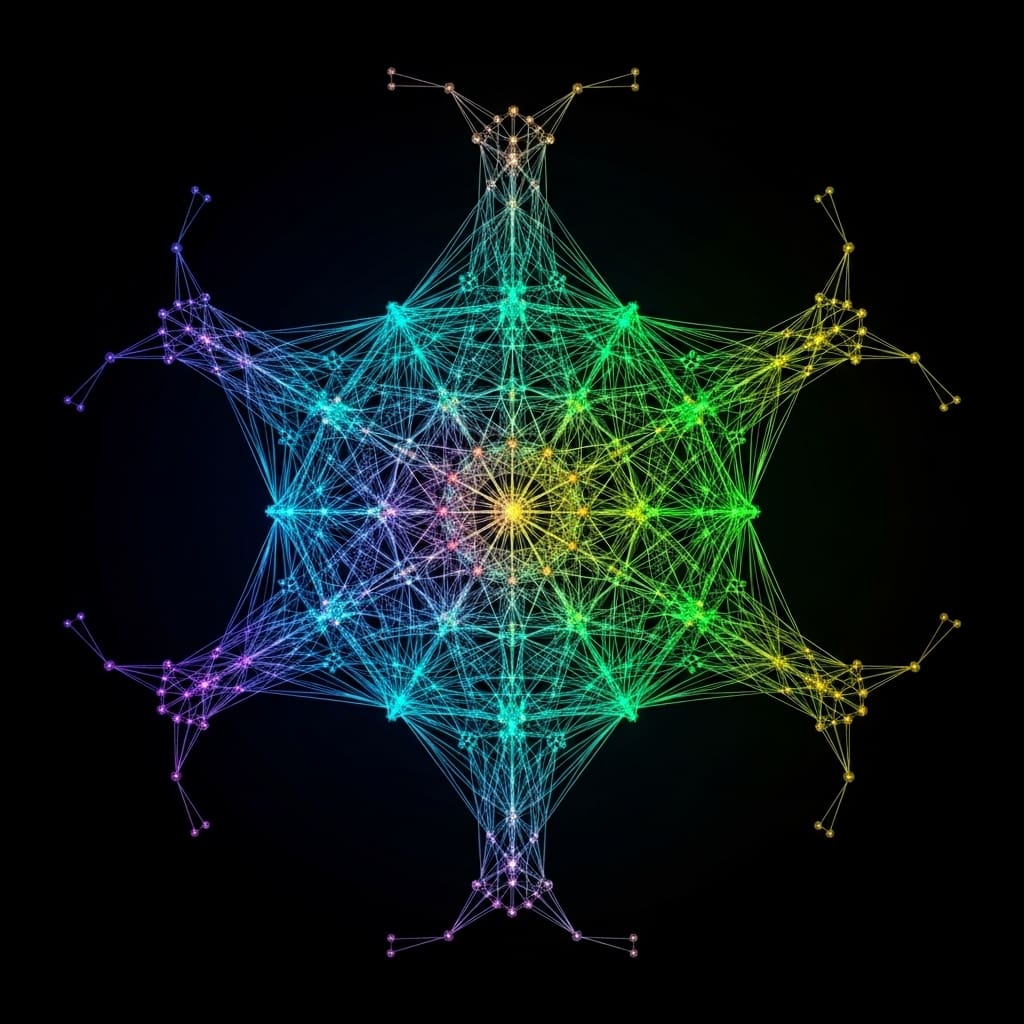
Scientists have long sought intuitive ways to visualise the complex world of quantum mechanics, and a new study proposes utilising ‘Majorana stars’ as a geometrical representation of quantum states. Led by L. L. Sanchez-Soto, A. B. Klimov, and A. Z. Goldberg, with contributions from G. Leuchs, this research demonstrates how these spin coherent states, orthogonal to a single spin state, provide a powerful and elegant method for understanding quantum structure and symmetries. The work surveys the development and applications of this ‘constellation’ approach, offering a bridge between abstract mathematical formulations and accessible geometrical intuition, and potentially advancing fields within quantum information science.
Majorana constellations and a geometrical interpretation of quantum states offer a novel perspective on particle physics
Researchers have unveiled a geometrical representation of quantum states rooted in the work of Ettore Majorana dating back to 1932. This innovative approach, utilising what are termed ‘Majorana constellations’, provides a novel method for visualising quantum states and gaining deeper insights into their underlying structure, symmetries, and entanglement properties.
The work establishes a direct correspondence between abstract algebraic formulations of quantum mechanics and intuitive geometrical interpretations, offering a powerful new tool for quantum information science. By representing spin-S states as configurations of 2S points on the unit sphere, this research bridges theoretical concepts with a readily visualisable framework.
Originally proposed as a means to generalise the Stern, Gerlach experiment, Majorana’s initial concept remained largely unnoticed until recognised by Julian Schwinger in 1935. The current study surveys the development and applications of these Majorana constellations, demonstrating their relevance to modern quantum information theory.
Researchers have confirmed the validity of Majorana’s original proposition, revealing that any spin-S state can be expressed as a superposition of 2S spin-1/2 particles, or qubits. This realisation allows for a complete mapping of quantum states onto geometrical arrangements, facilitating a more intuitive understanding of complex quantum phenomena.
Further investigation has revealed the utility of this representation in characterising “the most quantum” states and developing criteria for quantifying quantumness, specifically through a measure called stellar rank. The research demonstrates how the degeneracy patterns within Majorana stars can be used to classify symmetric N-qubit states under stochastic local operations and classical communication, offering a new perspective on entanglement analysis.
Moreover, the study highlights the application of Majorana constellations in quantum metrology, identifying states with heightened sensitivity to rotations, with potential implications for advancements in polarimetry and magnetometry. This work extends beyond quantum information, showcasing the applicability of Majorana constellations to diverse areas such as geometric phases, spinor Bose gases, and the Lipkin-Meshkov-Glick model.
By providing a comprehensive introduction to Majorana constellations, the research underscores their broad utility and explanatory power, paving the way for further exploration and innovation in the field of quantum physics. The ability to visualise and analyse quantum states through this geometrical lens promises to unlock new avenues for understanding and manipulating the quantum world.
Historical development of Majorana spin states and related quantum phenomena remains an active area of research
Majorana stars, representing spin coherent states orthogonal to a spin-S state, provide a geometrical method for visualizing quantum states. Initially proposed by Ettore Majorana in 1932, this construction represents an arbitrary spin-S state as a superposition of 2S spins 1/2, or qubits. Schwinger, recognizing the potential of this approach in 1935, confirmed its validity and connected it to the two-dimensional isotropic harmonic oscillator, though his subsequent work surprisingly omitted explicit reference to Majorana’s original formula.
The research detailed the probability of nonadiabatic transitions in oriented atomic beams near vanishing magnetic fields, a problem previously investigated by G uttinger. Majorana predicted a nonzero probability of spin flipping for a spin-1/2 particle even without a magnetic field, a prediction later generalized by Bloch and Rabi to arbitrary spin-S systems and forming the basis for nuclear magnetic resonance.
This effect resurfaced in atomic physics as the Majorana hole, initially hindering evaporative cooling before being addressed through modified trap configurations with nonzero minimum magnetic fields. Further development of the Majorana representation occurred through the work of Roger Penrose, who utilized it in 1960 within a spinor approach to general relativity to prove Petrov’s classification of gravitational fields.
Recognizing these directions as Majorana constellations decades later, Penrose employed the representation in a refined proof of Bell’s theorem and popularized it through his published work. Subsequent research expanded the scope, with Hannay deriving the pair correlation function of random spin states and obtaining a general expression for Berry’s phase, applying the spin-1 case to optical polarization. The geometric insights offered by this representation have inspired applications in quantum information, including characterization of highly quantum states and development of criteria for quantumness, such as the stellar rank.
Constellation states and their relation to spherical designs and atomic models offer a unique perspective on structural organization
Visualising Quantum States via Constellation Geometry and Spherical Arrangements offers new insights into complex systems
Stars, representing spin coherent states orthogonal to a spin-down state, provide a valuable visualisation tool for quantum states. This geometrical representation clarifies the structure, symmetries, and entanglement characteristics inherent in quantum systems, effectively linking abstract algebraic formulations with more intuitive geometrical understanding.
The constellation approach facilitates insights into modern quantum information science by offering a different perspective on state representation. This method builds upon established mathematical foundations in areas such as the statistical theory of electromagnetic fields and spherical code design, adapting principles from these fields to the quantum realm.
Investigations into the arrangement of points on spheres, initially explored in contexts like Thomson’s problem and charge distribution, find a parallel in the distribution of quantum states within the constellation framework. Furthermore, the technique connects to phase space analysis and group theory, offering a multifaceted approach to understanding quantum phenomena.
The authors acknowledge that the constellation approach, while insightful, is primarily a visualisation tool and does not inherently solve computational challenges. Future research may focus on extending the constellation method to higher-dimensional systems and exploring its potential in developing novel quantum algorithms or measurement strategies. This geometrical perspective offers a complementary approach to traditional methods, potentially aiding in the development of more intuitive and efficient quantum technologies.
👉 More information
🗞 The quantum sky of Majorana stars
🧠 ArXiv: https://arxiv.org/abs/2601.20922

