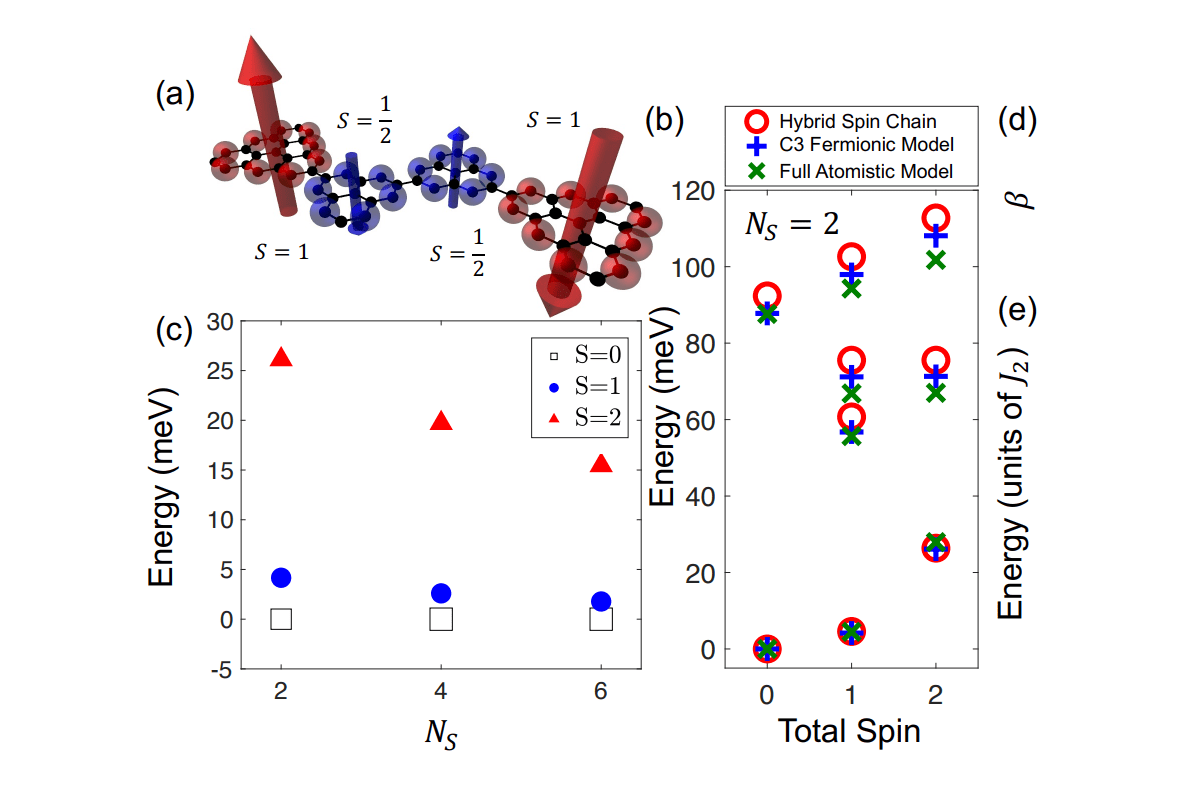
The pursuit of exotic quantum states in low-dimensional systems holds immense promise for building practical quantum simulators, but often demands precise control over complex interactions between atomic spins. Yasser Saleem, Weronika Pasek, Marek Korkusinski, and colleagues now demonstrate a strategy for engineering these challenging interactions within spin-1 chains. The team reveals how inserting pairs of spin-1/2 spacers between spin-1 sites induces a specific ‘biquadratic’ interaction, and crucially, allows tuning of its strength by adjusting the connections within the spacers themselves. This control enables a pathway towards realising the elusive AKLT state, a symmetry-protected topological phase, and the researchers identify specific nanographene structures that, through advanced bottom-up growth techniques, could achieve the necessary coupling strengths, delivering a blueprint for creating tailored quantum simulation platforms.
Low-dimensional quantum systems host a variety of exotic states, such as symmetry-protected topological ground states in spin-Haldane chains. Real-world realizations of such states could serve as practical quantum simulators if the interactions can be controlled. However, many proposed models require unconventional forms of spin interactions beyond standard Heisenberg terms, which do not naturally emerge from microscopic interactions. Here, researchers demonstrate a general strategy to induce a biquadratic term between two spin-1 sites and to tune its strength by strategically placing pairs of spin-1/2 spins between them.
DMRG Simulations of Spin-1/2 Chains
This work details the computational methods and analysis used to study hybrid spin-1/2-1 chains constructed from graphene quantum dots. The team employed density matrix renormalization group (DMRG) techniques to ensure the reliability of their results. The accuracy of DMRG depends on the maximum bond dimension, and the authors used a value of 2000-3000 to guarantee convergence, which was also tested with respect to chain length. Convergence of the correlation length required longer chains, while double degeneracy in the entanglement spectrum confirmed a correct ground state. The chains exhibit hidden antiferromagnetic order and demonstrate double degeneracy in their entanglement spectra.
Tuning Biquadratic Interactions in Hybrid Spin Chains
This work demonstrates a strategy for engineering unconventional interactions in quantum systems, specifically focusing on creating a biquadratic interaction between spin-1 sites. Researchers achieved this by strategically placing spin-1/2 spacers between the spin-1 sites and carefully controlling the strength of the interactions through the ratio of coupling constants. Detailed simulations using DMRG techniques were performed on hybrid spin chains composed of spin-1 and spin-1/2 sites, confirming that the system exhibits behavior consistent with an effective biquadratic coupling. The simulations show a transition from a standard Heisenberg interaction for small spacer interactions to a value characteristic of the AKLT state for intermediate ratios.
Specifically, the team found that for a coupling ratio of 0. 5, the low-energy spectrum closely resembles that of a spin-1 chain in the Haldane phase, characterized by degenerate ground states and a finite energy gap. Further analysis of the spin density revealed that the spin density is predominantly concentrated on the spin-1 sites, approaching the theoretical prediction for the AKLT state. This work delivers a blueprint for creating bottom-up synthesized quantum simulators with precisely tailored interactions.
Tuning Interactions Reveals Novel Spin-Liquid Phases
This research demonstrates a strategy for engineering specific interactions between spins in one-dimensional chains, crucial for creating and controlling exotic quantum states. Scientists have shown that inserting pairs of spin-1/2 sites between spin-1 sites allows for the tuning of biquadratic interactions, which are not typically found in natural magnetic materials. Through detailed simulations, the team uncovered evidence of Haldane physics, a unique quantum state, across a range of interaction strengths, characterized by a finite energy gap, specific ordering of spins, and the presence of edge quasiparticles. Notably, the researchers observed a transition between two distinct spin-liquid phases as the interaction ratio changed, a finding revealed by changes in the entanglement spectrum.
Combining spin models with atomistic calculations, they identified nanographene chains, composed of 22-atom and 13-atom flakes, as a promising solid-state platform for realizing these interactions. The calculated exchange ratios for these nanographene structures place them in a regime suitable for approaching the desired quantum state. This work provides a blueprint for creating tunable quantum spin liquids and topological states using bottom-up synthesized nanographene architectures, potentially advancing the field of quantum materials.
👉 More information
🗞 Engineering Biquadratic Interactions in Spin-1 Chains by Spin-1/2 Spacers
🧠 ArXiv: https://arxiv.org/abs/2510.26956