The pursuit of increasingly precise measurements drives advances across sensing, imaging, and fundamental physics, and researchers continually seek ways to surpass established limits of precision. Kimin Park from Palacký University, Tanjung Krisnanda and Yvonne Gao from the National University of Singapore, and colleagues demonstrate a significant step forward in this field by achieving quantum phase estimation that exceeds the Gaussian limit, a benchmark previously thought difficult to overcome. Their work focuses on utilising specific quantum states, asymmetric superpositions of coherent states, which offer a practical pathway to enhanced precision, and the team rigorously analyses how these states perform under realistic conditions including noise and signal loss. This comprehensive investigation quantifies the trade-offs between achievable precision and the range over which this quantum advantage holds, offering valuable insights into harnessing non-Gaussian quantum resources for next-generation sensing technologies.
Quantum Sensing, Limits and Bayesian Approaches
This collection of research explores the frontiers of quantum metrology and sensing, investigating how quantum mechanics can enhance measurement precision beyond classical limits. Researchers are particularly focused on surpassing the Gaussian bound, a fundamental limit for measurements using standard quantum states, by employing non-Gaussian states and optimized measurement strategies. These advancements promise improvements in diverse fields, from fundamental physics investigations to advanced sensing technologies. A central theme is the use of Gaussian states, such as coherent and squeezed states, as resources for sensing, optimizing these states and measurement strategies to approach fundamental limits.
Squeezed states, which reduce noise, are crucial for enhancing sensitivity, and entanglement often plays a key role in achieving the highest levels of precision. Phase estimation, a common target in many sensing applications, is a key area of investigation. Protecting quantum states from decoherence, the loss of quantum information due to environmental noise, is a critical challenge. Researchers are actively developing quantum error correction techniques to mitigate these effects and build robust sensors, combining QEC with continuous-variable quantum systems. Exploring the regime of ultrastrong coupling, where the interaction between light and matter is very strong, offers the potential for novel quantum phenomena and enhanced sensing capabilities.
Adaptive sensing strategies, where the measurement process is adjusted based on incoming data, are also gaining prominence. Combining these strategies with machine learning algorithms could lead to even more powerful sensors, allowing for real-time optimization and extraction of weak signals. Researchers are also investigating hybrid quantum systems, combining different quantum platforms to leverage their individual strengths and create more versatile sensors.
Asymmetric Superpositions for Enhanced Precision Sensing
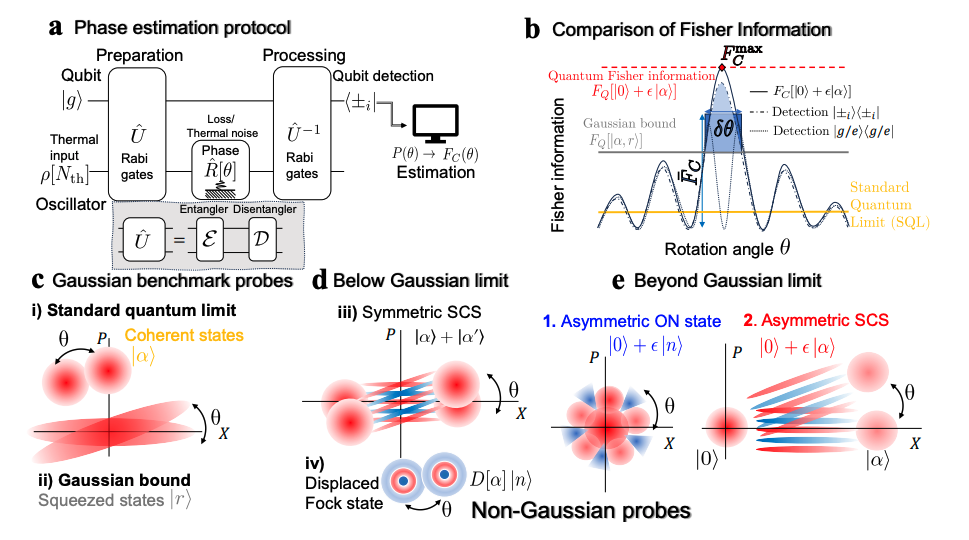
Researchers are developing methods to enhance measurement precision beyond established limits, opening possibilities for advancements in sensing, imaging, and fundamental physics investigations. A key goal is to surpass the Gaussian bound, a fundamental limit for precision achievable with standard quantum states. Certain non-Gaussian quantum states, specifically asymmetric superpositions of coherent states, offer the potential to exceed this bound within a specific range of energies. The research team’s approach centers on carefully crafting and utilizing these non-Gaussian states to achieve improved precision, while also accounting for real-world imperfections like signal loss and noise.
They define a “non-Gaussian enhancement range” as the interval of phase angles where the non-Gaussian state outperforms the best possible Gaussian state, given the same energy input, and calculate an average measurement precision across this range. A novel aspect of this methodology lies in the simplicity and efficiency of preparing and measuring these asymmetric superpositions, utilizing only two types of quantum gates. This streamlined approach is a significant advantage over more complex methods, making it more feasible for near-term implementation. The process is designed to be robust against qubit decoherence and utilizes a projective measurement on the qubit in the Pauli σy basis, which avoids saturation and preserves sensitivity even in the presence of moderate noise.
Asymmetric Superpositions Beat Quantum Measurement Limits
Researchers have demonstrated a new approach to precision measurement that surpasses established limits in quantum metrology, potentially enhancing technologies like sensing and imaging. This work reveals that carefully engineered quantum states, specifically asymmetric superpositions of coherent states, can outperform the Gaussian bound, achieving greater precision than previously thought possible. The team focused on asymmetric superpositions because they offer a practical advantage for building near-term sensing devices, requiring relatively simple preparation and processing techniques. Through detailed analysis incorporating realistic conditions like signal loss and noise, they quantified the trade-off between achievable precision and the range over which this enhanced performance is maintained, demonstrating a significant improvement in sensitivity. Importantly, the performance of these states was compared to other advanced quantum probes, and the asymmetric superpositions proved highly competitive, particularly when considering the ease with which they can be created. The researchers utilized both theoretical calculations of the ultimate precision limit and practical estimations based on realistic detection schemes to provide a comprehensive assessment, highlighting that the asymmetry of the quantum state allows for improved performance with a fixed average number of quanta.
Asymmetric Superpositions Beat Gaussian Phase Estimation Limits
This research demonstrates that asymmetric superpositions of coherent states can enhance precision in phase estimation beyond the limitations imposed by classical resources and even beyond the Gaussian bound. The study establishes that optimized asymmetric superpositions not only surpass this Gaussian bound but also exhibit robustness against realistic experimental imperfections like signal loss and thermal noise, positioning them as a promising resource for advanced sensing applications.
🗞 Quantum Phase Estimation Beyond the Gaussian Limit
🧠 ArXiv: https://arxiv.org/abs/2508.13046