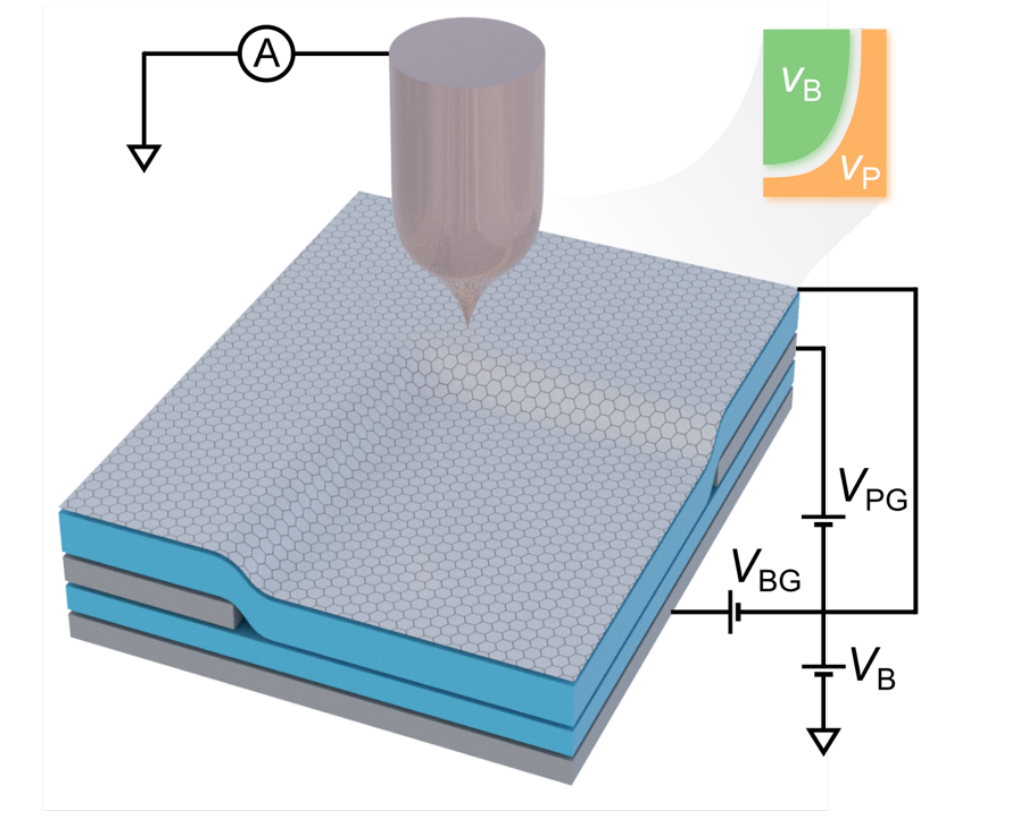
The behaviour of electrons at the edges of certain materials, known as topological phases, profoundly impacts their overall properties, yet understanding how these edge states respond to interactions between electrons has remained a significant challenge. Jiachen Yu, Haotan Han, and Kristina G. Wolinski, working at Princeton University, alongside Ruihua Fan, Amir S. Mohammadi, Tianle Wang, and colleagues at the University of California at Berkeley, now directly visualises these interactions within quantum Hall edge states using a technique called scanning tunneling microscopy. Their research reveals how electron correlations reshape the velocity and spatial arrangement of these edge channels, even inducing unexpected polarisation effects, and demonstrates that these interactions are more complex than previously thought. By directly imaging these edge states in graphene, the team establishes a powerful new method for exploring the fundamental physics of two-dimensional topological materials, paving the way for advances in areas like quantum computing and novel electronic devices.
Interacting Boundary Modes in Topological Phases
Many topological phases of matter host gapless boundary modes, and understanding how electronic interactions modify these modes is a central challenge in modern physics. This work explores the interplay between topology and strong interactions in a high-mobility two-dimensional electron gas subjected to a perpendicular magnetic field and modulated by a periodic potential. Researchers aim to engineer and manipulate these edge states for potential applications in future quantum devices and information processing technologies. Scientists achieved the ability to tune the properties of these edge states, including their spin and isospin polarization, and propagation direction, by manipulating the electrostatic potential at the graphene edge. Scientists achieved high-resolution imaging of electrostatically defined Hall edges, revealing how electronic interactions fundamentally shape the behavior of edge channels on both magnetic and atomic length scales. Experiments demonstrate that interactions renormalize the edge velocity, dictating the spatial profile of copropagating modes and inducing unexpected valley polarization. Measurements revealed the number of zero-bias peaks corresponds to the difference in filling factors between the two sides of the interface, confirming the bulk-edge correspondence principle. Further investigation revealed an unexpected upward renormalization of edge velocity, with measured edge mode velocities of approximately 105 meters per second, and demonstrated that these channels follow the local tangential direction of the potential gradient.
Imaging Interactions in Hall Edge States
This research establishes scanning tunneling microscopy as a powerful technique for directly imaging and understanding the behavior of edge states in two-dimensional materials. Scientists successfully visualized Hall edge states in graphene with unprecedented spatial resolution, revealing how interactions between electrons dictate the structure of these edge channels at both magnetic and atomic scales. For integer Hall states, interactions modify the velocity of edge states, influence the spatial distribution of copropagating modes, and induce unexpected valley polarization. Furthermore, the study extends these observations to fractional Hall phases, detecting spectroscopic signatures of interactions within these chiral Luttinger liquids, and provides a crucial platform for investigating two-dimensional topological phases.
👉 More information
🗞 Visualizing interaction-driven restructuring of quantum Hall edge states
🧠 ArXiv: https://arxiv.org/abs/2511.00156