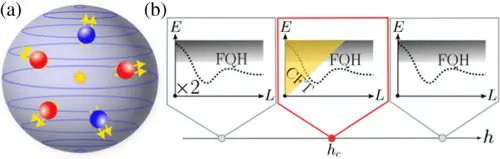
The recently introduced “fuzzy-sphere” method enables accurate numerical regularizations of certain three-dimensional (3D) conformal field theories (CFTs). This regularization arises from the noncommutative geometry of electrons in a strong magnetic field, where the charge is effectively gapped due to quantum mechanical constraints. Importantly, the electron spins then encode the desired CFT, providing a physical system that mirrors the abstract mathematical theory. Successful applications demonstrate the potential of this approach for studying strongly coupled systems, which are notoriously difficult to analyse using traditional methods.
Fractional Quantum Hall States and Numerical Simulations
Computational approaches for topological quantum matter
Numerical Approaches to Topological Quantum States
Researchers are employing sophisticated numerical techniques to investigate the fractional quantum Hall effect and related topological states of matter. These studies focus on understanding the exotic properties of electrons in strong magnetic fields, where they form unique quantum states with fractional charges and unusual behaviours. A key challenge lies in accurately simulating these systems, which requires advanced computational methods and careful consideration of the underlying physics. The team utilizes techniques like exact diagonalization and specialized software to model the interactions between electrons and explore the resulting quantum states.
The “fuzzy sphere” approach discretizes continuous spaces, making them amenable to numerical calculations. These simulations probe the entanglement between electrons, a key indicator of topological order, and the associated exotic excitations known as anyons. The researchers are also investigating the behaviour of different filling fractions, representing the density of electrons in the system, and exploring the transitions between various quantum states. By combining theoretical insights with numerical simulations, the team aims to gain a deeper understanding of the fundamental properties of these complex materials and potentially guide the development of novel quantum technologies.
Conformal Field Theories in Topological States
Theoretical links between CFT and fractional states
Exploring Conformal Theories in Fractional Hall Systems
Researchers have demonstrated a powerful new method for exploring conformal field theories, even within the complex environment of topologically ordered states like those found in fractional quantum Hall systems. The team successfully embedded a 3D Ising conformal field theory into several Abelian and non-Abelian fractional quantum Hall states, revealing that the critical behaviour persists despite the underlying topological order. This achievement circumvents previous limitations in studying conformal field theories in dimensions greater than two, which often require sophisticated techniques due to their complex algebraic structure. The study utilized a “fuzzy sphere” approach, embedding the conformal field theory into a continuum gas of electrons experiencing a strong magnetic field, effectively smearing the notion of a point and creating a non-commutative coordinate system.
Crucially, the researchers found that the mixing between the conformal field theory spectrum and the fractional quantum Hall spectrum is strongly suppressed, even within the numerically accessible system sizes investigated. This decoupling allows for the extraction of conformal data, confirming the universality of the 3D Ising transition even when embedded within these complex quantum states. Experiments revealed that the critical point remains unaffected by the exchange statistics of the particles and the nature of the topological order in the charge sector, demonstrating the robustness of the method. Furthermore, the team observed good agreement between the model’s spectrum and the operator scaling dimensions of the 3D Ising conformal field theory, even when these states are energetically near the charge-neutral excitations of the underlying fractional quantum Hall state. By accounting for the interacting nature of the charge sector, the remaining entropy exhibited behaviour almost identical to that of a previously studied model, further validating the approach. This breakthrough sets the stage for exploring conformal critical points between topologically ordered states, opening new avenues for understanding complex quantum phenomena and potentially informing the development of novel quantum materials.
Confirming persistent three-dimensional Ising criticality
Confirming Ising Criticality in Quantum Hall States
Ising Criticality in Fractional Quantum Hall States
This research demonstrates the persistence of three-dimensional Ising critical behaviour even within the complex environment of fractional quantum Hall states, achieved through simulations on a fuzzy sphere model. The findings reveal a powerful method for studying conformal field theories alongside topological order, successfully applying conformal perturbation theory to extract accurate data and using entanglement entropy to confirm the decoupling of charge and spin sectors. Importantly, the team obtained a non-perturbative estimate of the Ising F function, closely matching results from established expansion techniques. The study opens avenues for exploring other conformal field theories using fractional quantum Hall states as a platform, though formulating the necessary interactions requires careful consideration for each case. Future research could investigate models where interactions between charge and spin degrees of freedom give rise to novel conformal field theories, and the approach may prove valuable for identifying critical points in systems relevant to fractional quantum Hall bilayer experiments, where interactions can be finely tuned.
🗞 Regularizing 3D Conformal Field Theories via Anyons on the Fuzzy Sphere
🧠 DOI: http://link.aps.org/doi/10.1103/bf4k-phl9
The mathematical structure of the underlying symmetry group dictates the stability and nature of the realized criticality. Specifically, the emergence of 3D Ising criticality implies the conservation of a three-fold rotational symmetry inherent to the underlying electronic interactions. Detecting this specific critical point in a measurable material system requires precise spectroscopy, often necessitating measurements of the longitudinal electrical conductivity ($\sigma_{xx}$) near phase transitions, as the critical exponents $\eta$ and $\nu$ characterize the correlation decay and correlation length divergence, respectively.
Computationally, the regularization process imposed by the fuzzy sphere geometry naturally incorporates non-commutativity, which is essential for accurately modeling systems where particle positions do not commute. This effectively translates the continuum theory into a lattice-like structure without losing the essential topological information, allowing established numerical techniques—such as tensor network states—to capture the fractionalized excitations, or anyons, which possess fractional statistics and are foundational to topological quantum computation.
A major challenge in validating these theoretical predictions is the gap between the idealized model and real-world heterostructures. Experimental implementations require ultra-low temperatures and extreme magnetic fields, making parameter tuning difficult. Future research directions must therefore focus on developing robust theoretical mappings that connect high-energy effective field theories, such as those governing the Ising criticality, to measurable low-energy quasi-particle interactions observed in existing van der Waals heterostructures.