

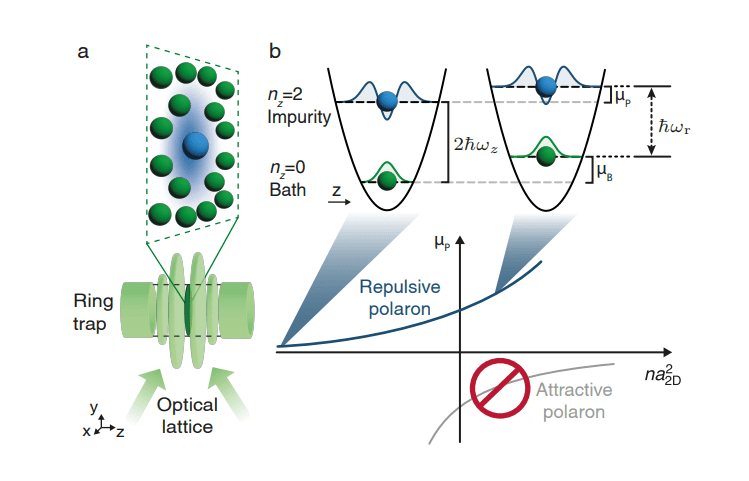
The behaviour of mobile impurities within a quantum medium generates quasiparticles called polarons, a fundamental concept in many areas of physics, but realising repulsive polarons under strongly correlated conditions has proven remarkably difficult. René Henke, Jesper Levinsen, and Meera M. Parish, along with colleagues at the Universität Hamburg, Monash University, and the Universitat Politècnica de Catalunya, now report the successful creation of these elusive entities. The team achieves this breakthrough by utilising a superfluid of lithium dimers and introducing impurities through carefully controlled excitation, suppressing typical decay mechanisms that hinder polaron formation. This demonstration of a stable repulsive Bose polaron not only provides access to a previously unexplored regime of impurity physics, but also allows precise measurement of key polaron properties, including energy, quasiparticle residue, and a significantly enhanced effective mass exceeding twice that of a free dimer, revealing deviations from established theoretical predictions.
Polaron Formation in Quasi-Two-Dimensional Gases
This research investigates polarons, quasiparticles formed when an impurity atom moves through a sea of other atoms, in systems that behave as two-dimensional (2D). When an impurity enters this atomic sea, it distorts the surrounding atoms, effectively dressing itself with a cloud of particles and changing its properties. Scientists explore how these dressed impurities, or polarons, behave in systems confined to be nearly 2D, achieved through precise control of atomic gases using harmonic potentials. The team employs advanced computational techniques, including Quantum Monte Carlo methods, to calculate the energies of both the ground state and excited states of these polarons.
A key focus of this work is understanding the excited states of the polaron, which are more challenging to determine than the ground state. Researchers utilize nodal wavefunctions to describe these excited states, focusing on the first and second excited states and how they relate to the energy levels of the confining harmonic trap. By carefully mapping the location of nodes, points where the wavefunction is zero, scientists accurately characterize the behavior of the polaron in these excited states, even when the impurity gains momentum. This research pushes the boundaries of understanding many-body physics in quasi-2D systems, providing valuable insights into the behavior of complex systems.
Repulsive Polaron Formation in Lithium Superfluid
Scientists have successfully created repulsive polarons, quasiparticles formed when an impurity interacts with a medium, within a strongly correlated gas by creating a superfluid of lithium dimers. The team prepared a two-dimensional superfluid from a balanced mixture of lithium atoms, utilizing a specialized dipole trap to confine the gas near a specific magnetic field. They then transferred the gas into a repulsive potential created by a carefully shaped dipole trap, achieving strong confinement with precisely controlled trapping frequencies. This setup allowed them to reach the quantum regime, where thermal energy is extremely low, ensuring the formation of a clean superfluid.
Precise control over the evaporation process and the trapping potential enabled the team to achieve the necessary conditions for observing repulsive polarons. Measurements of key polaron properties, including energy, quasiparticle residue, and effective mass, were obtained using trap modulation and Bragg spectroscopy. These techniques involve precisely controlling the trapping potential and analyzing the resulting atomic response, providing detailed characterization of the polaron behavior. The study demonstrates a stable repulsive Bose polaron, establishing a platform for investigating impurity physics in low-dimensional and strongly correlated systems.
Stable Repulsive Polarons Observed in Lithium Dimer Gas
Scientists have successfully created and studied repulsive polarons, quasiparticles formed when an impurity interacts with a medium, in a strongly repulsive, quasi-two-dimensional gas of lithium dimers. This achievement overcomes a longstanding challenge, as repulsive polarons are typically unstable and decay rapidly. The team engineered a system where decay channels are suppressed, allowing for the stable observation of these elusive particles. Experiments revealed key polaron properties, including energy, quasiparticle residue, and effective mass, using sophisticated techniques like trap modulation and Bragg spectroscopy.
Measurements demonstrate a significant enhancement of the polaron mass, exceeding twice the mass of a free dimer, indicating substantial interaction with the surrounding medium. The observed energy shift provides a direct measure of the polaron energy and confirms the many-body dressing of the impurity. Further analysis revealed a well-defined resonance throughout the strongly interacting regime, confirming the remarkable stability of the repulsive polaron branch. These results validate theoretical predictions from both diffusion Monte Carlo simulations and T-matrix-based polaron theory, confirming the applicability of the polaron picture to excitations in this system.
Repulsive Polaron Stability and Enhanced Mass
This research successfully demonstrates the creation and characterization of stable repulsive polarons in a quasi-two-dimensional gas, a significant achievement in the field of impurity physics. By utilizing a superfluid of lithium dimers and promoting a fraction into higher energy levels, scientists engineered what they term ‘synthetic-spin polarons’, allowing access to strongly repulsive interactions where typical decay mechanisms are suppressed. Detailed measurements of key polaron properties, energy, quasiparticle residue, and effective mass, were obtained using trap modulation and Bragg spectroscopy, revealing deviations from predictions based on simpler theoretical models. Notably, the team observed a substantial enhancement of the polaron mass, exceeding twice the mass of a free dimer, and a surprising absence of energy shift associated with the polaron. These findings align well with advanced theoretical calculations, including T-matrix approaches and Monte Carlo simulations, validating the experimental results and deepening understanding of many-body interactions in low-dimensional systems. The authors acknowledge that their current work is limited to zero temperature conditions and plan to extend these investigations to finite temperatures to explore the impact of thermal fluctuations on polaron stability and mobility.
👉 More information
🗞 Realization of repulsive polarons in the strongly correlated regime
🧠 ArXiv: https://arxiv.org/abs/2511.03569

