The behaviour of complex quantum systems, particularly those interacting with their environment, remains a significant challenge in modern physics, but new theoretical work addresses this problem by introducing the concept of ‘open-system quantum many-body scars’. Lorenzo Gotta from the University of Geneva, alongside colleagues, develops a framework to understand how specific, non-equilibrium states can persist for unexpectedly long times even within systems constantly losing energy to their surroundings. This research establishes a formal definition of these ‘scars’ within open quantum systems, revealing a previously unrecognised symmetry structure that allows for the existence of these anomalous states, and offers crucial insights into the dynamics of complex quantum phenomena, potentially influencing the development of more robust quantum technologies. The team’s theoretical predictions are supported by benchmarks demonstrating the behaviour of these states and their eventual relaxation, offering a new pathway to control and understand complex quantum systems.
Researchers employ commutant algebras to describe strong symmetries, revealing an unconventional structure that leads to the existence of anomalous stationary states. These states, unlike those typically found in isolated quantum systems, represent a key advancement in understanding non-equilibrium dynamics and provide a theoretical foundation for identifying and characterizing quantum scars in systems subject to dissipation and decoherence.
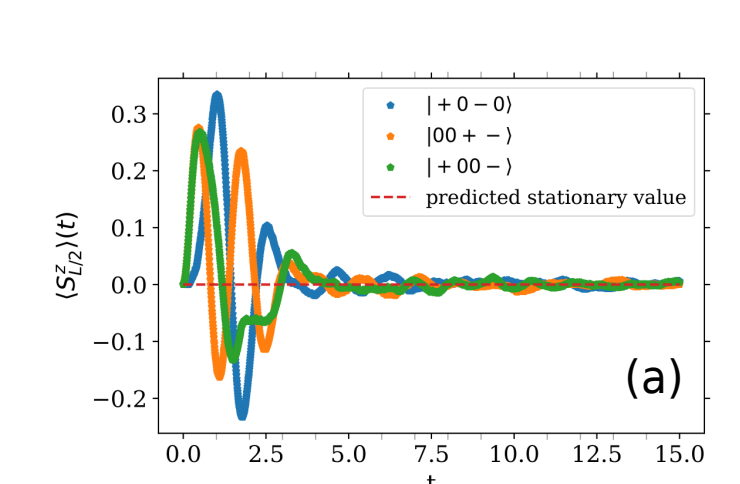
The researchers identify stationary states, termed open-system quantum many-body scars, which coexist alongside a typical thermal state. The team validates their theoretical predictions through benchmarks assessing convergence to stationarity and by describing the time evolution of quantum coherences within specific symmetry sectors defined by these scars. Furthermore, the investigation explores asymptotic open quantum many-body scars, states that ultimately converge to a thermal state but exhibit unusually long relaxation times, which the researchers thoroughly characterize.
Ordered Subspace Scars and Quantum Dynamics
This document details the theoretical underpinnings and mathematical analysis of many-body quantum systems, specifically focusing on the emergence of open-system quantum many-body scars and their implications for dynamics and decoherence. The central theme revolves around these scars, special subspaces within the system’s quantum state that exhibit unusual dynamical behaviour. Unlike typical many-body systems that quickly reach equilibrium, these scars retain coherence for extended periods, indicating non-ergodic behaviour, where the system doesn’t explore all possible states equally. The research investigates how these scars affect the decay of quantum coherence and the overall time evolution of the system, using the Lindblad master equation to describe the open quantum system and its interaction with the environment.
The team establishes a mathematical framework, defining operators, quantum states, and the Lindblad master equation, then derives the time evolution of the system’s quantum state, identifying key factors contributing to decoherence and dynamics. Analysis of short-time behaviour reveals dominant mechanisms governing the system’s evolution, and scaling analysis reveals how dynamics change with system size. The research establishes a connection between long-lived coherence and the existence of gapless excitations, suggesting that the scars are associated with special types of excitations protected from decay. Detailed mathematical derivations underpin the main results, demonstrating that the presence of scars slows down dynamics, meaning the system takes longer to reach equilibrium, and that long-lived quantum coherence is preserved. This coherence is linked to the existence of gapless excitations, and the system exhibits non-ergodic behaviour. The authors derive scaling laws describing how the dynamics change with system size.
Open Quantum Scars and Prolonged Relaxation
This work introduces a formal theory of quantum many-body scarring in open quantum systems, those interacting with an external environment, by applying an algebraic framework based on commutant algebras. Researchers identified specific conditions within these algebras that give rise to exceptional stationary states, termed open quantum many-body scars, alongside the typical thermal state. The team demonstrated these theoretical predictions through numerical analysis of convergence to stationarity and detailed the behaviour of quantum coherences within symmetry sectors defined by these scars. Furthermore, the study investigated asymptotic open quantum many-body scars, states that ultimately converge to a thermal state but exhibit significantly prolonged relaxation times. Analysis of fidelity, a measure of state preservation, revealed the characteristics of this delayed relaxation. This research advances understanding of how symmetries influence quantum dynamics in both closed and open systems, offering new insights into the behaviour of complex quantum materials.
🗞 Open-system quantum many-body scars: a theory
🧠 ArXiv: https://arxiv.org/abs/2509.18023