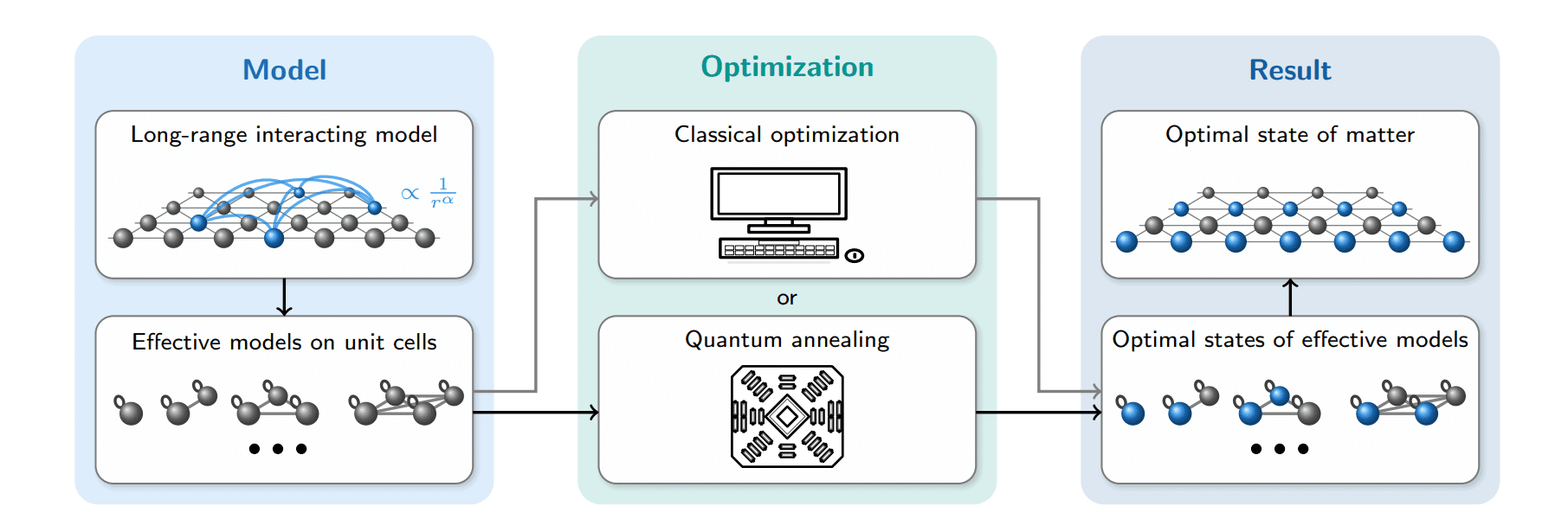
Lattice models exhibiting competing long-range interactions present a significant challenge for modern physics, hindering progress in areas from materials science to atomic simulation. Jan Alexander Koziol and Kai Phillip Schmidt, from Friedrich-Alexander-Universität Erlangen-Nürnberg, now demonstrate a method for determining the ground state of these complex systems using superconducting qubit annealing. Their approach employs a unit-cell-based optimisation scheme, leveraging existing commercial annealing hardware to tackle problems previously inaccessible to direct computation. This breakthrough enables the investigation of diverse physical phenomena, including the behaviour of frustrated magnetic materials and the properties of artificial spin ice, offering a realistic and broadly applicable advance for researchers working with lattice problems.
Finite optimisations on each unit cell are performed using commercial quantum annealing hardware. To demonstrate the capabilities of this approach, the team chose three exemplary problems relevant for other quantum simulation platforms and material science, including the calculation of devil’s staircases of magnetisation plateaux, evaluating the ground state on a Kagome lattice, and studying frustrated Ising compounds.
D-Wave Annealing for Lattice Model Ground States
Scientists are leveraging the power of D-Wave quantum annealers to investigate complex lattice models used in condensed matter physics. This research focuses on finding approximate ground states, the lowest energy configurations, of these models, which are notoriously difficult for classical computers to simulate. The team decomposes large lattices into smaller, manageable unit cells, a crucial step given the limitations of current quantum hardware. These unit cells are then mathematically transformed into a format the D-Wave annealer can understand, allowing the system to search for low-energy configurations.
The annealer doesn’t provide a single solution, but a distribution of possibilities, which researchers then analyse to determine the ground state energy and other properties of the system. The team utilises the D-Wave Advantage system and its Ocean SDK software development kit, employing a specific sampling method optimised for problems with extensive connectivity. They set parameters to collect 1000 samples with an annealing time of 200 microseconds. Detailed algorithms were developed to generate the unit cells for each lattice type, ensuring accurate representation on the quantum hardware. While the size of these unit cells is currently limited to 64 sites due to hardware constraints, this work demonstrates a viable workflow for exploring complex quantum systems.
This research doesn’t aim to find exact solutions, but to demonstrate the feasibility of using quantum annealing for these models and to potentially overcome the limitations of classical simulation methods. The study focuses on specific lattice models, including the triangular and Kagome lattices, to demonstrate their approach. While a clear quantum advantage hasn’t been established, this work provides a valuable contribution to the field of quantum simulation and opens avenues for materials discovery and the development of new quantum algorithms. This methodology could also serve as a challenging test case for evaluating the performance of quantum annealers.
Long-Range Ising Models Solved with Quantum Annealing
Scientists have developed a unit-cell-based optimisation scheme that determines the ground states of complex Ising models with long-range interactions using commercial quantum annealing devices. This approach is particularly relevant to areas such as atomic simulators and materials science, where algebraically decaying interactions are common. Results demonstrate that the quantum annealing implementation achieves comparable accuracy to classical optimisation methods. Notably, the quantum annealer completed calculations of the devil’s staircase in 10 minutes, a significant reduction from the 2500 minutes required for CPU-based classical optimisation.
Reliable performance was observed for unit cells up to 24 sites, successfully identifying the lowest energy state on a 12-site Kagome lattice unit cell. However, performance diminished on larger 36-site unit cells, where the system occasionally identified higher-energy states. The triangular lattice maintained accuracy even with 36-spin unit cells, suggesting a dependency on lattice structure. Scientists recommend caution when analysing unit cells exceeding 30 sites, and suggest 1000 annealing runs as a good balance between computational cost and accuracy. This breakthrough delivers a practical application of existing quantum annealing technology, offering a significant speed-up over classical methods while maintaining comparable accuracy in determining ground states of complex models.
Quantum Annealing Finds Ground States Efficiently
Scientists have successfully used a unit-cell-based optimisation scheme to identify the ground states of lattice models featuring algebraically decaying, competing long-range interactions using commercially available quantum annealing devices. This approach is relevant to diverse areas including atomic simulators, artificial spin ice materials, and frustrated Ising compounds. Results indicate that the quantum annealing implementation achieves comparable accuracy to classical optimisation methods, while offering a substantial reduction in computation time. The team acknowledges that the reliability of results may decrease when using larger unit cells, observing a point where the likelihood of finding known optimal states diminishes.
However, they anticipate that improvements in quantum annealing hardware will directly translate to enhanced optimisation performance. Future research will focus on extending the method to study more complex models, such as those describing long-range density-density interactions relevant to quantum dot arrays, Moiré materials, and ultracold gases. They also suggest exploring alternative coding schemes to address limitations related to chain lengths and potentially broaden the applicability of the optimisation scheme beyond the current hardware architecture.
👉 More information
🗞 Quantum annealing for lattice models with competing long-range interactions
🧠 ArXiv: https://arxiv.org/abs/2511.08336