Measurement-based quantum computation presents a promising pathway towards building practical quantum computers, and a key challenge lies in identifying the optimal ‘resource states’ to drive these computations. Brent Harrison from Dartmouth College, Vishnu Iyer from the University of Texas at Austin, and Ojas Parekh, Kevin Thompson, and Andrew Zhao from Sandia National Laboratories investigate whether circle graph states, previously considered highly expressive, possess the necessary properties for universal quantum computation. The team demonstrates that, despite their apparent power, circle graph states are not efficiently universal for measurement-based quantum computation, a finding that significantly refines our understanding of resource state requirements. They achieve this breakthrough by establishing a precise connection between circle graph states and a specific class of fermionic Gaussian states, effectively uniting techniques from both stabilizer states and fermionic systems, and opening new avenues for research beyond the immediate scope of quantum computation.
A key challenge for MBQC is identifying resource states that can perform any quantum computation, requiring unbounded entanglement but not guaranteeing universality. This research investigates circle graph states, a specific type of fermionic resource state, to determine their capacity for universal quantum computation, combining theoretical analysis and numerical simulations. Researchers demonstrate that, despite possessing unbounded entanglement, circle graph states cannot implement certain fundamental quantum gates, specifically those requiring highly complex entanglement.
This limitation arises from the restricted structure of entanglement within these states, which limits their ability to represent complex quantum operations. The analysis involves mapping required quantum gates onto measurement patterns on the circle graph state and identifying instances where such mappings are impossible, proving that circle graph states cannot approximate the controlled-Z gate with arbitrary accuracy on a set of qubits, a gate essential for many quantum algorithms. The team further demonstrates that this limitation extends beyond the controlled-Z gate, applying to a broader class of gates requiring complex entanglement patterns. These results establish a fundamental constraint on using circle graph states as universal resources for measurement-based quantum computation, contributing to a deeper understanding of the relationship between entanglement structure and computational power in quantum systems and guiding the search for more suitable resource states.
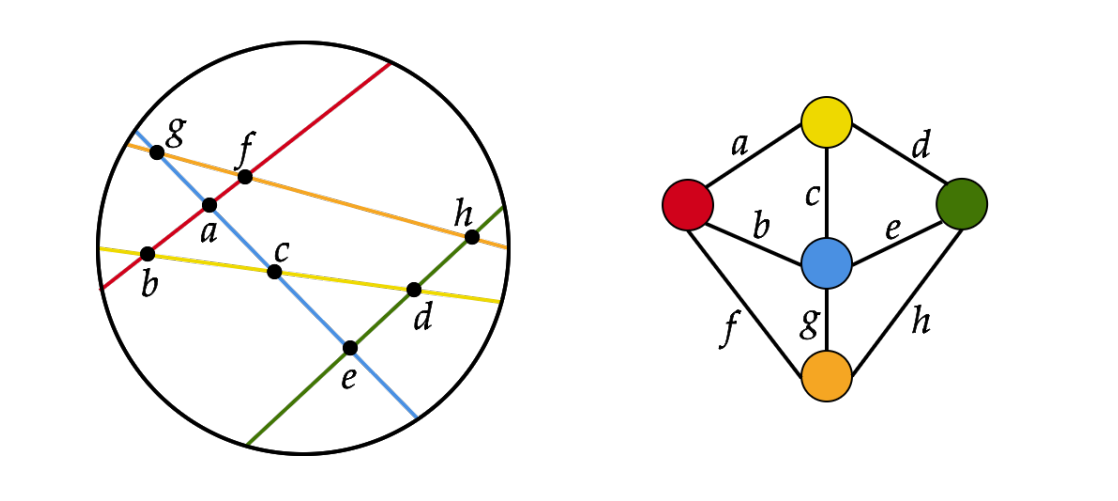
Scientists know that generating any circle graph state from a family of states is equivalent to using only local Clifford operations, local Pauli measurements, and classical communication. Researchers demonstrate that, despite their expressivity, circle graph states are not efficiently universal for measurement-based quantum computation, assuming a widely held belief in quantum computational complexity. This proof involves articulating a precise graph-theoretic correspondence between circle graph states and a specific subset of fermionic Gaussian states, accomplished by synthesising techniques applicable to both stabilizer states and fermionic systems.
Circle Graph States Lack Universal Computation
This work establishes a fundamental limitation for measurement-based quantum computation (MBQC), demonstrating that circle graph states, despite their expressive power, do not constitute an efficiently universal resource. Researchers proved this by articulating a precise graph-theoretic correspondence between circle graph states and a specific subset of fermionic Gaussian states, effectively linking these two distinct quantum formalisms. The team synthesized techniques for handling both stabilizer states and fermionic Gaussian states simultaneously, allowing for a rigorous analysis of their computational capabilities. The core finding reveals that circle graph states lack the necessary properties for universal computation, as they cannot efficiently support the complex operations required for solving a broad range of problems.
The research builds upon established connections between isotropic systems, graph states, and stabilizer codes, leveraging these relationships to establish the crucial link between circle graphs and fermionic Gaussian states. Furthermore, the study highlights the importance of considering the limitations of specific resource states in MBQC, demonstrating that expressive power alone does not guarantee universality. The team’s work extends previous research on classical simulation of MBQC, building upon results showing that resource states with restricted parameters, such as logarithmic tree width, are efficiently simulatable. This breakthrough contributes to a deeper understanding of the boundaries of quantum computation and informs the development of more powerful and versatile quantum algorithms and architectures.
Circle States Lack Universal Quantum Advantage
This research presents a significant advance in understanding the capabilities of different quantum states for measurement-based computation. Scientists investigated whether circle graph states, a class of complex quantum entanglement, can serve as a universal resource for performing any quantum computation. The team demonstrated that, despite their expressive power, circle graph states are not efficiently universal for this purpose, meaning that quantum computations using them would not offer a significant advantage over classical simulation. This conclusion was reached by establishing a precise connection between circle graph states and a specific type of fermionic Gaussian state, utilizing a combination of techniques from both stabilizer state and fermionic quantum information theory. By articulating this correspondence, the researchers were able to prove that computations based on circle graph states can be efficiently simulated classically, thus limiting their potential as a universal quantum resource. This research contributes valuable insights into the design of effective quantum computational resources and guides the search for states capable of achieving scalable quantum computation.
🗞 Fermionic Insights into Measurement-Based Quantum Computation: Circle Graph States Are Not Universal Resources
🧠 ArXiv: https://arxiv.org/abs/2510.05557