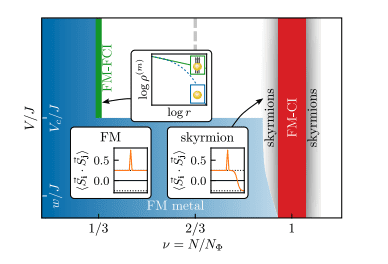
The search for novel quantum phases of matter drives exploration into systems where topology and strong interactions combine to produce exotic behaviours, such as fractional Chern insulators. Fabian J. Pauw, Ulrich Schollwöck, Nathan Goldman, and Sebastian Paeckel, along with Felix A. Palm, investigate this interplay using a sophisticated model of interacting electrons on a lattice. Their work demonstrates the emergence of a unique quantum state exhibiting characteristics of a fractional Chern insulator, alongside evidence of long-range order and, crucially, the formation of skyrmions, stable, swirling textures in the material’s spin. This achievement not only expands understanding of these complex quantum states, but also provides a theoretical framework directly applicable to experiments using ultracold atoms and electronic systems, potentially paving the way for new discoveries in quantum materials.
Hubbard Model Studies of Fractional Hall States
This research investigates exotic states of matter arising from the complex behavior of interacting electrons in a two-dimensional system subjected to a strong magnetic field. Scientists explore fractional quantum Hall (FQH) physics, where electrons form states with fractional charges and unusual properties, focusing on systems where electron-electron interactions are particularly strong. The team utilizes the Hubbard model, a fundamental framework in condensed matter physics, extending it with additional interactions to accurately represent these complex systems. Researchers measure incompressibility, a hallmark of FQH phases, and investigate the energy spectrum of low-lying excited states to understand the nature of the excitations.
They also analyze how the spins of electrons are correlated to understand the magnetic properties of the system, employing advanced numerical techniques like Density Matrix Renormalization Group and Exact Diagonalization to simulate the system’s behavior. The results demonstrate incompressibility at specific electron densities, indicating a robust ground state, and suggest the emergence of a state similar to the Laughlin state, characterized by an energy gap. At higher electron densities, the system tends towards a fully spin-polarized state, and the team observes the formation of skyrmion-like spin textures carried by particle excitations. In certain conditions, the system exhibits metallic behavior, revealing long-range ferromagnetic correlations. This research contributes to our understanding of exotic phases of matter and provides insights into the nature of FQH states, potentially informing the design of new materials with novel electronic properties.
Hofstadter-Hubbard Model and DMRG Simulations
Scientists are investigating exotic phases of matter arising from the interplay of topology and strong interactions, specifically focusing on fractional Chern insulators and their spin textures. To explore these states, they engineered a Hofstadter-Hubbard model, a complex system of interacting electrons arranged on a square lattice and subject to a magnetic field. The core of the research relies on large-scale Density Matrix Renormalization Group (DMRG) simulations, a powerful computational technique used to determine the ground state properties of strongly correlated quantum systems. Researchers fixed the magnetic field and the strength of interactions to values previously shown to stabilize specific behaviors, restricting simulations to sectors with specific spin orientations to gain deeper insights. To characterize the various phases, scientists developed a comprehensive toolbox of complementary observables, analyzing the energetic landscape and calculating the charge gap as a measure of incompressibility. They also examined the local and global properties of the system, focusing on identifying signatures of topological order and spin textures, and meticulously analyzed the single-particle spectrum, identifying edge states.
Spin-Polarized Fractional Chern Insulator Emerges
Using large-scale Density Matrix Renormalization Group (DMRG) simulations, scientists demonstrated the existence of a spin-polarized fractional Chern insulator (FCI) phase at a specific electron density, characterized by a quantized property and a finite energy gap. This phase emerges when interactions between neighboring electrons are sufficiently strong, confirming the presence of a lattice analog of the Laughlin state for electrons with spin. Further analysis revealed hidden long-range order within this phase, detected through theoretical techniques, and conclusive evidence of skyrmionic spin excitations, demonstrating that interactions stabilize these swirling patterns of spin. This stabilization overcomes previously observed asymmetry. The research establishes a comprehensive diagnostic toolbox, utilizing local densities, correlation functions, and spin-resolved observables, directly applicable to experiments employing quantum gas microscopy, allowing for unambiguous identification of competing emergent phases and providing a pathway for exploring FCIs with complex spin textures in both ultracold atom and solid-state systems.
Skyrmions Emerge in Fractional Chern Insulator
Through large-scale computational simulations, scientists have identified a spin-polarized fractional Chern insulator (FCI) phase characterized by a quantized property, an energy gap, and hidden long-range order, indicating strong topological properties. The findings reveal that even modest interactions between electrons are sufficient to stabilize this state, which closely resembles the Laughlin state. Furthermore, the team investigated the behavior of this state when a small number of electrons are added or removed, discovering the formation of skyrmions, stable, swirling patterns of spin, around specific interaction strengths. The diagnostic tools developed during this study, based on analyzing local densities and correlation functions, are directly applicable to experiments involving ultracold atoms and solid-state electronic devices. Future research will focus on exploring the behavior of this state in larger systems and investigating the impact of different interaction parameters, opening new avenues for understanding and potentially harnessing topologically ordered states of matter, with implications for advanced materials and quantum technologies.
👉 More information
🗞 From hidden order to skyrmions: Quantum Hall states in an extended Hofstadter-Fermi-Hubbard model
🧠 ArXiv: https://arxiv.org/abs/2509.12184