

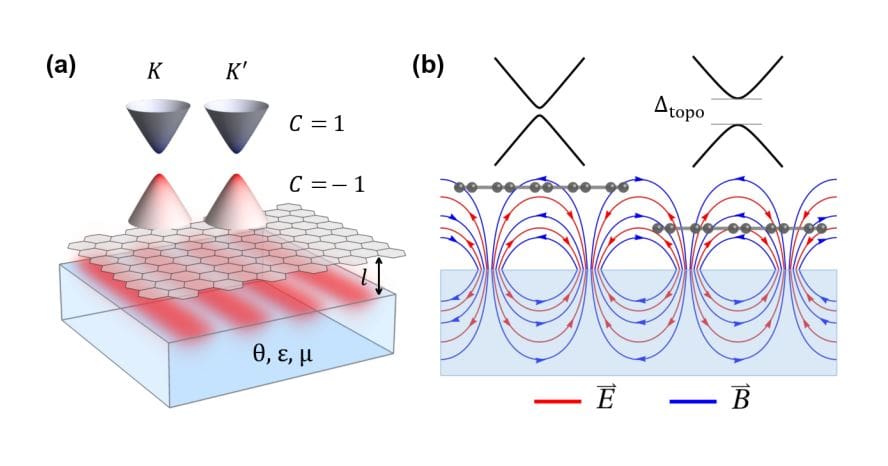
The pursuit of novel quantum states of matter receives a significant boost from new research demonstrating a pathway to engineer topological insulators using the subtle interplay of light and materials. Xinle Cheng, Emil Viñas Boström, and colleagues from the Max Planck Institute for the Structure and Dynamics of Matter, alongside collaborators at The University of Texas at Austin and RWTH Aachen University, reveal how quantum fluctuations within specially designed cavities can induce exotic behaviour in nearby materials. The team demonstrates that by employing cavities constructed from magneto-electric materials, they can break a fundamental symmetry in physics, known as time-reversal symmetry, and drive a monolayer into an anyonic Chern insulator. This achievement opens exciting possibilities for controlling and creating quantum states with anyonic quasi-particles, potentially paving the way for advancements in quantum computing and materials science.
Graphene Chern Insulator From Vacuum Fluctuations
Scientists have discovered a pathway to create an anyonic Chern insulator in graphene by harnessing the interaction between surface electromagnons and quantum vacuum fluctuations. This research demonstrates that these interactions induce a non-trivial topological band structure within the material, characterized by a specific quantum number known as the Chern number, resulting in protected edge states robust against imperfections and disorder. The magnitude of the insulating gap, and therefore the strength of this protection, depends strongly on the coupling between graphene and surface electromagnons, arising from the interplay of spin-orbit interaction and surface magnetism. This work establishes a novel method to engineer topological states in two-dimensional materials using collective spin excitations and vacuum fluctuations, potentially enabling spintronic devices and platforms for quantum information processing.
Surface Electromagnons in Magneto-Electric Cavities
Researchers engineered a novel sub-wavelength cavity system to investigate light-matter interactions and induce exotic quantum states in materials. This work overcomes limitations of previous studies by utilizing magneto-electric materials, which host surface electromagnons possessing both electric and magnetic field components, thereby breaking time-reversal symmetry. The team analytically derived classical solutions to Maxwell’s equations for these surface modes, establishing conditions for their dispersion and defining the relationship between momentum and frequency, revealing a constant frequency for large momentum values determined by the material’s permittivity, permeability, and magneto-electric coupling. They determined the field profiles of the surface electromagnons, demonstrating that the electric and magnetic fields are parallel within the magneto-electric material but anti-parallel in the vacuum, strongly confined near the interface.
Graphene Chern Insulator via Electromagnon Coupling
Scientists have achieved a breakthrough in manipulating quantum states by creating a cavity system utilizing magneto-electric materials, demonstrating a path to controllably break time-reversal symmetry and induce exotic quantum states through cavity vacuum fluctuations. This work centers on the development of sub-wavelength cavities that support surface electromagnons and their interaction with a graphene monolayer. Results demonstrate that this interaction effectively attaches a magnetic flux to external charges within the graphene, causing the quasi-particles to acquire anyon exchange statistics. Crucially, the quantum fluctuations of these surface modes transform the graphene into a Chern insulator, opening a topological gap of up to approximately 1 Kelvin.
Axionic Cavities Induce Topological Chern Insulator
This research demonstrates a new approach to manipulating quantum states of materials by utilizing specially designed cavities constructed from magneto-electric materials. Scientists have shown that these cavities, termed “axionic cavities”, can break time-reversal symmetry through the quantum fluctuations of surface electromagnons, inducing a Chern insulating state in a single layer of graphene, characterized by unique anyonic quasi-particles and a topological gap. Importantly, the topological gap observed in this system decays polynomially with distance from the substrate, suggesting a more robust and controllable pathway to engineer topological states. This work establishes a foundation for a new class of symmetry-breaking cavity systems and provides a realistic route to induce exotic phases of matter through interaction with a quantum electromagnetic environment.
👉 More information
🗞 Anyonic Chern insulator in graphene induced by surface electromagnon vacuum fluctuations
🧠 ArXiv: https://arxiv.org/abs/2511.10836

