The pursuit of understanding exotic states of matter, such as those found in the Fractional Quantum Hall Effect, typically requires extreme conditions, but new research demonstrates a pathway to explore these phenomena in a more accessible system. Viktor Bekassy, Mikael Fogelström, and Johannes Hofmann, from Chalmers University of Technology and Gothenburg University, reveal that weakly interacting Fermi gases offer a unique opportunity to probe Fractional Quantum Hall states without the need for rapid rotation. Their work establishes that these gases naturally support the key wave functions characteristic of these states, even at moderate rotation frequencies, opening up new avenues for experimental investigation using existing excitation and imaging techniques. This achievement represents a significant step towards understanding the fundamental properties of Fractional Quantum Hall states and exploring the transition to systems with larger numbers of particles.
At the lowest Landau level (LLL) with neutral atoms, creating the necessary conditions typically involves rotating the gas at the confining harmonic trap frequency, a requirement that proves difficult to achieve in practice. Researchers now demonstrate that, for weakly interacting Fermi gases, this rapid-rotation limit is not necessary to access the LLL. They find that many-body wave functions of states in the LLL remain unchanged at any rotation, with only their energies shifting, a direct consequence of first-order perturbation theory. The team focuses on systems with a small number of fermions, simplifying theoretical treatment while capturing essential physics. They explore how concepts like conformal and scale invariance apply to these systems, particularly in the lowest Landau level, using theoretical tools to understand the correlated states of electrons and the emergence of quasiparticles with fractional charge and statistics.
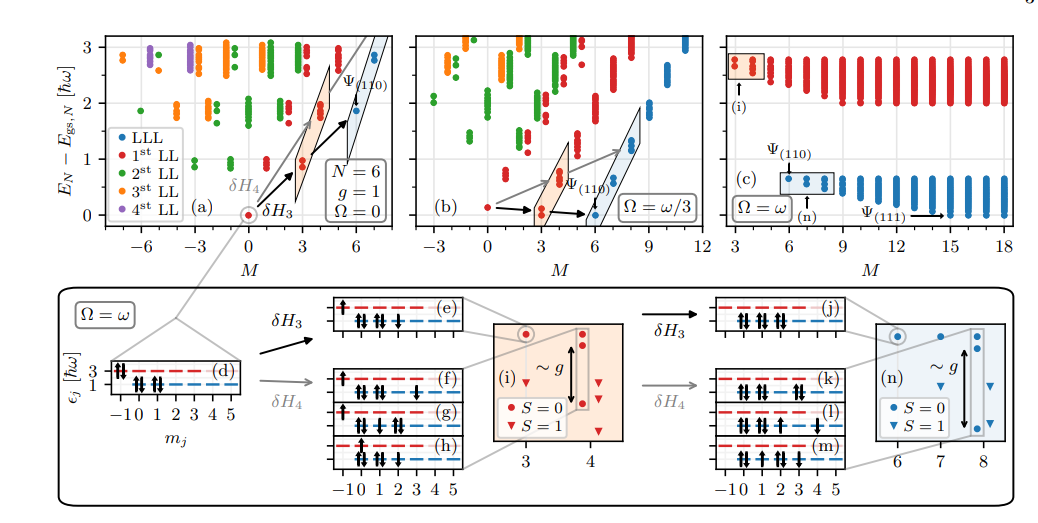
The work aims to provide a deeper understanding of the fundamental physics underlying the FQHE and related phenomena, also looking at collective excitations and other correlated states that can arise in these systems. Imagine electrons confined to a flat surface and subjected to a strong magnetic field. Under certain conditions, they form a bizarre state of matter where their behavior is governed by new rules. Instead of acting like individual particles, they cooperate to create new particles with fractional charge and strange properties. This research is trying to understand the underlying principles that govern this behavior, using mathematical tools to describe the interactions and correlations between the electrons. Key contributions include exploring conformal and scale invariance in these systems, developing theoretical models of correlated states, investigating collective excitations, and connecting the FQHE to other correlated states like Wigner crystals and quantum droplets. The research team investigated how manipulating rotation influences the energy levels of a Fermi gas, revealing that LLL states persist as excited states at finite angular momentum, regardless of rotation frequency. This breakthrough simplifies the experimental requirements for studying these exotic states, potentially opening new avenues for research. The study involved calculating the energy spectrum of a six-fermion gas under varying rotation frequencies, showing that as rotation increases, the single-particle energy spectrum tilts, shifting energies proportionally to angular momentum.
Importantly, the team discovered that LLL states consistently
Importantly, the team discovered that LLL states consistently form the manifold of lowest excitations, even when the gas is not rotating. This means that these states are not solely dependent on achieving a specific, high rotation speed, as previously believed. The team meticulously mapped the excitation spectrum, demonstrating how states transition with increasing rotation, and identified specific pathways for exciting particles into LLL states using carefully designed perturbations. The team’s calculations demonstrate that this approach extends to larger ensembles, offering a complementary method for realizing and studying these complex quantum states. This finding challenges previous assumptions that accessing these states required rapid rotation, and instead reveals they appear as excited states at any measurable rotation. Specifically, the team showed that for weakly interacting Fermi gases, the energy of these states shifts with rotation, but the fundamental wave functions remain unchanged, allowing for their observation under more readily achievable conditions. This work establishes that existing experimental techniques, such as those used to study few-fermion systems, are not limited to two-particle interactions, but can be extended to investigate more complex, many-particle systems exhibiting Landau level behaviour.
The researchers confirmed their theoretical predictions through detailed analysis of particle distributions, successfully matching analytical calculations with computer simulations. While acknowledging that factors like trap imperfections and anisotropy may limit the number of particles observable in experiments, they highlight the potential for exploring a wider range of excited states within the lowest Landau level, including exotic phenomena like magnetorotons and anyon excitations. Future research could focus on developing more sophisticated excitation protocols to access these states and further investigate the properties of these quantum systems, with the approach applicable to both spin-polarized and dipolar fermions.
👉 More information🗞Probing Fractional Quantum Hall states in
🗞 Probing Fractional Quantum Hall states in weakly interacting Fermi gases
🧠 ArXiv: https://arxiv.org/abs/2509.22606