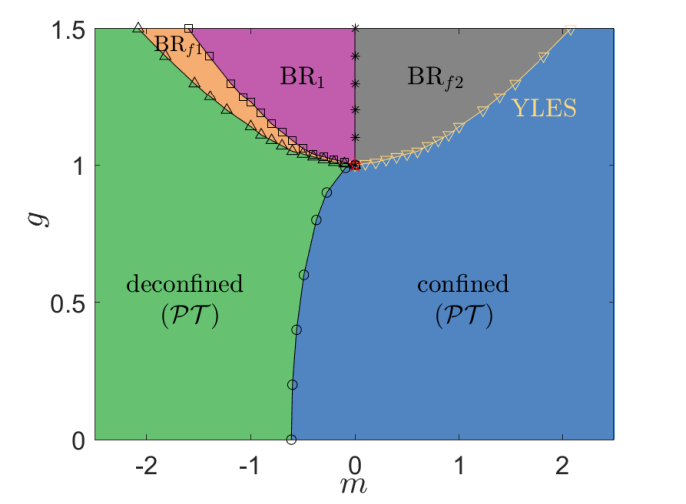
Criticality in complex systems attracts considerable attention, and recent research explores these phenomena within the unconventional realm of non-Hermitian physics. Wen-Yi Zhang, Meng-Yun Mao, and Qing-Min Hu, alongside colleagues Xinzhi Zhao, Gaoyong Sun, and Wen-Long You, present a complete theoretical understanding of criticality in a non-Hermitian model known as the detuned PXP model. Their work establishes a precise boundary separating different phases and demonstrates that this system falls into the well-known Ising universality class, confirming its fundamental nature. Crucially, the team identifies the location of a Yang-Lee edge singularity, a critical point where the system’s behaviour dramatically changes, and accurately determines its properties, offering a pathway to explore non-Hermitian critical phenomena and potentially observe these singularities in experiments using Rydberg atomic arrays.
Non-Hermitian Rydberg Systems and Quantum Criticality
This collection of research explores the intersection of non-Hermitian physics, quantum many-body systems, and Rydberg atom quantum simulation. Researchers focus on understanding quantum criticality and phase transitions, particularly the Yang-Lee edge singularity, and how these phenomena manifest in non-Hermitian systems. They employ techniques like Loschmidt echoes and fidelity measurements to probe critical points and characterize emergent behaviour. Rydberg atoms, with their strong interactions, serve as a promising platform for simulating complex quantum systems and testing theoretical predictions.
Investigations centre on implementing models like the Ising chain and Hubbard model to study emergent phenomena, including quantum scars, which exhibit unusual dynamics and potentially lead to new quantum phases. Researchers also investigate the dynamics of open quantum systems, crucial for understanding decoherence, dissipation, and building reliable quantum simulators. Connections emerge between the Yang-Lee singularity and methods like fidelity susceptibility and Loschmidt echoes, used to detect and characterize it. Rydberg atom systems are frequently used to study quantum many-body scars, providing the necessary conditions for their formation.
Non-Hermitian Hamiltonians can be implemented in quantum simulators, such as those based on Rydberg atoms, to explore their unique properties. Understanding open quantum system dynamics is crucial for building reliable quantum simulators, as Rydberg atom systems are susceptible to decoherence and dissipation. Prominent researchers in this field include W. -L. You, focusing on quantum scars and dynamics, G. Sun, specializing in quantum criticality and fidelity susceptibility, and Z. Song, working on quantum magnetism and non-Hermitian systems.
Criticality and Universality in the PXP Model
This research presents a detailed investigation of criticality within a non-Hermitian detuned PXP model, successfully establishing a complete critical diagram. Researchers identified a critical point numerically and then constructed an exact second-order boundary using a similarity transformation within the real-energy regime. To probe both equilibrium and nonequilibrium properties, they introduced biorthogonal entanglement entropy and the biorthogonal Loschmidt echo, demonstrating that the system falls into the Ising universality class. Analysis of the correlation function further distinguished between confined and deconfined phases, revealing how the system’s behaviour changes with varying parameters.
Scientists also examined the complex-energy regime, identifying both a full and a first-excited-state phase transition. The location of the Yang-Lee edge singularity was pinpointed using both the associated-biorthogonal and self-normal Loschmidt echoes, and the corresponding critical exponent was extracted, confirming its agreement with predictions from non-unitary conformal field theory. To facilitate future experimental exploration, the team proposed a scheme to observe the Yang-Lee edge singularity in Rydberg atomic arrays, offering a promising route to investigate non-Hermitian critical phenomena and singularities. A key methodological innovation involved the use of the correlation function, G(l, t), after a local spin excitation, to map the spatial and temporal evolution of the system.
Researchers observed that for positive parameter values, the correlation remained confined, while decreasing the parameter led to rapid expansion across the entire system, clearly delineating the transition between phases. To address limitations in characterizing transitions within the complex-energy regime, researchers developed the concept of associated states, enabling a more accurate description of the system’s dynamics. This involved defining a set of associated states based on the biorthogonal structure of the system, allowing for the construction of the associated-biorthogonal Loschmidt echo, a refined metric for identifying phase transitions. The logarithm of this echo was then presented to clearly highlight the location of the phase transition, providing a powerful visualization tool for understanding the system’s behaviour.
Ising Universality in Non-Hermitian Critical Systems
This work presents a comprehensive theoretical understanding of critical behaviour in a non-Hermitian system, establishing a complete critical diagram. Scientists identified an exact second-order boundary within the system using a novel similarity transformation, operating within a real-energy framework. By introducing biorthogonal entanglement entropy and the biorthogonal Loschmidt echo, the team demonstrated, from both equilibrium and non-equilibrium perspectives, that this system belongs to the Ising universality class. Analysis of the correlation function further distinguished between confined and deconfined phases within the symmetric region.
In the complex-energy regime, researchers pinpointed both a full and a first-excited-state phase transition, characterized by the emergence of complex energy levels. The location of the Yang-Lee edge singularity was identified using both associated-biorthogonal and self-normal Loschmidt echoes, yielding a critical exponent consistent with predictions from non-unitary conformal field theory. Measurements of the energy gap at the phase transition point revealed scaling behaviour, demonstrating a second-order phase transition with Ising universality. Further investigation into the system’s phases revealed that the correlation function remains localized in the confined phase but expands rapidly in the deconfined phase following a local spin excitation.
Analysis of the complex-energy spectrum showed that a full phase transition occurs at a specific parameter value, while a first-excited-state transition emerges at another, signaled by the appearance of imaginary components in the low-lying excited states. Researchers successfully characterized these transitions using the biorthogonal Loschmidt echo and associated states, providing insights into the system’s dynamical behaviour and confirming the presence of the Yang-Lee edge singularity. This work proposes an experimental scheme to observe the Yang-Lee edge singularity in Rydberg atomic arrays, offering a promising route to explore non-Hermitian critical phenomena and singularities.
Non-Hermitian PXP Model Reveals Ising Universality
This research establishes a comprehensive theoretical understanding of critical behaviour within a non-Hermitian detuned PXP model, successfully mapping its complete critical diagram. Researchers identified a critical point numerically and then constructed an exact second-order boundary using a similarity transformation within the real-energy regime. To probe both equilibrium and nonequilibrium properties, they introduced biorthogonal entanglement entropy and the biorthogonal Loschmidt echo, demonstrating that the system falls into the Ising universality class. Analysis of the correlation function further distinguished between confined and deconfined phases, revealing how the system’s behaviour changes with varying parameters.
Scientists also examined the complex-energy regime, identifying both a full and a first-excited-state phase transition. The location of the Yang-Lee edge singularity was pinpointed using both the associated-biorthogonal and self-normal Loschmidt echoes, and the corresponding critical exponent was extracted, confirming its agreement with predictions from non-unitary conformal field theory. To facilitate future experimental exploration, the team proposed a scheme to observe the Yang-Lee edge singularity in Rydberg atomic arrays, offering a promising route to investigate non-Hermitian critical phenomena and singularities. A key methodological innovation involved the use of the correlation function, G(l, t), after.
🗞 Yang-Lee edge singularity and quantum criticality in non-Hermitian PXP model
🧠 ArXiv: https://arxiv.org/abs/2510.13581