Reconstructing the properties of quantum states represents a significant challenge in quantum physics, particularly when dealing with complex forms of light. Mwezi Koni, Shawal Kasim, and Paola C. Obando, alongside colleagues at the University of the Witwatersrand, now present a new computing approach that tackles this problem by transforming it into a form solvable by existing quantum hardware. The team demonstrates this method successfully with entangled photons carrying orbital angular momentum, a type of structured light, and shows it maintains reliable performance even with imperfect devices. This achievement unlocks the potential for efficient state tomography, offering a pathway to overcome limitations faced by traditional methods when analysing high-dimensional quantum systems and paving the way for more detailed characterisation of complex quantum phenomena.
Variational Quantum Tomography of OAM States
This research explores quantum state tomography (QST), the process of reconstructing an unknown quantum state from a series of measurements. Traditional QST methods can be resource-intensive, especially for high-dimensional quantum systems. The authors investigate variational quantum algorithms (VQAs) as a potential solution to make QST more efficient, particularly when applied to high-dimensional quantum systems encoded in structured light, specifically orbital angular momentum (OAM) states. They aim to address the challenges of reconstructing these complex states with fewer measurements and reduced computational cost.
The research leverages light beams carrying orbital angular momentum (OAM) to encode quantum information, offering a high-dimensional space enabling the encoding of more information per photon. Quantum state tomography (QST) is the standard method for characterizing a quantum state, involving measurements and mathematical techniques to reconstruct the density matrix. Variational Quantum Algorithms (VQAs) are hybrid quantum-classical algorithms that use a parameterized quantum circuit (ansatz) and a classical optimization loop to minimize a cost function. VQAs are promising for near-term quantum devices.
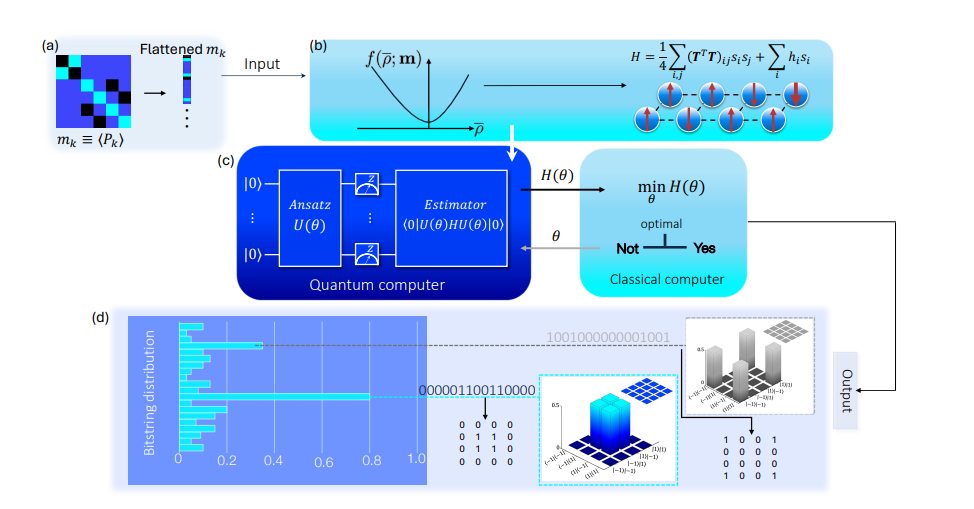
The authors cleverly map the QST problem onto an Ising model, allowing them to leverage existing optimization techniques and potentially improve efficiency. A crucial element is the cost function, which quantifies the difference between the reconstructed density matrix and the true state, driving the optimization process. The choice of the parameterized quantum circuit (ansatz) is critical, and the authors explore different designs to find one well-suited for the QST problem. The paper demonstrates the feasibility of using a VQA to perform QST on high-dimensional quantum states encoded in structured light, a significant step towards practical QST for complex quantum systems.
The authors’ mapping of the QST problem onto an Ising model is a novel approach, leveraging the power of Ising optimization techniques. The research explores different ansatz designs and identifies one that performs well for the QST problem. The VQA-based approach has the potential to reduce the number of measurements required for QST, a major advantage for experimental implementations. VQAs are generally more resilient to noise than traditional quantum algorithms, potentially making them more suitable for near-term quantum devices. The authors validate their approach using simulated data, demonstrating its ability to accurately reconstruct the unknown quantum state.
This work could lead to more accurate and efficient quantum measurements, with applications in sensing, imaging, and communication. Accurate state tomography is essential for verifying the fidelity of quantum communication protocols. The VQA-based approach is well-suited for implementation on near-term quantum devices, which are limited in size and coherence. Further research could focus on exploring more sophisticated ansatz designs to improve the accuracy and efficiency of the QST process. Experimental validation using real quantum systems is a crucial next step.
Developing strategies to mitigate the effects of noise on the VQA-based QST process is essential for practical implementations. The approach could be extended to other types of quantum systems, such as qubits and qudits. In conclusion, this is a high-quality research paper that makes a significant contribution to the field of quantum state tomography, with the potential to enable more efficient and accurate quantum measurements across a wide range of areas.
Reconstructing Quantum States with Variational Methods
Scientists have developed a novel variational quantum computing methodology for reconstructing quantum states from measurement data, achieving reliable performance even with noisy hardware. The work introduces a method for reconstructing an unknown quantum state from complete experimental measurements, focusing on two entangled photons each occupying a two-dimensional state. Researchers derived an algebraic mapping to an Ising Hamiltonian, then implemented a variational quantum eigensolver-based reconstruction scheme to determine the underlying quantum state. Experiments validated the approach by reconstructing structured photons carrying orbital angular momentum, generated via spontaneous parametric down-conversion.
The collected data consisted of classical joint measurement outcomes, representing photon coincidence counts, serving as input for the reconstruction procedure. This process was performed on a superconducting qubit-based quantum computer, demonstrating the feasibility of state reconstruction using near-term quantum technology. The team successfully reconstructed the two-photon state, utilizing an overcomplete set of measurements obtained from the eigenvalues of Pauli operators. By implementing an optimisation routine on the quantum computer, scientists were able to determine the underlying density matrix representing the quantum state. This breakthrough delivers a pathway for efficient quantum state tomography, particularly for high-dimensional structured light where classical approaches often encounter limitations, offering a promising solution for characterising quantum systems and ensuring their reliability and performance in emerging quantum technologies.
Ising Optimisation Reconstructs Quantum States Efficiently
This research demonstrates a new approach to quantum state tomography, reconstructing the properties of quantum states from measurement data by reformulating the problem as an Ising optimisation task. By mapping the reconstruction cost function onto an Ising model, the team successfully solved the problem using existing computational hardware, achieving reliable performance even with noisy data. This method was validated through experiments using entangled photons carrying orbital angular momentum, a form of structured light increasingly important in quantum technologies. The achievement establishes a foundation for efficient state reconstruction, particularly crucial for high-dimensional quantum systems that utilise structured light.
While the current implementation is limited to small, real-valued reconstructions, the researchers highlight the potential for scalability through advancements in encoding techniques, ansatz design, and error mitigation strategies. The team acknowledges that future work will focus on expanding the method’s capabilities to handle larger and more complex quantum states. This work addresses a pressing challenge in the field, providing a pathway towards efficient characterisation and verification of high-dimensional quantum systems, and paving the way for advancements in quantum cryptography and imaging.
🗞 Towards reconstructing quantum structured light on a quantum computer
🧠 ArXiv: https://arxiv.org/abs/2509.21804