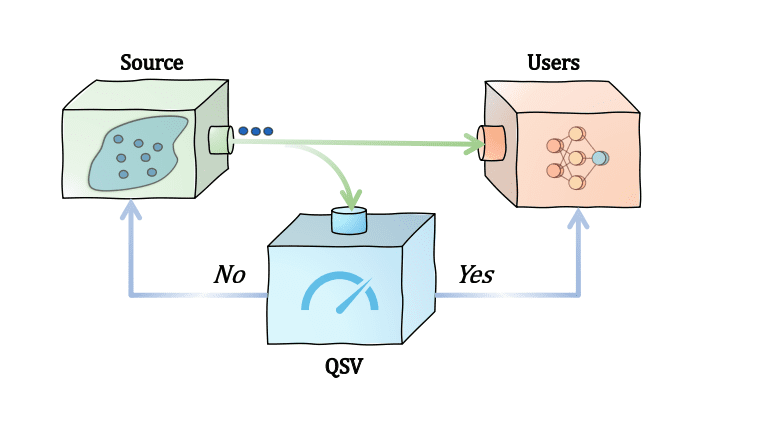
Entanglement represents a fundamental resource for advancing quantum technologies, yet reliably creating and confirming complex entangled states remains a significant challenge. Jian Li, Ye-Chao Liu, and Xiao-Xiao Chen, working alongside colleagues at the Beijing Institute of Technology, now demonstrate a new method for both preparing and verifying a particularly challenging type of entangled state known as a nonstabilizer state. Their approach integrates quantum state verification directly into the state preparation process, allowing for real-time validation and optimisation of the generated quantum states. The team achieves this with a remarkably efficient protocol, requiring fewer measurement samples than traditional methods and confirming a high fidelity of over 99% using a streamlined measurement scheme, establishing a powerful alternative to full state characterisation for practical quantum engineering.
Generating and Studying Genuine Multipartite Entanglement
Introduction. Entanglement is a fundamental feature of quantum physics and underpins various applications in quantum information science. While preparing bipartite entangled states is now a mature technique, realizing multipartite entanglement remains challenging. Among these states, GHZ and Dicke states are widely studied for their genuine multipartite entanglement, while W states offer robustness against particle loss, making them attractive for practical applications. Characterizing entangled states traditionally relies on quantum state tomography, but this method is time-consuming and computationally intensive, prompting research into more efficient, non-tomographic methods.
Quantum State Verification of Entangled States
Methods. Quantum state verification has emerged as a powerful tool for high-precision verification, ensuring a prepared state closely matches the target state using local operations and classical communication. This method involves preparing candidate states and verifying them using a quantum state verification protocol based on local measurements, determining whether the prepared state meets the required criteria for fidelity and entanglement.
Real-time Feedback Improves Entanglement Fidelity and Certification
Results demonstrate that quantum state verification can actively assist in both the preparation and verification of entangled states. An adaptive protocol was experimentally applied to guide the fine-tuning of an entanglement source, forming a closed feedback loop that enables real-time, high-precision generation of a multipartite W state without the need for full tomography. Using only 104 tests, a fidelity of 97.07(±0.26)% was certified, independently confirmed by quantum state tomography to be 98.58(±0.12)%. These results constitute the first experimental realization of quantum state verification for nonstabilizer W states, establishing it as a viable alternative to full tomography for resource-efficient quantum state engineering.
Theoretical framework considers a quantum device intended to produce a specific target state, but in practice outputs a sequence of independent states. Quantum state verification verifies that a quantum state meets certain criteria without fully reconstructing the density matrix. Experimentally, the focus was on a three-qubit W3 state, adopting a modified protocol that improves verification efficiency. The experimental setup involved a two-photon entanglement source and measurement apparatus, allowing for the preparation and verification of both two-qubit states and the three-qubit W3 state.
Fast Quantum State Verification and Preparation
This research demonstrates that quantum state verification is a faster, more resource-efficient alternative to full quantum state tomography for both verifying and preparing entangled quantum states. The authors demonstrate that quantum state verification achieves comparable fidelity to quantum state tomography, particularly in terms of the prepared states, while requiring significantly fewer measurements. They tested this with two-qubit and three-qubit (W3) states. Overall Theme: The research details methods and results of experiments related to quantum state verification and preparation. Key Concepts & Methods: Quantum state tomography is the standard, but resource-intensive, method for characterizing a quantum state.
Quantum state verification focuses on verifying that a quantum state meets certain criteria without fully reconstructing the density matrix, making it faster and requiring fewer measurements. Fidelity is a key metric for evaluating both quantum state tomography and quantum state verification. Entangled states, including two-qubit and three-qubit (W3) states, are central to the research. Experimental Setup & Procedure: The authors prepare entangled states and use either quantum state tomography or quantum state verification as a feedback mechanism to optimize their preparation. They then use both methods to verify the quality of the prepared states and perform simulations to model statistical uncertainty.
Key Results & Findings: Quantum state verification is a viable alternative to quantum state tomography, achieving comparable fidelity with fewer resources. It is scalable, as demonstrated by its successful extension to the three-qubit W3 state. Results obtained using both methods are consistent, indicating that quantum state verification provides a reliable assessment of state quality.
👉 More information
🗞 Real-time preparation and verification of nonstabilizer states
🧠 DOI: https://doi.org/10.48550/arXiv.2507.11180