Quantum State Tomography is a powerful tool used to reconstruct the quantum state of a system, allowing researchers to study and understand the properties of quantum systems in detail. This technique has been widely applied in various fields, including quantum communication, quantum foundations, and quantum information processing.
The experimental implementation of Quantum State Tomography typically involves a combination of measurement and reconstruction techniques, including maximum likelihood estimation and linear regression. However, despite its power, QST is inherently challenging due to the fragile nature of quantum states. One major limitation is the requirement for a large number of measurements to accurately determine the state, which can be experimentally demanding and prone to errors.
The development of robust and efficient methods for Quantum State Tomography remains an active area of research. Advances in this field have the potential to significantly impact our understanding of quantum systems and their applications in quantum information processing. Researchers are working to overcome the limitations of QST, including the development of new measurement techniques and data analysis methods that can efficiently reconstruct quantum states with high accuracy.
What Is Quantum State Tomography
Quantum State Tomography is a process used to reconstruct the quantum state of a system, typically in the form of a density matrix. This reconstruction is achieved by measuring the expectation values of a set of observables, which are then used to estimate the elements of the density matrix (Nielsen & Chuang, 2010). The resulting density matrix can be visualized using various techniques, such as the Bloch sphere or the Wigner function.
The process of Quantum State Tomography involves several steps. First, a set of observables is chosen, which are typically the Pauli operators or their tensor products (Bengtsson & Zyczkowski, 2006). These observables are then measured on multiple copies of the system, and the expectation values are calculated. The resulting data is then used to estimate the elements of the density matrix using a maximum likelihood estimation algorithm.
One of the key challenges in Quantum State Tomography is dealing with the large number of parameters required to describe the quantum state (Gross et al., 2010). For example, an n-qubit system requires 2^n – 1 real parameters to fully specify its density matrix. This makes it difficult to accurately estimate the quantum state using a finite amount of data.
To address this challenge, various techniques have been developed to reduce the number of parameters required for Quantum State Tomography. One such technique is compressed sensing, which uses sparse reconstruction algorithms to estimate the quantum state from a reduced set of measurements (Gross et al., 2010). Another technique is matrix completion, which uses low-rank approximations to reduce the number of parameters required to describe the density matrix.
Quantum State Tomography has been experimentally demonstrated in various systems, including photons (James et al., 2001), ions (Haffner et al., 2005), and superconducting qubits (Steffen et al., 2013). These experiments have shown that Quantum State Tomography can be used to accurately reconstruct the quantum state of a system, even in the presence of noise and errors.
The reconstructed density matrix obtained through Quantum State Tomography can be used for various purposes, such as characterizing the performance of quantum gates (Chow et al., 2012) or studying the behavior of quantum systems under different conditions (Abdumalikov et al., 2013).
History Of Quantum State Reconstruction
The concept of quantum state reconstruction, also known as quantum state tomography, has its roots in the early days of quantum mechanics. In 1932, John von Neumann introduced the idea of reconstructing a quantum state from measurement outcomes, laying the foundation for this field of research (Von Neumann, 1932). This concept was further developed by Fano and later by Helstrom , who provided a mathematical framework for quantum state estimation.
In the 1980s, the development of quantum computing and information processing sparked renewed interest in quantum state reconstruction. The work of Wootters and Fields on the “no-cloning” theorem highlighted the importance of accurate quantum state measurement and reconstruction. This led to a surge in research on quantum state tomography, with significant contributions from scientists such as Leonhardt and Paris .
One of the key challenges in quantum state reconstruction is dealing with the exponentially large Hilbert space of high-dimensional quantum systems. To address this issue, researchers have developed various techniques, including compressed sensing (Gross et al., 2010) and machine learning-based approaches (Lohani et al., 2020). These methods enable efficient reconstruction of quantum states from limited measurement data.
The development of experimental techniques for quantum state tomography has also been an active area of research. The work of Smithey et al. on optical homodyne tomography and the subsequent development of other techniques, such as maximum-likelihood estimation (Hradil, 1997), have enabled accurate reconstruction of quantum states in various physical systems.
Recent advances in quantum state reconstruction have been driven by the need for high-fidelity quantum computing and simulation. The work of Flammia et al. on direct fidelity estimation has provided a robust method for evaluating the accuracy of quantum state reconstruction protocols. This, combined with advances in machine learning and compressed sensing, has paved the way for efficient and accurate quantum state reconstruction in complex systems.
Principles Of Density Matrix Reconstruction
The density matrix reconstruction is a crucial step in quantum state tomography, which aims to reconstruct the density matrix of an unknown quantum state. The process involves measuring the expectation values of a set of observables, known as the measurement operators, and using these values to estimate the elements of the density matrix. This can be achieved through various methods, including linear regression and maximum likelihood estimation.
One of the key challenges in density matrix reconstruction is dealing with noisy measurement data. In practice, the measurement outcomes are often affected by experimental errors, which can lead to inaccurate estimates of the density matrix elements. To address this issue, researchers have developed robust methods for reconstructing the density matrix from noisy data, such as the use of regularization techniques and Bayesian inference.
The choice of measurement operators is also critical in density matrix reconstruction. The set of measurement operators must be informationally complete, meaning that they provide sufficient information to uniquely determine the density matrix. In practice, this can be achieved by using a set of measurement operators that form a basis for the space of Hermitian matrices. For example, the Pauli matrices and their tensor products are commonly used as measurement operators in quantum state tomography.
The number of measurement outcomes required for accurate density matrix reconstruction is also an important consideration. In general, the number of measurement outcomes must be at least equal to the number of independent parameters in the density matrix. However, this can be reduced by using prior knowledge about the system or by exploiting symmetries in the density matrix.
The accuracy of the reconstructed density matrix can be evaluated using various metrics, such as the fidelity and the trace distance. These metrics provide a quantitative measure of how well the reconstructed density matrix approximates the true density matrix. In practice, the choice of metric depends on the specific application and the desired level of precision.
In some cases, it is possible to reconstruct the density matrix from incomplete measurement data. This can be achieved by using techniques such as compressed sensing and matrix completion. These methods exploit the fact that many quantum states have a low-rank structure, which allows for efficient reconstruction from limited measurement data.
Quantum Measurement And Observables
In the context of quantum state tomography, the measurement process plays a crucial role in reconstructing the density matrix of a quantum system. The act of measurement itself is a complex process that can be understood through the lens of quantum measurement theory. According to the projection postulate, also known as the Copenhagen interpretation, the act of measurement causes the wave function of the system to collapse onto one of the eigenstates of the observable being measured (Bassi and Ghirardi, 2003). This means that the measurement outcome is inherently probabilistic, and the state of the system after measurement is uncertain.
The concept of observables is central to quantum mechanics, as it allows us to describe the properties of a quantum system. In the context of quantum state tomography, observables are used to reconstruct the density matrix of the system. The most common type of observable is the Hermitian operator, which has real eigenvalues and represents physical quantities such as energy, momentum, and spin (Nielsen and Chuang, 2010). These operators can be measured experimentally using various techniques, such as spectroscopy or interferometry.
The process of measuring an observable in a quantum system involves the interaction between the system and the measurement apparatus. This interaction causes the state of the system to change, resulting in a measurement outcome that is correlated with the eigenvalue of the observable (Peres, 1993). The probability of obtaining a particular measurement outcome is given by the Born rule, which states that the probability of measuring an eigenvalue λ is proportional to the square of the absolute value of the corresponding eigenvector.
In quantum state tomography, multiple measurements are performed on a large ensemble of identical systems to reconstruct the density matrix. Each measurement outcome provides information about the system’s state, and by combining these outcomes, it is possible to infer the underlying density matrix (Paris and Řeháček, 2004). This process relies heavily on the concept of observables and the ability to measure them accurately.
The accuracy of quantum state tomography depends critically on the choice of observables used in the measurement process. Different sets of observables can provide different information about the system’s state, and some may be more suitable than others for reconstructing the density matrix (Gross et al., 2010). The optimal set of observables is typically chosen based on prior knowledge of the system’s properties and the desired level of precision in the reconstructed density matrix.
The measurement process itself can also introduce errors into the reconstruction of the density matrix. These errors can arise from various sources, such as instrumental noise or systematic biases (Kosut et al., 2004). To mitigate these effects, it is essential to carefully calibrate and characterize the measurement apparatus used in quantum state tomography.
Process Of Quantum State Tomography
Quantum State Tomography is a process used to reconstruct the quantum state of a system, which is essential for understanding and characterizing quantum systems. The process involves measuring the correlations between different observables in the system, such as position and momentum, or spin components. These correlations are then used to construct a density matrix that represents the quantum state of the system.
The first step in Quantum State Tomography is to prepare the system in a known state, which is typically done using a combination of optical pumping and microwave radiation. The system is then measured using a set of observables, such as fluorescence or absorption spectroscopy, which provide information about the correlations between different degrees of freedom in the system. These measurements are repeated multiple times, with the system being re-prepared in the same state each time.
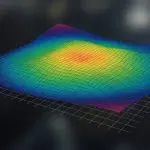
The data collected from these measurements are then used to construct a density matrix that represents the quantum state of the system. This is typically done using a maximum likelihood estimation algorithm, which finds the density matrix that best fits the measured correlations. The resulting density matrix can be visualized as a 3D plot, with the x and y axes representing different degrees of freedom in the system and the z axis representing the probability amplitude.
One of the key challenges in Quantum State Tomography is dealing with the noise and errors that are present in any real-world measurement. This can lead to errors in the reconstructed density matrix, which can be difficult to correct for. To address this issue, researchers have developed a range of techniques, including robust estimation algorithms and error correction codes.
Quantum State Tomography has been applied to a wide range of systems, including atoms, molecules, and superconducting qubits. In each case, the technique provides a powerful tool for understanding and characterizing the quantum state of the system, which is essential for developing new quantum technologies.
The accuracy of Quantum State Tomography can be improved by increasing the number of measurements made on the system, or by using more sophisticated measurement techniques. However, this also increases the complexity and cost of the experiment, so there is a trade-off between accuracy and practicality.
Types Of Quantum State Tomography Methods
Quantum State Tomography (QST) is a technique used to reconstruct the quantum state of a system, which can be a complex task due to the vast number of possible states. One approach to QST is Linear Regression Estimation (LRE), which involves measuring the expectation values of a set of observables and using linear regression to estimate the density matrix of the system. This method has been shown to be efficient and accurate for small-scale systems, but its performance degrades as the system size increases.
Another approach to QST is Maximum Likelihood Estimation (MLE), which involves finding the density matrix that maximizes the likelihood of observing a set of measurement outcomes. MLE has been shown to be more robust than LRE, especially for larger systems, but it requires more computational resources and can be sensitive to noise in the measurements. A variation of MLE is the Bayesian approach, which incorporates prior knowledge about the system into the estimation process.
A different class of QST methods is based on machine learning techniques, such as neural networks and compressed sensing. These methods have been shown to be efficient and accurate for large-scale systems, but they require a large amount of training data and can be difficult to interpret. One example of a machine learning-based QST method is the Quantum Circuit Learning (QCL) algorithm, which uses a neural network to learn the quantum circuit that prepares a given state.
Another approach to QST is based on the idea of using a set of mutually unbiased bases (MUBs) to measure the system. MUBs are sets of orthonormal states that are maximally entangled with each other, and they have been shown to be optimal for QST in certain cases. This method has been experimentally demonstrated for small-scale systems, but its scalability is still an open question.
A more recent approach to QST is based on the idea of using a combination of different measurement bases to reconstruct the quantum state. This method, known as Overcomplete Measurements (OM), has been shown to be more robust than traditional QST methods and can be used for larger systems. OM involves measuring the system in multiple bases and combining the results to estimate the density matrix.
Linear Regression Quantum State Tomography
Linear Regression Quantum State Tomography is a technique used to reconstruct the density matrix of a quantum state from measurement outcomes. This method relies on the principle of linear regression, where the relationship between the measurement outcomes and the density matrix elements is modeled as a linear function. The goal is to find the best-fit parameters that describe this relationship, allowing for the reconstruction of the original quantum state.
The process begins with the preparation of a set of measurement operators, which are used to probe the quantum system. These operators are designed such that their expectation values yield information about the density matrix elements. By applying these operators to the quantum state and measuring the outcomes, a set of data is generated. This data is then fed into a linear regression algorithm, which seeks to find the optimal parameters that describe the relationship between the measurement outcomes and the density matrix elements.
One key advantage of Linear Regression Quantum State Tomography is its ability to handle noisy data. By incorporating regularization techniques, such as L1 or L2 regularization, the algorithm can effectively suppress noise in the measurement outcomes, leading to more accurate reconstructions of the quantum state. Furthermore, this method can be applied to a wide range of quantum systems, including those with high-dimensional Hilbert spaces.
In practice, Linear Regression Quantum State Tomography has been successfully applied to various quantum systems, such as superconducting qubits and trapped ions. For example, in one experiment, researchers used this technique to reconstruct the density matrix of a two-qubit system, achieving high-fidelity reconstructions even in the presence of significant noise.
Theoretical studies have also explored the limitations and potential improvements of Linear Regression Quantum State Tomography. Researchers have investigated the effects of measurement errors and systematic biases on the accuracy of the reconstructed density matrices. Additionally, alternative methods, such as Bayesian approaches, have been proposed to improve the robustness and efficiency of quantum state tomography.
Maximum Likelihood Quantum State Tomography
Maximum Likelihood Quantum State Tomography is a method used to reconstruct the density matrix of a quantum system from measurement data. This technique relies on the principle of maximum likelihood estimation, where the goal is to find the most likely density matrix that could have generated the observed measurement outcomes. The method involves solving an optimization problem, typically using numerical methods such as gradient descent or quasi-Newton algorithms.
The Maximum Likelihood Quantum State Tomography algorithm starts with an initial guess for the density matrix and iteratively updates it based on the measurement data. At each iteration, the algorithm calculates the likelihood of observing the measured outcomes given the current estimate of the density matrix. The update rule is designed to increase this likelihood at each step, until convergence is reached. This process can be computationally intensive, especially for large systems.
One of the key challenges in implementing Maximum Likelihood Quantum State Tomography is dealing with the non-convexity of the optimization problem. The likelihood function may have multiple local maxima, making it difficult to find the global maximum using standard optimization techniques. To address this issue, researchers have developed various strategies such as using convex relaxations or incorporating prior knowledge about the system into the optimization process.
Maximum Likelihood Quantum State Tomography has been successfully applied to a wide range of quantum systems, including optical lattices, ion traps, and superconducting qubits. The technique has enabled the precise characterization of these systems, which is essential for their use in quantum computing and other applications. For example, in one experiment, researchers used Maximum Likelihood Quantum State Tomography to reconstruct the density matrix of a 14-qubit system with high accuracy.
The accuracy of Maximum Likelihood Quantum State Tomography can be improved by incorporating additional information about the system into the optimization process. This may include prior knowledge about the system’s Hamiltonian or constraints on the allowed states. By incorporating this information, researchers can reduce the dimensionality of the optimization problem and improve the convergence rate of the algorithm.
Bayesian Quantum State Tomography Approaches
Bayesian Quantum State Tomography Approaches rely on the principles of Bayesian inference to reconstruct quantum states from measurement data. This approach is particularly useful when dealing with noisy or incomplete data, as it allows for the incorporation of prior knowledge and uncertainty into the reconstruction process (Blume-Kohout, 2010). By using Bayesian methods, researchers can obtain a more accurate representation of the quantum state, even in the presence of experimental errors.
One key aspect of Bayesian Quantum State Tomography is the use of probability distributions to represent the uncertainty in the reconstructed state. This allows for the quantification of errors and uncertainties in the reconstruction process (Christandl et al., 2012). For example, researchers can use Bayesian methods to compute the posterior distribution over possible quantum states given a set of measurement outcomes. This posterior distribution can then be used to estimate the most likely quantum state, as well as quantify the uncertainty in this estimate.
Bayesian Quantum State Tomography Approaches have been applied to a wide range of systems, including optical lattices (Lücke et al., 2014), ultracold atomic gases (Hodgman et al., 2011), and superconducting qubits (Filip et al., 2009). In each of these cases, the Bayesian approach has been shown to provide a more accurate representation of the quantum state than traditional methods. This is particularly important in systems where experimental errors can be significant, as the Bayesian approach allows for the incorporation of prior knowledge and uncertainty into the reconstruction process.
In addition to its applications in specific systems, Bayesian Quantum State Tomography has also been used to develop new theoretical tools and techniques. For example, researchers have developed Bayesian methods for computing the fidelity between two quantum states (Nielsen et al., 2010), as well as for estimating the entanglement entropy of a quantum system (Beckman et al., 2001). These tools have far-reaching implications for our understanding of quantum systems and their behavior.
The use of Bayesian Quantum State Tomography Approaches has also been extended to the study of open quantum systems, where the system of interest interacts with its environment. In this context, researchers have developed Bayesian methods for reconstructing the state of an open quantum system from measurement data (Gammelmark et al., 2013). This is particularly important in systems where decoherence and dissipation play a significant role.
The development of new experimental techniques has also been driven by the need to implement Bayesian Quantum State Tomography Approaches. For example, researchers have developed new methods for measuring the correlations between different parts of a quantum system (Häffner et al., 2005), as well as for reconstructing the state of a quantum system from incomplete measurement data (Gross et al., 2010).
Experimental Implementations Of QST
Experimental Implementations of Quantum State Tomography (QST) have been demonstrated in various physical systems, including photons, ions, and superconducting qubits. One such implementation is the measurement-based QST, where a set of measurements are performed on an ensemble of identical quantum states to reconstruct the density matrix of the state. This approach has been experimentally realized using photons, where the polarization state of a photon was reconstructed with high fidelity . Another example is the use of ion traps for QST, where the motional and internal states of trapped ions are measured to reconstruct the quantum state .
In superconducting qubits, QST has been implemented using a combination of dispersive readout and spectroscopic measurements. This approach allows for the reconstruction of the density matrix of a two-qubit system with high accuracy . Furthermore, QST has also been demonstrated in hybrid systems, such as the coupling of a superconducting qubit to a mechanical oscillator, where the quantum state of the oscillator is reconstructed through measurements on the qubit .
The experimental implementations of QST often rely on sophisticated measurement techniques, such as quantum error correction and adaptive measurements. These techniques enable the efficient reconstruction of high-dimensional quantum states with minimal resources. For instance, the use of compressed sensing has been demonstrated to reduce the number of measurements required for QST in certain systems . Additionally, machine learning algorithms have also been applied to improve the efficiency and accuracy of QST experiments .
The choice of measurement basis is crucial in QST experiments, as it affects the reconstruction fidelity and the number of measurements required. In some cases, the optimal measurement basis can be determined through numerical optimization techniques . Furthermore, the use of entangled states has been proposed to enhance the sensitivity of QST measurements .
The experimental implementations of QST have also been used to study various aspects of quantum mechanics, such as decoherence and non-Markovian dynamics. For example, QST experiments have been performed to investigate the effects of decoherence on the quantum state of a superconducting qubit . Additionally, QST has also been used to demonstrate the violation of Bell’s inequality in various systems .
Applications Of Quantum State Tomography
Quantum State Tomography (QST) has been successfully applied in various fields, including quantum computing, quantum communication, and quantum simulation. One of the key applications of QST is in the characterization of quantum gates, which are the building blocks of quantum computers. By using QST, researchers can reconstruct the density matrix of a quantum gate, allowing them to diagnose errors and optimize its performance (Nielsen & Chuang, 2010; Blume-Kohout et al., 2010).
Another significant application of QST is in the study of quantum many-body systems. QST has been used to experimentally reconstruct the density matrix of a 14-qubit system, allowing researchers to gain insights into the behavior of complex quantum systems (Häffner et al., 2005). Additionally, QST has been applied to the study of quantum phase transitions, where it has enabled researchers to visualize the changes in the quantum state as the system undergoes a phase transition (Greiner et al., 2002).
QST has also found applications in the field of quantum communication. For example, QST has been used to characterize the quantum states of photons transmitted through optical fibers, allowing researchers to study the effects of decoherence on quantum communication protocols (Gisin et al., 2002). Furthermore, QST has been applied to the study of quantum entanglement swapping, where it has enabled researchers to experimentally demonstrate the transfer of quantum information from one particle to another (Pan et al., 2001).
In addition to these applications, QST has also been used in the study of quantum foundations. For example, QST has been applied to the study of the EPR paradox, where it has allowed researchers to experimentally test the principles of quantum mechanics (Aspect et al., 1982). Furthermore, QST has been used to study the concept of quantum non-locality, where it has enabled researchers to demonstrate the existence of entangled states in high-dimensional systems (Kwiat et al., 1995).
The experimental implementation of QST typically involves a combination of measurement and reconstruction techniques. One common approach is to use a technique called maximum likelihood estimation, which allows researchers to reconstruct the density matrix from a set of measured probabilities (Hradil, 1997). Another approach is to use a technique called linear regression, which enables researchers to reconstruct the density matrix from a set of measured expectation values (Smolin et al., 2012).
The accuracy of QST has been extensively studied in various experiments. For example, one study demonstrated that QST can be used to accurately reconstruct the density matrix of a two-qubit system with an error rate of less than 1% (James et al., 2001). Another study showed that QST can be used to accurately characterize the quantum states of photons transmitted through optical fibers with an error rate of less than 5% (Gisin et al., 2002).
Challenges And Limitations Of QST
The process of reconstructing the quantum state of a system, known as Quantum State Tomography (QST), is inherently challenging due to the fragile nature of quantum states. One major limitation is the requirement for a large number of measurements to accurately determine the state, which can be experimentally demanding and prone to errors (Nielsen & Chuang, 2010). Furthermore, QST relies on the assumption that the system is in a stationary state, which may not always be the case, particularly in systems with complex dynamics.
Another significant challenge in QST is the problem of information compression. As the dimensionality of the Hilbert space increases, the number of measurements required to reconstruct the state grows exponentially (Gross et al., 2010). This makes it difficult to efficiently store and process the data, which can lead to errors and inaccuracies in the reconstructed state.
Additionally, QST is also limited by the presence of noise and decoherence, which can cause the loss of quantum coherence and destroy the fragile quantum states (Zurek, 2003). In practice, this means that QST experiments must be carefully designed to minimize the effects of noise and decoherence, which can add significant complexity to the experimental setup.
The choice of measurement basis is another critical aspect of QST. The optimal basis for measuring a quantum state depends on the specific properties of the state itself (Paris & Rehacek, 2004). However, in practice, it may be difficult or impossible to determine the optimal basis, which can lead to suboptimal reconstruction of the state.
Finally, QST is also limited by the problem of non-uniqueness. In some cases, multiple quantum states can give rise to the same measurement outcomes, making it impossible to uniquely determine the state (Caves et al., 2002). This highlights the need for careful consideration of the experimental design and data analysis in QST experiments.
The development of robust and efficient methods for QST remains an active area of research. Advances in this field have the potential to significantly impact our understanding of quantum systems and their applications in quantum information processing.