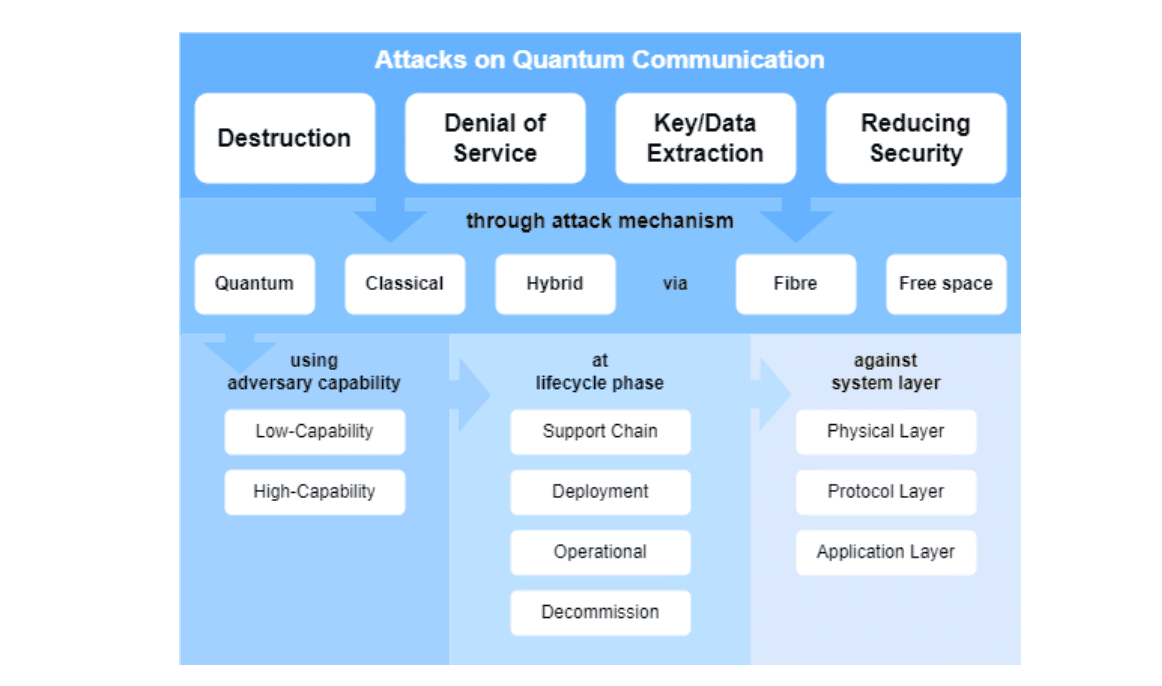
The increasing reliance on quantum communication promises fundamentally secure data transmission, but practical systems remain vulnerable to a range of threats beyond purely cryptographic attacks. Michal Krelina from QuDef B. V., Tom Sorger from KTH Royal Institute of Technology, and Bob Dirks from QuDef B. V. address this critical gap by presenting SQOUT, a novel risk-based threat analysis framework specifically designed for quantum communication systems. This work moves beyond theoretical security, systematically analysing potential attacks targeting the physical infrastructure, communication protocols, and operational procedures of these emerging technologies. By combining a detailed understanding of attacker tactics with established risk assessment methodologies, SQOUT provides a practical and structured approach to identifying and mitigating vulnerabilities, ultimately paving the way for the secure deployment of future quantum networks.
Practical Cybersecurity Risks For Quantum Communication
Scientists have developed a comprehensive cybersecurity framework specifically for quantum communication systems, addressing vulnerabilities beyond the theoretical security of Quantum Key Distribution (QKD). The study pioneers a method for analysing threats by combining a Tactic, Technique, and Procedure (TTP) approach with a detailed risk assessment methodology. Researchers leveraged the established MITRE ATT and CK framework, adapting its globally recognised knowledge base of adversary behaviours to the unique characteristics of quantum protocols and hardware, enabling a more actionable and comprehensive approach to threat detection and mitigation compared to traditional cybersecurity models. The team engineered the SQOUT platform, a novel threat intelligence matrix designed for quantum systems, to facilitate the analysis of potential attacks.
This platform allows security professionals to map out complete attack pathways, chaining together both quantum and classical techniques to understand how an adversary might compromise a system. To demonstrate its capabilities, scientists applied SQOUT to a detailed examination of a Photon-Number-Splitting (PNS) attack, modelling the entire kill chain from initial reconnaissance through to exploitation, creating coherent attack sequences and enabling a holistic risk scoring system. The methodology moves beyond isolated vulnerability assessments, providing a unified adversarial model for quantum communication. Researchers applied established international standards and best practices for information security risk management, specifically aligning the work with processes outlined in ISO/IEC 27005, to assess quantum-specific risk scenarios. This integration ensures compatibility with existing classical cybersecurity frameworks, allowing both quantum and conventional security practitioners to utilise the developed tools effectively. This work addresses the urgent need to understand and manage security risks as quantum technologies transition from experimental prototypes to operational systems, such as those planned under the European Quantum Communication Infrastructure (EuroQCI) initiative.
Quantum Threat Analysis For Communication Systems
This work presents a structured framework for analysing cybersecurity threats to emerging quantum communication systems, moving beyond theoretical security to address practical operational resilience. The team developed a method combining kill-chain modelling, quantitative risk assessment aligned with international standards, and an interactive threat intelligence platform named SQOUT. This approach enables the identification, scoring, and management of threats by chaining quantum and classical tactics, techniques, and procedures into complete attack pathways. The framework advances existing quantum security work by translating qualitative threats into quantitative risk ratings, allowing for comparison and governance by stakeholders.
Scores reflect real-world conditions through the inclusion of factors such as site hardening and adversary capability. While the current model assumes independence between kill-chain steps and relies on manually assigned base scores, the researchers acknowledge these limitations and plan to address them. The team believes this shared methodology will support organisations in confidently securing these emerging infrastructures.
Quantum Attack Likelihoods in Communication Systems
Scientists have developed a structured framework for assessing cybersecurity risks in emerging quantum communication systems, addressing vulnerabilities beyond the theoretical security of quantum key distribution. Researchers developed a technique-based model for evaluating threats, combining a tactic, technique, and procedure approach with established risk management standards. The core of this system is a method for scoring individual attack techniques, applying context-specific modifiers to reflect real-world operating environments. The team measured the likelihood of each step in a potential attack, calculating three continuous measures from nine individual technique contributions: a maximum likelihood of 24.
0, an average likelihood of approximately 7. 62, and a geometric-mean likelihood of 1. 22. These calculations were demonstrated using a Photon-Number-Splitting (PNS) attack kill chain, where individual steps were assigned scores based on threat and exposure levels, adjusted by technique-specific modifiers. Applying these calculations to a 5×5 risk matrix, researchers obtained risk ratings ranging from 5 (Medium) to 20 (High), depending on the aggregation strategy employed.
A maximum-based approach, focusing on the most vulnerable step, resulted in a High risk rating of 20, while average and geometric-mean methods yielded Medium ratings of 5. This demonstrates that the choice of aggregation strategy significantly impacts risk classification and subsequent decision-making, with the maximum method providing a conservative assessment suitable for high-assurance environments. The team’s measurements confirm the importance of considering practical vulnerabilities alongside theoretical security in quantum communication systems, providing a robust framework for prioritizing mitigation efforts.
👉 More information
🗞 SQOUT: A Risk-Based Threat Analysis Framework for Quantum Communication Systems
🧠 ArXiv: https://arxiv.org/abs/2510.23462