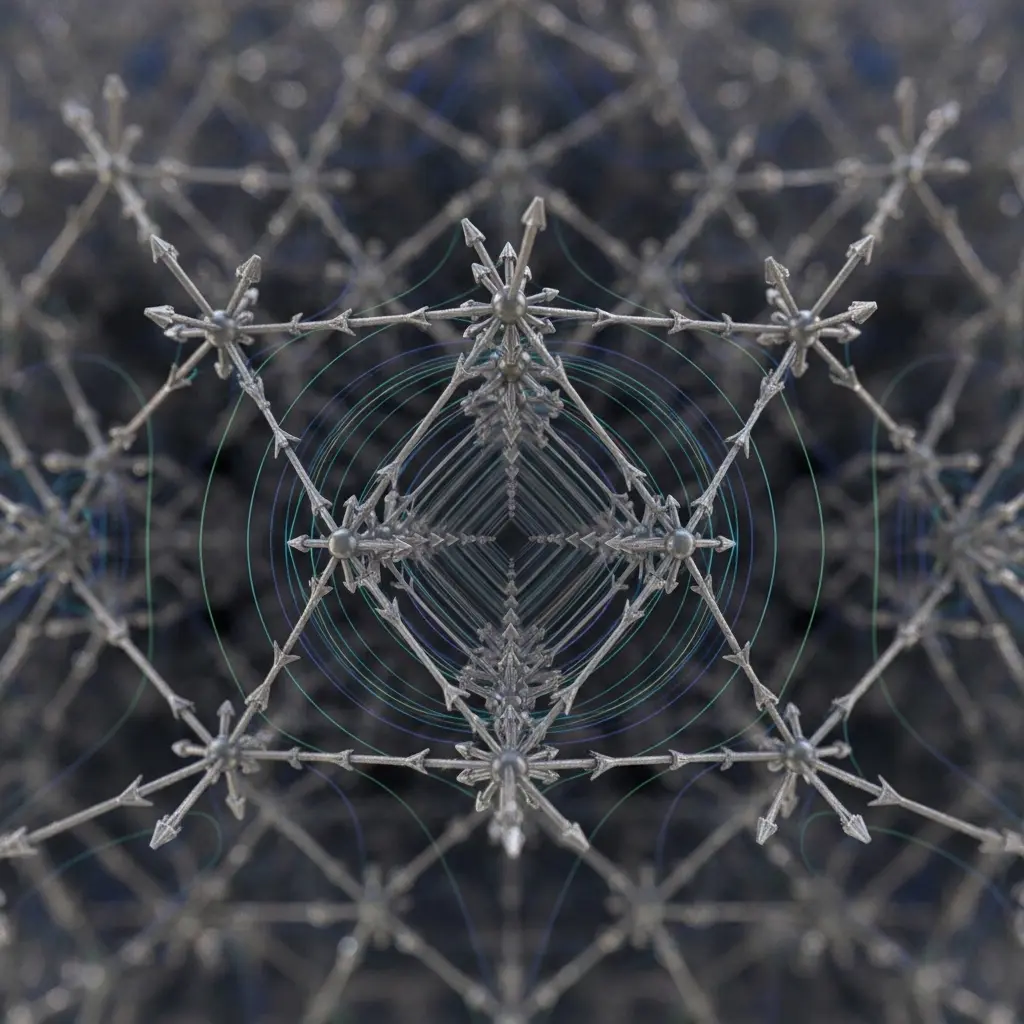
The search for quantum spin liquids, exotic states of matter where magnetic moments remain disordered even at absolute zero, receives a boost from new research into disordered pyrochlore oxides. Marcus V. Marinho and Eric C. Andrade, both from the Instituto de Física at the Universidade de São Paulo, alongside their colleagues, demonstrate that structural randomness, rather than destroying these fragile states, can actually stabilise them. Their work challenges the conventional wisdom that disorder always leads to short-range entanglement and reveals a surprising resilience in these materials, even under strong magnetic fields. This discovery suggests that quantum spin liquids may be more prevalent in real materials than previously thought, opening new avenues for exploring and potentially harnessing their unique quantum properties.
Disorder Stabilizes Quantum Spin Liquids
This study investigates the emergence of quantum spin liquid phases in pyrochlore oxides containing structural randomness, which introduces quantum fluctuations that influence the spin ice state. Contrary to the expectation that disorder favours phases with short-range entanglement, the research demonstrates that disorder can, in fact, stabilize these quantum spin liquid phases, revealing a novel mechanism for realizing these elusive states of matter.
To assess the stability of these phases, the team analysed a model system using a gauge mean-field theory directly in real space. This approach allows for the inclusion of disorder by introducing a random distribution of magnetic field strengths at each lattice site. The resulting equations were solved self-consistently to determine the ground state properties of the system, including spin correlations and the energy spectrum.
Quantum Spin Liquids and Frustrated Magnetism
This research encompasses theoretical and experimental work related to frustrated magnetism, quantum spin liquids, and disordered systems. It investigates quantum spin liquids, particularly those realized in pyrochlore lattices, and explores frustrated magnetism where competing magnetic interactions prevent conventional magnetic ordering. A significant portion of the work focuses on the effects of disorder on quantum magnetism, including random magnetic fields and random exchange interactions, and their impact on the stability of quantum spin liquid phases.
The research also delves into the theoretical description of fractionalized excitations, such as spinons and visons, and their spectroscopic signatures. Entanglement and topological order are crucial tools for characterizing quantum spin liquids, and the work explores their use in detecting and characterizing these phases. It encompasses various spectroscopic techniques, including neutron scattering and Raman scattering, used to identify experimental signatures of quantum spin liquids, and draws from a wide range of disciplines, including condensed matter physics and materials science.
Disorder Preserves Quantum Spin Ice Stability
This research demonstrates the remarkable stability of the quantum spin ice phase in materials with structural randomness. Contrary to expectations, the team found that the spin ice state persists even with significant fluctuations introduced by the disordered structure. Through a detailed analysis of a model system, they mapped the boundary between the spin liquid and polarized phases, revealing that disorder primarily renormalizes energy scales rather than inducing strong, localized inhomogeneities.
The study further establishes that any region exhibiting enhanced disorder-induced fluctuations is extremely limited, confined to the immediate vicinity of the critical point where the material transitions between phases. Importantly, the researchers observed that disorder initially delocalizes the spinons, the fundamental excitations of the system, before ultimately localizing them again as the disorder increases and the critical field is approached. This dual effect of disorder appears to minimize the extent of a Griffiths phase, effectively shrinking its influence on the overall system behavior. The authors verified their conclusions through tests for finite-size effects and the inclusion of additional exchange terms, suggesting that existing understanding of clean or weakly disordered systems likely provides a good qualitative description of the quantum spin ice phase.
🗞 Quantum Spin Liquids Stabilized by Disorder in Non-Kramers Pyrochlores
🧠 ArXiv: https://arxiv.org/abs/2510.25539