

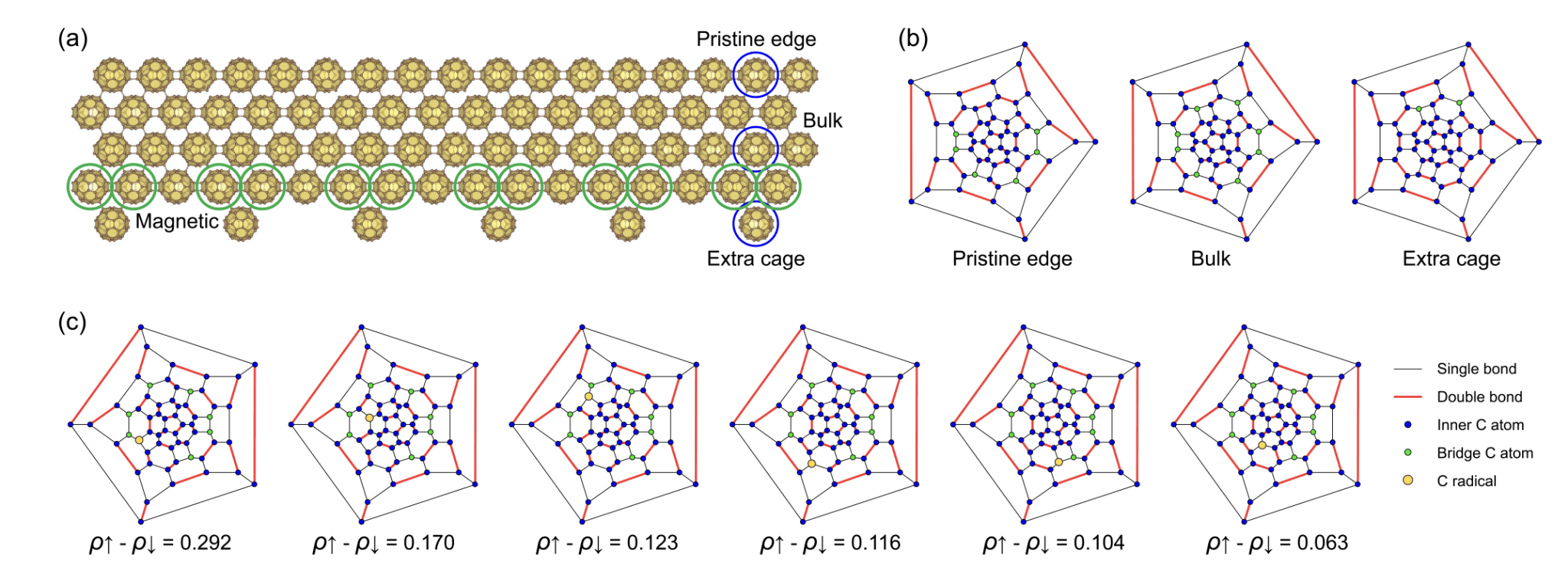
Researchers are actively exploring new avenues for creating nanoscale magnetic materials, and a recent study details a novel approach using specially designed carbon nanostructures. Bo Peng and Michele Pizzochero, from the University of Bath, lead a team that computationally designs antiferromagnetic chains within Janus fullerene nanoribbons, effectively introducing magnetism into otherwise non-magnetic materials. The team achieves this by strategically adding carbon cages to the nanoribbon edges, creating unpaired electrons and inducing a magnetic moment, and importantly, they demonstrate the formation of a stable antiferromagnetic arrangement. This work offers a potentially more practical route to creating magnetic edge states with atomic precision in low-dimensional carbon materials, which could prove vital for developing scalable spin-based devices and unlocking new quantum phenomena.
This process creates unpaired electrons, resulting in a quantifiable magnetic moment, and establishes a foundation for creating novel nanoscale devices. Researchers reveal that arranging these carbon cages linearly generates an antiferromagnetic ground state, a configuration remarkably stable regardless of specific structural arrangements.
Engineered Magnetism in Fullerene Nanoribbon Edges
Researchers engineered a novel approach to create magnetism in fullerene nanoribbons by computationally designing antiferromagnetic spin chains within their structure. The team introduced extra C60 cages at the edges of the nanoribbons, deliberately creating an odd number of intermolecular bonds, which induces an unpaired electron and a quantifiable magnetic moment. This precise functionalisation enables the rational design and engineering of magnetic fullerene nanoribbons, potentially leading to versatile nanoarchitectures for spin-based devices and the exploration of quantum phenomena. The methodology involved simulating the behaviour of models containing hundreds of carbon atoms, allowing researchers to precisely measure magnetic properties. They identified magnetic atoms by analysing the distribution of electrons, and confirmed that magnetic interactions diminish beyond a certain distance. To further understand the magnetic behaviour, the team employed advanced computational techniques to simulate the behaviour of magnons, the quantum units of spin waves, confirming the stability of the engineered magnetic edge states for various structural arrangements of the added cages.
Fullerene Ribbons Gain Magnetism Through Edge Cages
Researchers have computationally designed antiferromagnetic properties into fullerene nanoribbons by strategically adding extra carbon cages to their edges. This innovative approach induces unpaired electrons and, consequently, a quantifiable magnetic moment within otherwise non-magnetic nanostructures. The team discovered that arranging these carbon cages linearly fosters an antiferromagnetic ground state, demonstrating remarkable insensitivity to specific structural details. Adding a single fullerene cage to the edge of a nanoribbon significantly stabilises the structure, indicating a strong preference for this configuration.
The addition of these cages creates localized magnetic moments due to unpaired electrons confined within the fullerene units, with each cage possessing a spin-1/2 moment. Detailed analysis shows that the majority of the magnetic moment originates from a small number of carbon atoms within each fullerene cage. The team further demonstrated that the antiferromagnetic phase is energetically favoured over the ferromagnetic phase. Investigations into the interactions between magnetic carbon atoms show strong ferromagnetic interactions within individual fullerene cages, but antiferromagnetic interactions between neighboring cages, with the strongest interaction occurring between second-nearest neighboring cages.
Fullerene Ribbons Exhibit Tunable Antiferromagnetic Ordering
This research demonstrates a strategy for creating magnetism in fullerene nanoribbons by introducing extra carbon cages at their edges. This structural modification induces unpaired electrons and creates a one-dimensional antiferromagnetic spin chain, even in materials that are otherwise non-magnetic. The resulting chains exhibit quantised magnetic moments residing primarily at the added carbon cages, with weak interactions between them. These fullerene nanoribbons offer potential advantages over graphene-based systems due to their greater chemical stability and ease of structural control, lowering the practical barriers to experimental realisation. The weak spin-orbit and hyperfine interactions inherent to carbon also contribute to long spin coherence times, making these nanoribbons promising candidates for spintronic devices and qubit systems. While this work is computational, the tuneability and scalability of this platform are key features for integrating carbon-based magnetic architectures into future quantum information technologies.
👉 More information
🗞 Designing Antiferromagnetic Spin-1/2 Chains in Janus Fullerene Nanoribbons
🧠 ArXiv: https://arxiv.org/abs/2508.18849


