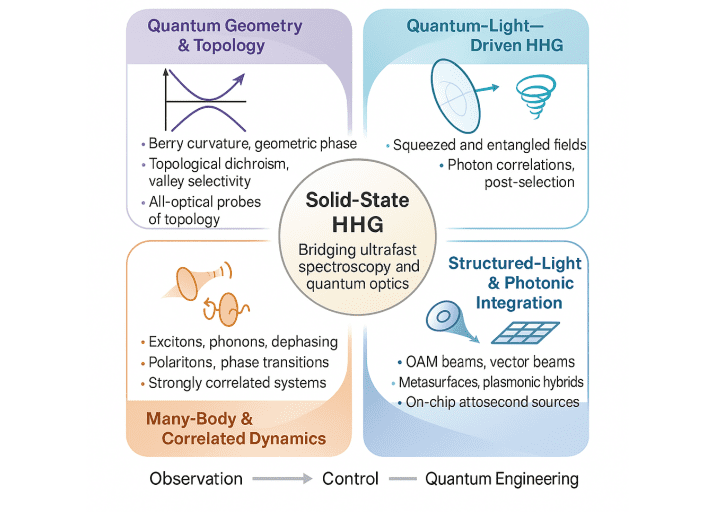
High-order harmonic generation (HHG) within solid materials represents a rapidly developing area with the potential to revolutionise ultrafast and quantum light science. Marcelo F. Ciappina from Guangdong Technion, Israel Institute of Technology, and colleagues are at the forefront of this research, demonstrating how solid-state HHG now reveals complex phenomena like Berry-phase effects and topological properties in harmonic emission. This work establishes solid-state HHG as a crucial link between ultrafast spectroscopy and advanced optics, opening up possibilities for designing novel attosecond light sources and achieving precise control over light-matter interactions within solid materials. The team’s findings significantly advance our understanding of electron behaviour and pave the way for future innovations in areas ranging from materials science to quantum technologies.
Solid-State High Harmonic Generation Mechanisms Explored
A comprehensive investigation into solid-state high harmonic generation (HHG) reveals the underlying physics driving this process in various materials. Scientists are actively exploring the roles of intraband and interband transitions, and focusing on materials with strong electron correlation, such as Mott insulators, to understand how these interactions influence harmonic generation. Studies on materials including niobium oxychloride and molybdenum disulfide demonstrate how material properties can enhance HHG efficiency. Researchers are developing techniques to boost HHG efficiency, such as using multiple laser frequencies and optimizing laser intensity.
Theoretical and computational studies complement these experimental efforts, providing deeper insights into the fundamental principles governing solid-state HHG. This research extends beyond fundamental understanding, with scientists utilizing HHG as a tool to probe material properties, including lattice dynamics and electron control, and developing it as a source of coherent extreme ultraviolet and attosecond pulses. A rapidly growing area explores the quantum nature of HHG in solids, focusing on manipulating quantum states of emitted light and generating non-classical states with reduced noise. Scientists are controlling the statistical properties of emitted photons and employing post-selection techniques to isolate specific quantum states. This intersection of HHG and quantum optics promises new avenues for research and the development of novel quantum technologies. Further advancements focus on controlling the shape and polarization of the HHG beam, utilizing vortex beams with helical wavefronts and manipulating spin-orbit angular momentum.
Attosecond Nanoscopy with Enhanced Harmonic Generation
Scientists are pioneering a new generation of attosecond nanoscopy in solids, harnessing high-order harmonic generation (HHG) to explore ultrafast and coherent phenomena in materials. Cryogenic platforms suppress thermal noise and enhance phase coherence during HHG, achieving attosecond-scale resolution in measurements of electron and lattice motion. Researchers developed EUV interferometry and Mach-Zehnder phase measurements to reconstruct the harmonic emission phase, providing access to subcycle dynamics within solids. The work demonstrates that harmonic polarization and phase depend on Berry curvature, establishing HHG as a sensitive probe of geometric and topological band properties.
Theoretical models incorporate dephasing, propagation, and electron-hole coherence effects, deepening understanding of interband and intraband dynamics. Experiments employ fiber-based and mid-IR laser systems with excellent phase stability to drive HHG in solids at high repetition rates and modest intensities. Macroscopic propagation and interface modeling, including full 3D models connecting microscopic polarization with experimental observables, reconcile discrepancies between experiments on bulk and thin-film systems. The study pioneers the use of squeezed-vacuum driving fields, revealing nonclassical photon statistics in harmonic emission and positioning solid HHG as a tabletop source of engineered quantum light. Quantum-field theoretical models demonstrate that quantum correlations between photons and electrons modify the harmonic spectrum, leading to antibunching, squeezing, and entanglement features in the emitted light.
Engineered Quantum Light from Solid-State Harmonics
Recent work demonstrates the remarkable potential of solid-state high harmonic generation (HHG) as a platform for exploring ultrafast phenomena and generating novel light sources. Scientists achieved control over harmonic emission through quantum-state engineering, positioning solid HHG as a tabletop source of engineered quantum light. Experiments utilizing squeezed-vacuum driving fields revealed nonclassical photon statistics in harmonic emission, demonstrating antibunching, squeezing, and entanglement features in the emitted light. Furthermore, investigations into materials like Moiré superlattices and flat-band two-dimensional materials reveal strong many-body enhancement of HHG and interband-polarization-dominated emission, respectively.
These advances establish solid HHG as a compact, scalable, and chip-compatible coherent light source. Researchers also achieved precise temporal control over harmonic emission, enabling attosecond shaping of the emitted radiation. Experiments resolving lattice vibrations in harmonic emission reveal the coupling between phonons and nonlinear polarization, completing the picture of a fully correlated electron-lattice response. Investigations into topological and correlated materials further expanded the capabilities of solid HHG, revealing how symmetry breaking and spin texture affect emission polarization. The generation of high harmonics carrying orbital angular momentum evolved to full control of structured attosecond emission.
Solid-State HHG Reveals New Quantum Control
Recent investigations into high-order harmonic generation (HHG) in solids demonstrate its potential as a platform for exploring ultrafast and coherent phenomena in materials science. Researchers have successfully observed and manipulated effects linked to Berry phase and topological properties, as well as strong-field control over excitons and lattice motion. These advances extend beyond fundamental observation, with studies revealing the generation of nonclassical light states and the transfer of orbital angular momentum within solid-state HHG processes. The work builds on theoretical models incorporating complex interactions within materials, deepening understanding of the interplay between interband and intraband dynamics. Through the use of nanostructured materials and hybrid plasmonic-semiconductor platforms, researchers are achieving significant enhancements in HHG yield.
👉 More information
🗞 Solid-State High-Order Harmonic Generation: Emerging Frontiers in Ultrafast and Quantum Light Science
🧠 ArXiv: https://arxiv.org/abs/2510.15207